The Star

by Edgar Degas

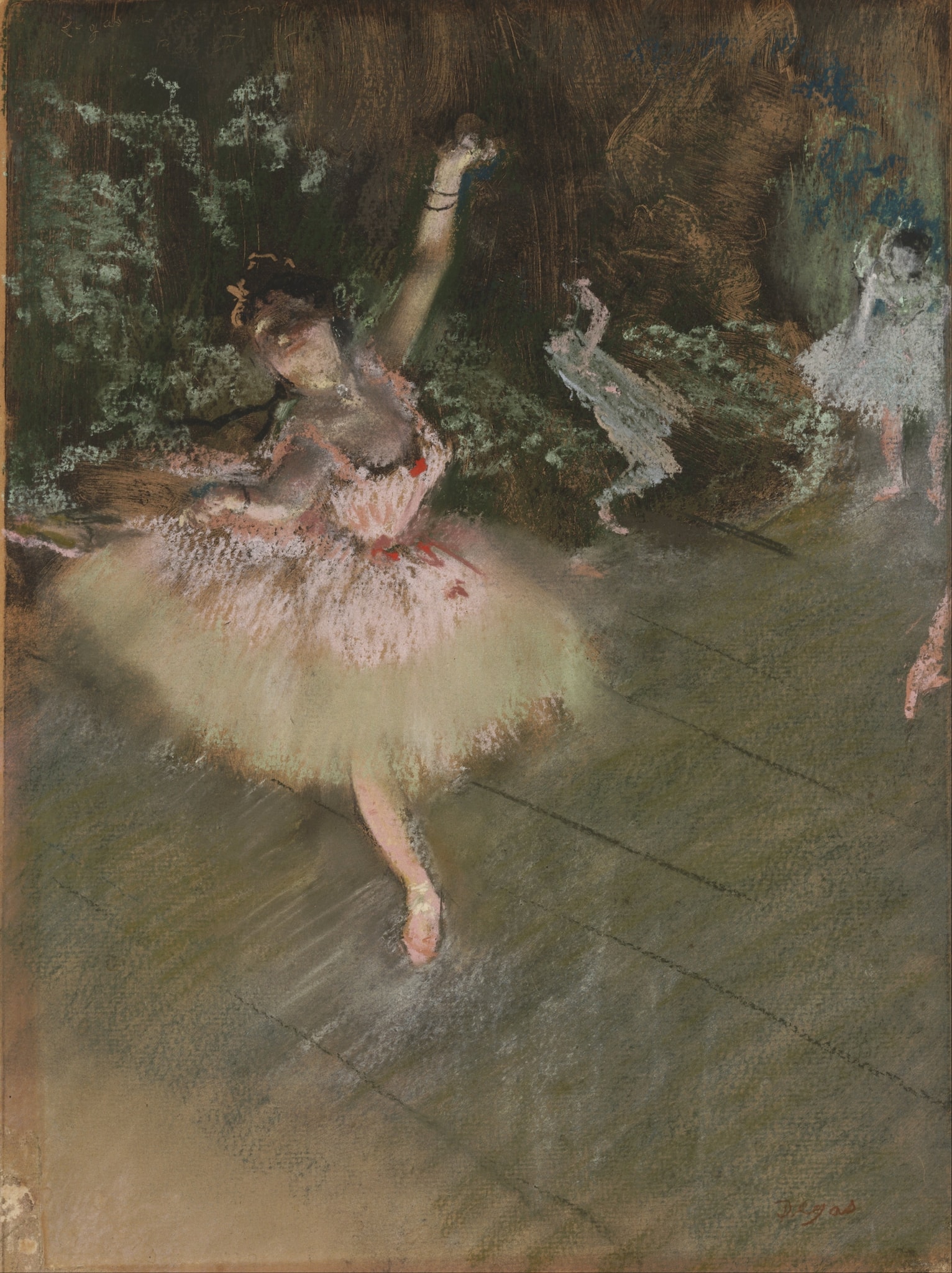
Edgar Degas’s The Star shows a prima ballerina caught at the crest of a pose, her tutu a vaporous flare against a murky, tilted stage. Diagonal floorboards rush beneath her single pointe, while pale, ghostlike dancers linger in the wings, turning triumph into a scene of radiant isolation [2][5].

Fast Facts

Year
c. 1876–1878
Medium
Pastel on paper
Dimensions
58 x 42 cm
Location
Musée d’Orsay, Paris
The Star by Edgar Degas (c. 1876–1878) featuring Single pointe, Diagonal floorboards (raked stage), Vaporous tutu (flare of light), Ghosted corps in the wings

Click on any numbered symbol to learn more about its meaning

Meaning & Symbolism

Degas composes The Star as a stage-managed paradox: the ballerina’s brilliance depends on the darkness that surrounds her. The diagonal planks pitch toward the audience, forming a visual ramp that sends the eye to the dancer’s single, knife-bright pointe. Her lifted arm and tilted head register triumph, but the gesture is pressed against a brown-green void where the set dissolves into abrasion and scumble. In that void, two chalky figures—corps dancers caught mid-shift—hover like afterimages, their bodies less drawn than breathed onto the paper. The composition isolates the étoile, not by centering her, but by flinging her toward the lower foreground, a move consistent with Degas’s cropped, sidelong vantage and his modern refusal of symmetrical staging 3. The effect is not celebration but tension: ascent performed on a cliff edge. Pastel’s material behavior becomes the painting’s subject. Degas loads dry pigment into the tutu until it blooms like lit vapor; then, at the hem, he lets it fray into the ground, so motion appears to abrade the figure into dust. This is technique enlisted as metaphor: the very medium that can be blown away with a breath conjures the instantaneous visibility of stage light and the frailty of acclaim 5. The spotlight whitens her bodice and face, flattening contours and bleaching identity; under this glare the dancer is perfect and anonymous at once, a trait museum texts identify as central to Degas’s exploration of artificial illumination at the Opéra 2. Even the warm sprigs at her waist read as perilously bright embers—color accents that flare and cool across the slanted boards. Degas’s theater is also a social machine. The “star” stands alone because a system requires her to be singular. The ghosted figures in the wings act as structural counterweights: their sketched limbs echo the soloist’s arabesque but remain unlit, reminding us that her radiance is relational, contingent on others who are present yet withheld from view. By choosing the side-stage vantage—neither the orchestra’s frontal focus nor the private vantage of a backstage patron—Degas positions us as complicit observers of a spectacle that produces isolation as its most dazzling effect 23. In the Opéra series, such devices allowed the artist to test how composition can stage power; here, the shallow rake of the floor and the high horizon squeeze space until fame looks like a narrowing corridor. The result is an image that reads like choreography for vision itself: advance and recoil, appearance and erasure, star and shadow. Within the broader project that Degas pursued at the Opéra—studies of movement, artificial light, and the unseen labor of performance—The Star crystallizes a thesis: beauty is engineered, discipline is invisible, and glory is a flare that fades as it forms 25. Acknowledging that Degas produced multiple versions of this theme underscores his insistence that the moment is both singular and serial, a repeatable pose that never quite repeats the same light, the same risk, the same brink 46.

Explore Deeper with AI

Ask questions about The Star

Popular questions:

Powered by AI • Get instant insights about this artwork

💬 Ask questions about this artwork!

Interpretations

Social History: Abonnés and the Theater’s Power Grid

The side-stage vantage skirts the orchestra’s public gaze and the backstage’s private deals, hinting at the Opéra’s stratified ecology of visibility. In Degas’s day, subscribers (abonnés) enjoyed privileged access to the foyer de la danse, establishing networks of patronage that shaped dancers’ careers and vulnerabilities. Read against this context, the shaded figures at the margin are not neutral staffage; they signal a managed economy of looking in which proximity equals leverage. The étoile’s isolation thus reads as systemic, not romantic: a carefully staged apex sustained by those who remain in penumbra. Degas, a meticulous observer of institutional spaces, turns composition into critique—who receives light, who provides support, and who polices the threshold between art and transaction 28.

Source: Musée d’Orsay (Degas at the Opera); Artsy (abonnés context)

Material Poetics: Pastel as Fugitive Light

Degas uses pastel not just to depict light but to behave like light—powdered pigment that can be blown away, fixed, and reworked until it hovers between matter and radiance. The tutu’s bloom and frayed hem literalize ephemerality, while fixative-darkened layers conjure the abrasive glare of stage illumination. Orsay’s technical studies emphasize his experimental procedure: layered pastel, fixatives, and scumble to achieve saturated brilliance that still reads as perishable. In The Star, medium and message fuse—the artist leverages pastel’s fugitive nature to figure the instantaneity of performance and the vanishing tenure of acclaim. The result is not a stable likeness but a time-sensitive apparition, a choreography of dust and light 32.

Source: Musée d’Orsay (Degas and pastel technique); Musée d’Orsay (exhibition framing)

Formal-Optical Analysis: Cropping as Choreography

The raked floor, high horizon, and cropped, sidelong vantage turn the image into a controlled vertigo. Instead of symmetrical staging, Degas engineers a visual ramp that accelerates the eye toward the dancer’s pointe, then arrests it against a constructed brink. This strategy aligns with his broader modern optics: asymmetry, off-center emphasis, and the “snapshot” feel that museums have linked to the era’s photographic and urban sensibilities. The corps in the wings operate as visual counterweights, stabilizing the thrust while denying full legibility. Seen this way, The Star is a lesson in optic choreography—a score for looking that alternates advance and recoil, proximity and eclipse, spectacle and structure 26.

Source: Musée d’Orsay (Degas at the Opera); National Gallery of Art (artist overview)

Performance Studies: Rank, Repertoire, and Theatercraft

DeVonyar and Kendall reposition Degas as a theater insider, attentive to ballet rank, rehearsal systems, and lighting conventions. Details like the floral adornment and neck ribbon signal the étoile’s role and status, while the wing-side presences reflect real staging practices—dancers in transition, attendants, or prompters governing entrances and exits. Rather than a generic “moment,” the picture channels the Opéra’s codified rituals: how a soloist is framed by the corps, how light flattens musculature into tone, how the floor’s rake heightens the sense of risk at the pit’s edge. The work records not only motion but institutional technique—a production grammar that crafts triumph as a regulated effect 72.

Source: Jill DeVonyar & Richard Kendall (Degas and the Ballet); Musée d’Orsay (exhibition)

Seriality and the Question of the ‘Original’ Star

Degas returns to this motif across versions, notably the Art Institute of Chicago’s The Star, complicating ideas of a single, definitive image. The Orsay pastel (c. 1876–78) and the Chicago work (1879–81) differ in scale, palette, and entourage, suggesting a serial inquiry into how light and angle recalibrate the same pose. The Degas digital catalogue treats the Orsay piece cautiously on dating and identity, while Chicago’s entry links its version to Rosita Mauri. Seriality becomes method: a repeatable moment that never repeats in effect, foregrounding process over finale and revising “originality” into a portfolio of trials in light, dust, and risk 45.

Source: Degas Digital Catalogue; Art Institute of Chicago

Psychological Interpretation: Anonymity Under the Glare

The spotlight whitens the bodice and face until contours retreat, producing an oxymoron: maximum visibility, minimum identity. As the body becomes planar under artificial light, the dancer’s persona is both perfected and evacuated. Set against the near-void of the wings, this bleaching suggests a modern condition of performance—subjectivity condensed into a function of illumination. The image’s tension, then, is not only physical (the pit’s brink) but psychic: to be the Star is to be held in a cone of light that isolates, abstracts, and erases in the act of display. Degas’s Opéra series repeats this double bind, testing how spectacle manufactures singularity as solitude 2.

Source: Musée d’Orsay (Degas at the Opera)

Related Themes

About Edgar Degas

Edgar Degas (1834–1917) trained in rigorous drawing, revered the Old Masters, and pursued modern urban subjects—from races to café-concerts and ballet. Though he exhibited with the Impressionists, he insisted on a controlled, realist construction of scenes, often synthesizing observations into complex studio compositions [5][6].
View all works by Edgar Degas

More by Edgar Degas

The Opera Orchestra by Edgar Degas | Analysis by Edgar Degas

The Opera Orchestra by Edgar Degas | Analysis

Edgar Degas

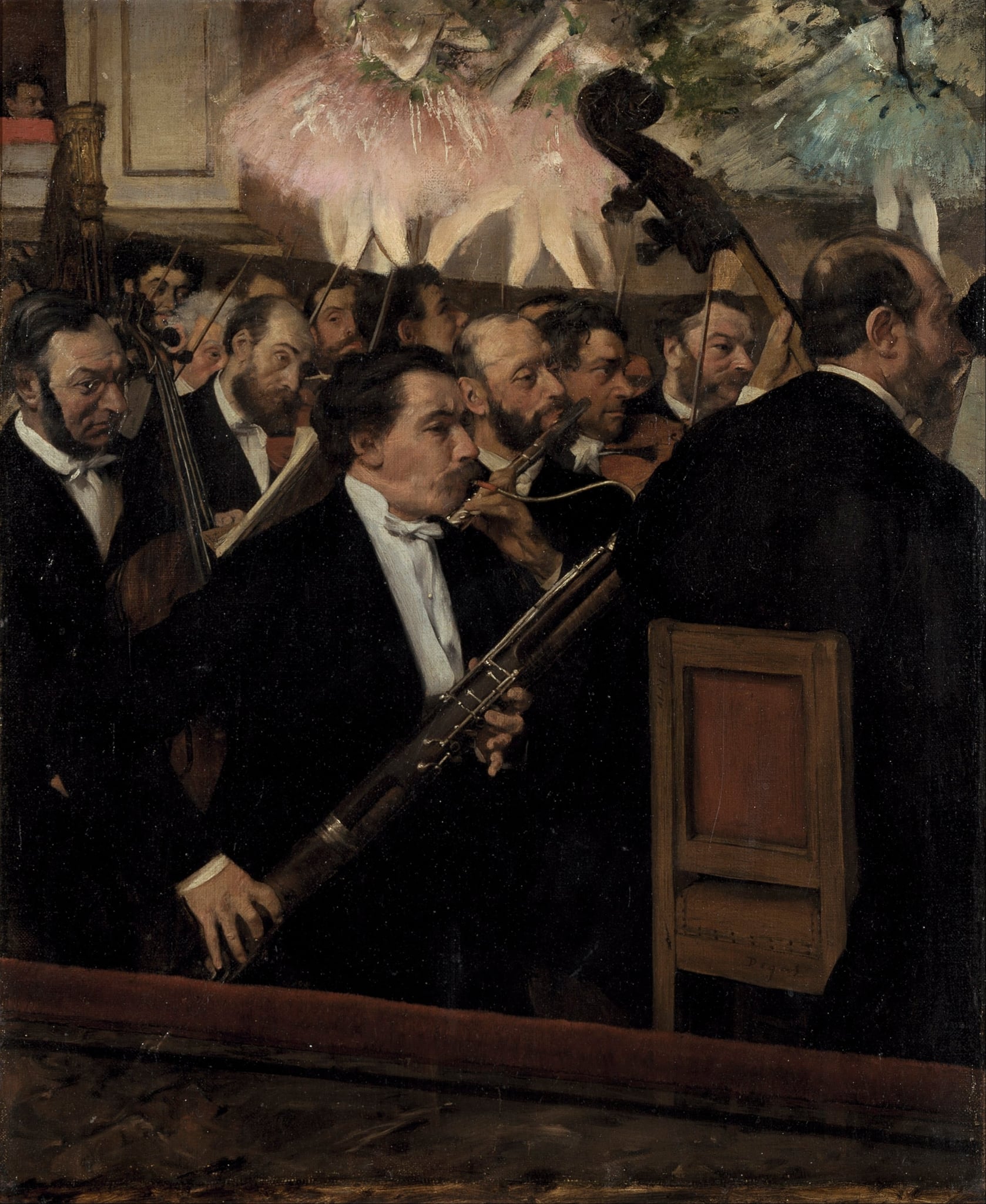
In The Opera Orchestra, Degas flips the theater’s hierarchy: the black-clad pit fills the frame while the ballerinas appear only as cropped tutus and legs, glittering above. The diagonal <strong>bassoon</strong> and looming <strong>double bass</strong> marshal a dense field of faces lit by footlights, turning backstage labor into the subject and spectacle into a fragment <sup>[1]</sup><sup>[2]</sup>.
The Tub by Edgar Degas

The Tub

Edgar Degas (1886)

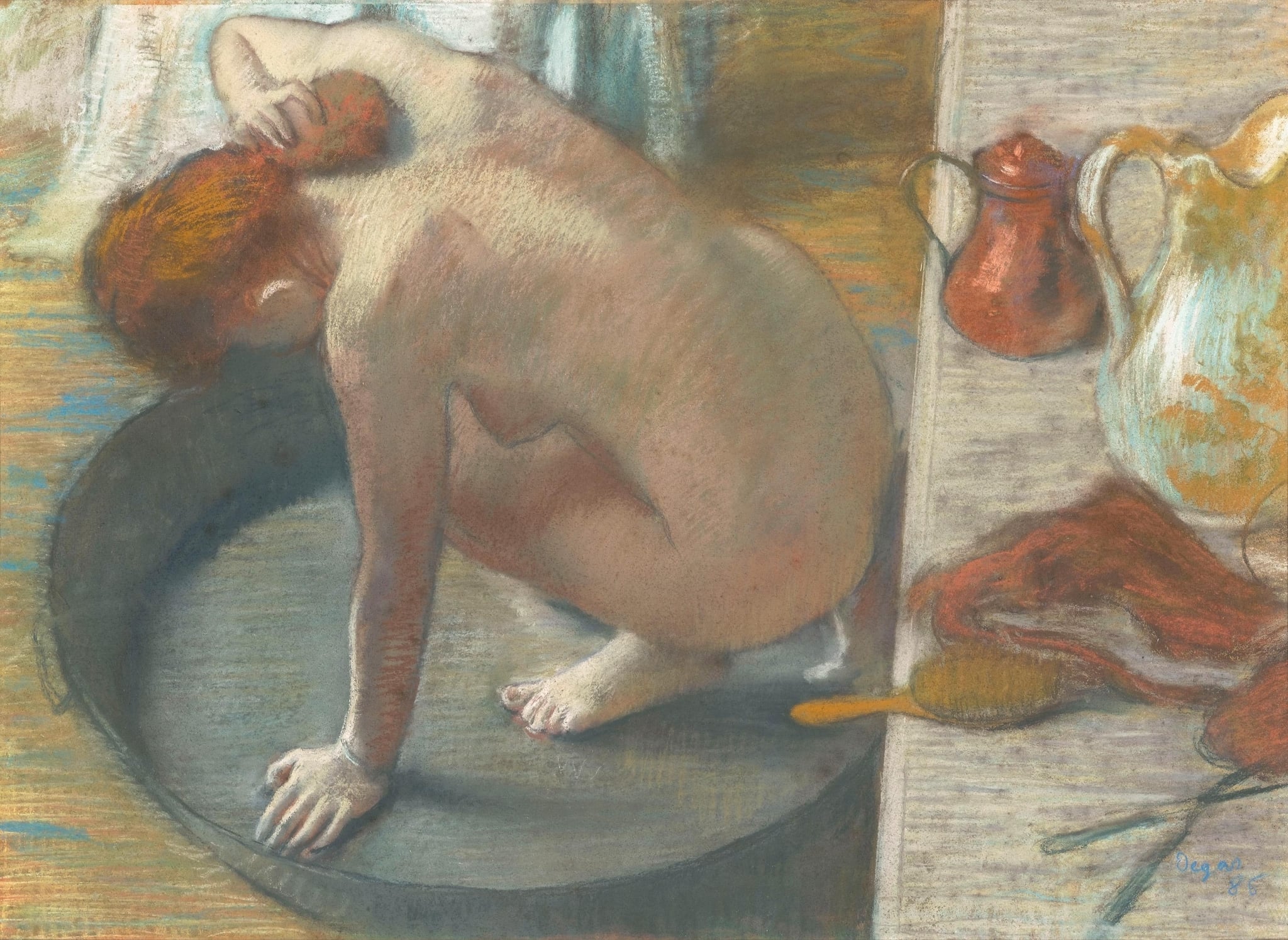
In The Tub (1886), Edgar Degas turns a routine bath into a study of <strong>modern solitude</strong> and <strong>embodied labor</strong>. From a steep, overhead angle, a woman kneels within a circular basin, one hand braced on the rim while the other gathers her hair; to the right, a tabletop packs a ewer, copper pot, comb/brush, and cloth. Degas’s layered pastel binds skin, water, and objects into a single, breathing field of <strong>warm flesh tones</strong> and blue‑greys, collapsing distance between body and still life <sup>[1]</sup>.
The Ballet Class by Edgar Degas

The Ballet Class

Edgar Degas (1873–1876)

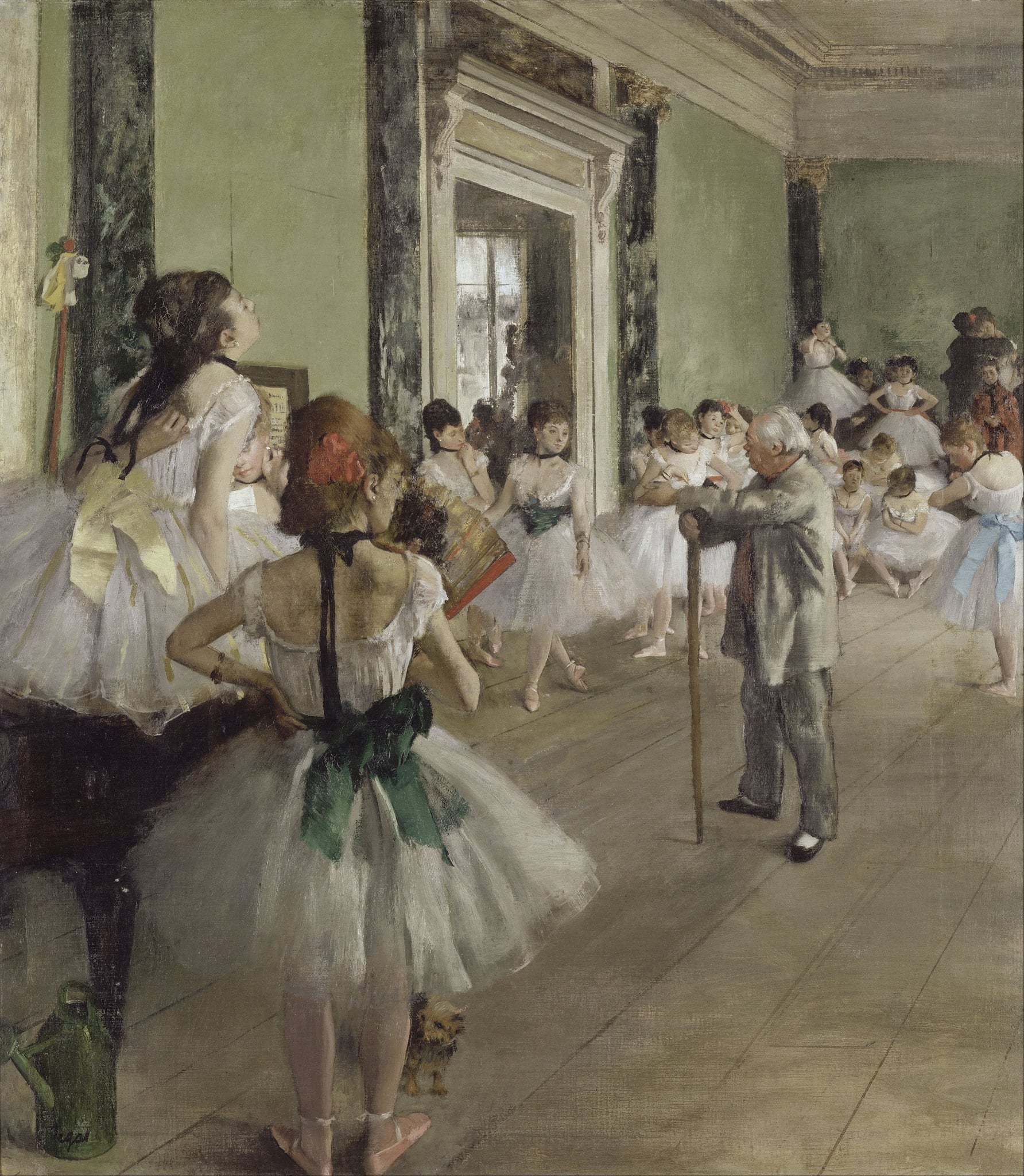
<strong>The Ballet Class</strong> shows the work behind grace: a green-walled studio where young dancers in white tutus rest, fidget, and stretch while the gray-suited master stands with his cane. Degas’s diagonal floorboards, cropped viewpoints, and scattered props—a watering can, a music stand, even a tiny dog—stage a candid vision of routine rather than spectacle. The result is a modern image of discipline, hierarchy, and fleeting poise.
Woman Ironing by Edgar Degas

Woman Ironing

Edgar Degas (c. 1876–1887)

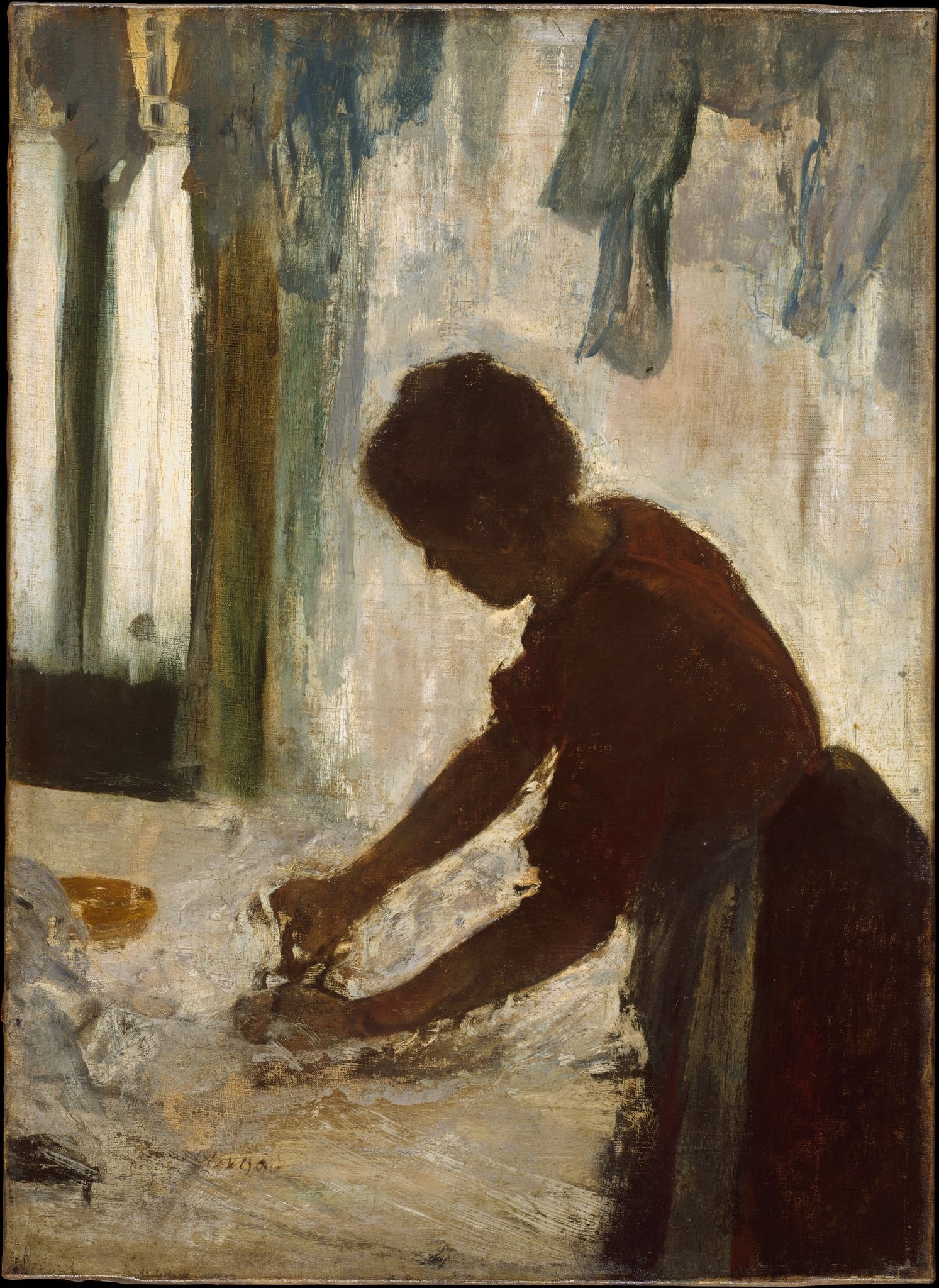
In Woman Ironing, Degas builds a modern icon of labor through <strong>contre‑jour</strong> light and a forceful diagonal from shoulder to iron. The worker’s silhouette, red-brown dress, and the cool, steamy whites around her turn repetition into <strong>ritualized transformation</strong>—wrinkled cloth to crisp order <sup>[1]</sup><sup>[2]</sup>.
The Rehearsal of the Ballet Onstage by Edgar Degas

The Rehearsal of the Ballet Onstage

Edgar Degas (ca. 1874)

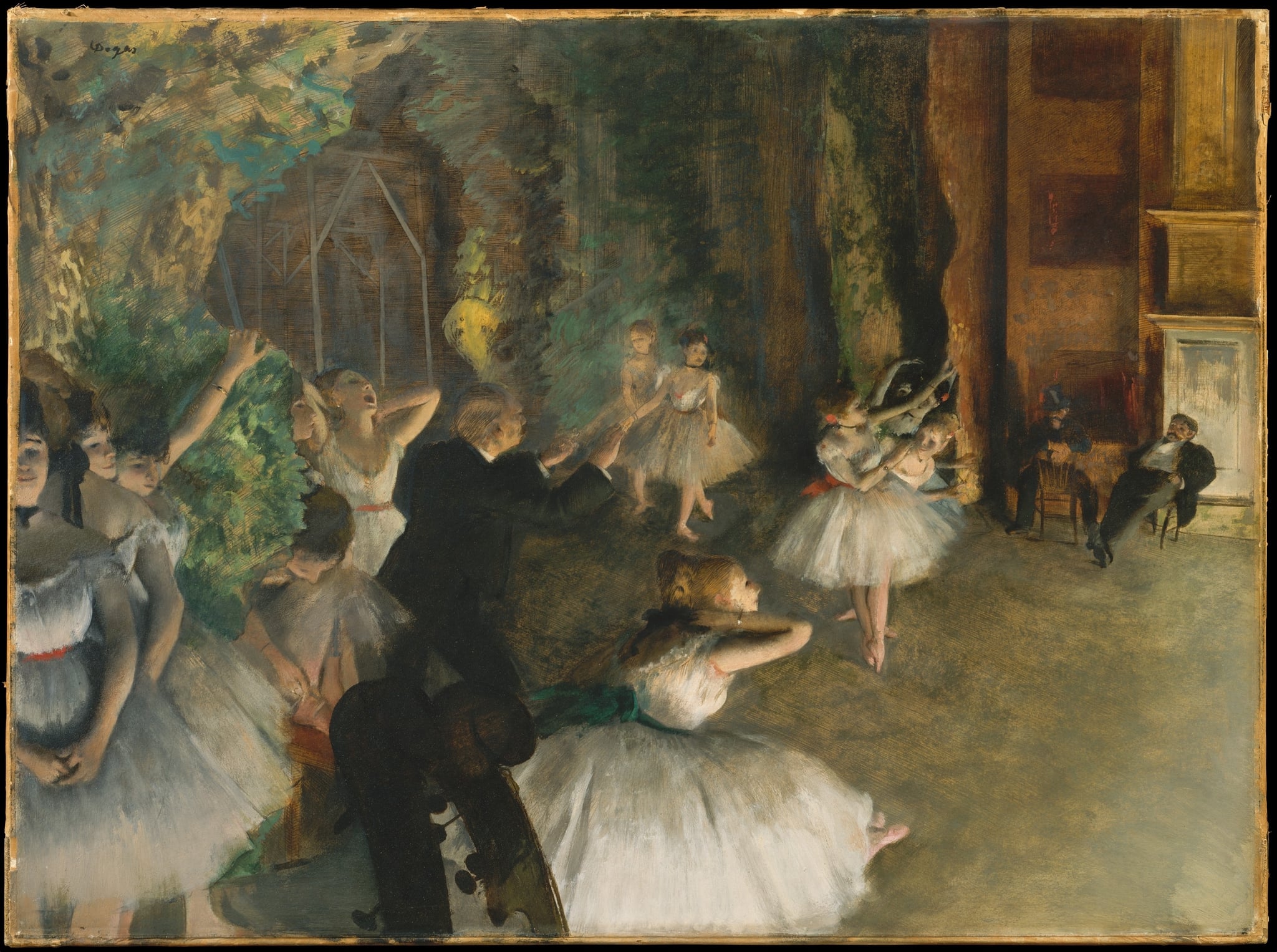
Degas’s The Rehearsal of the Ballet Onstage turns a moment of practice into a modern drama of work and power. Under <strong>harsh footlights</strong>, clustered ballerinas stretch, yawn, and repeat steps as a <strong>ballet master/conductor</strong> drives the tempo, while <strong>abonnés</strong> lounge in the wings and a looming <strong>double bass</strong> anchors the labor of music <sup>[1]</sup><sup>[3]</sup><sup>[4]</sup>.
Place de la Concorde by Edgar Degas

Place de la Concorde

Edgar Degas (1875)

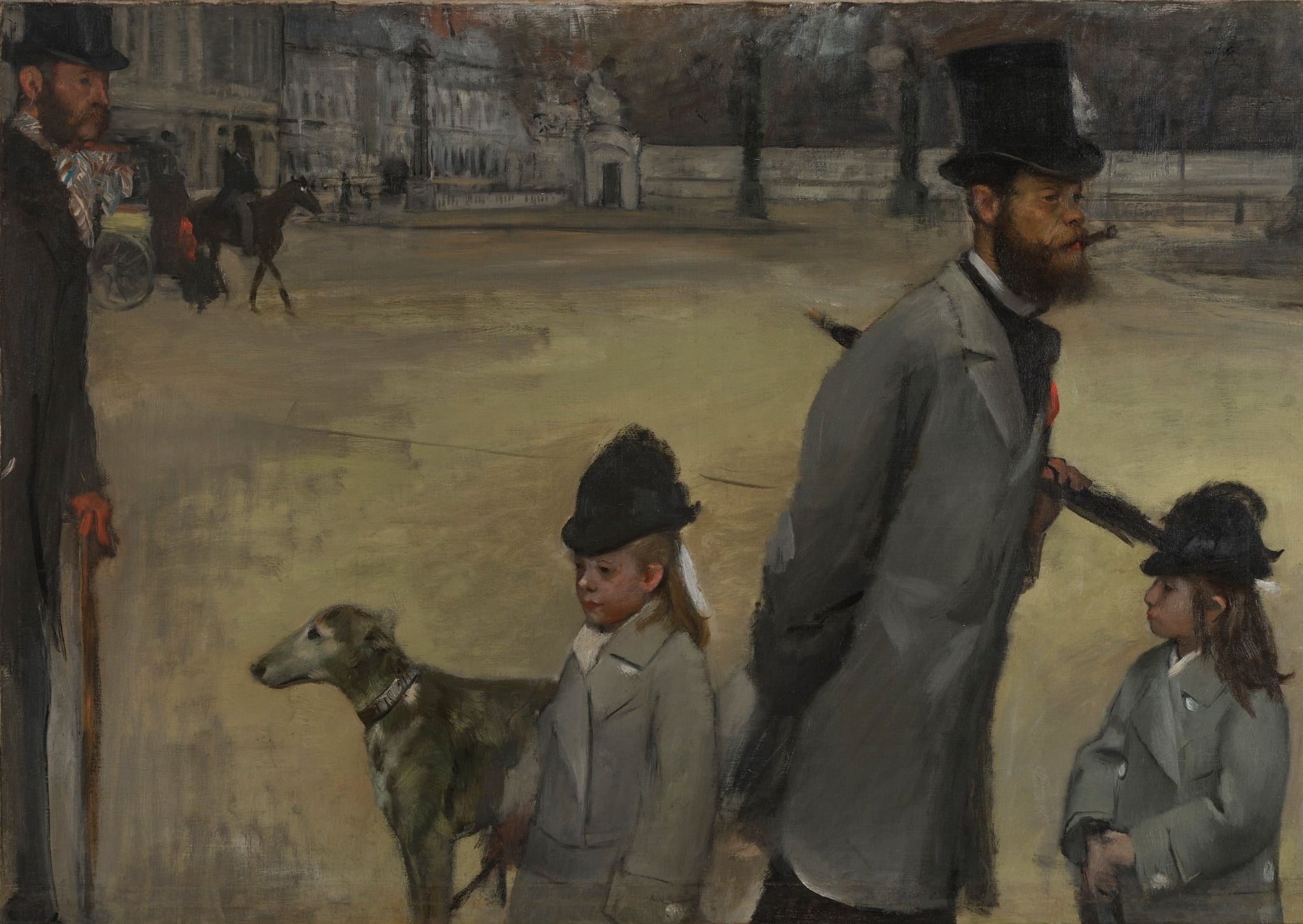
Degas’s Place de la Concorde turns a famous Paris square into a study of <strong>modern isolation</strong> and <strong>instantaneous vision</strong>. Figures stride past one another without contact, their bodies abruptly <strong>cropped</strong> and adrift in a wide, airless plaza—an urban stage where elegance masks estrangement <sup>[1]</sup><sup>[2]</sup>.