The Prima Ballerina in The Star
A closer look at this element in Edgar Degas's c. 1876–1878 masterpiece
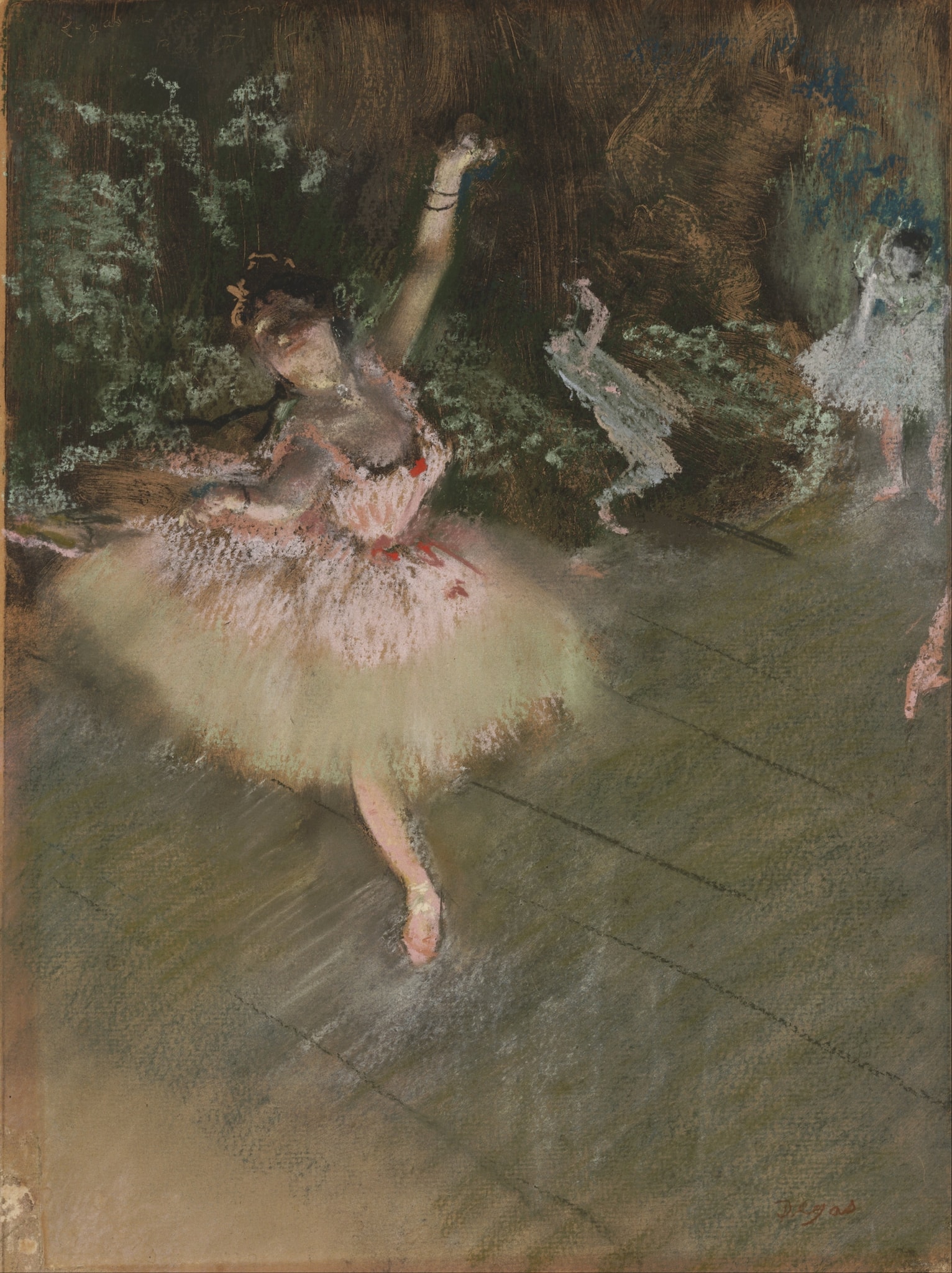
Degas’s The Star fixes the instant when the Opéra’s leading ballerina—its danseuse étoile—burns under the footlights at the height of acclaim. This prima ballerina is both the climax of performance and the lens through which Degas probes modern spectacle, labor, and the charged dynamics of looking.
Historical Context
Degas created the Musée d’Orsay’s pastel-over-monotype L’Étoile around 1876–1877, exhibiting it at the Third Impressionist Exhibition in 1877. The composition places the dancer on the stage platform, seen from above and caught mid-solo beneath the ramp lights—an angle that reflects Degas’s sustained access to the Paris Opéra during these years and his desire to scrutinize its mechanics and optics at their most theatrical pitch 1.
His engagement with the Opéra coincided with a broader modern-life program shared by the Impressionists, but Degas made the theatre uniquely his own by moving between stage and wings. Contemporary Opéra culture granted wealthy male subscribers (abonnés) privileged access backstage; Degas repeatedly insinuated their dark silhouettes into his ballet scenes to register the social economy surrounding performance. In L’Étoile the prima ballerina’s bravura moment is inseparable from that backstage world, an opposition that sharpened Degas’s fascination with display versus surveillance and the theatre’s power structures in late‑19th‑century Paris 2.
Symbolic Meaning
The title L’Étoile names both rank and aura. At the Opéra, an étoile is the highest status a ballerina can attain; Degas literalizes that status by flooding the principal with light and isolating her at the composition’s apex. She is the fulcrum of attention and the emblem of celebrity culture, a modern counterpart to the consecrated virtuosa of earlier theatre images while remaining grounded in Paris’s contemporary stage realities 167.
Degas also stages an ethics of looking. The brilliant, up-lit body of the star is countered by the shadow-world of the wings, where the abonné figure—granting access, influence, and scrutiny—signals how fame and labor are brokered in the Opéra’s social architecture. The image thereby entwines admiration with voyeurism and commerce with art, a tension that recurs throughout Degas’s theatre works 2. Light itself functions as metaphor: gas and footlights sculpt tulle and skin into apparition-like forms, underscoring both the enchantment and the constructed nature of performance. The archetypal étoile appears across closely related variants, confirming that Degas mined this role—not a single sitter—for its power to symbolize movement, acclaim, and the modern spectacle of viewing 135.
Artistic Technique
Degas builds the star with pastel over a dark, printed monotype. After pulling a single, tonally rich impression from an inked plate, he worked in vigorous pastel to ignite color and light—an approach that let him pit velvety shadows against the glare of the footlights and achieve the powdery bloom of tulle and skin 34.
The top‑down, cropped vantage pushes the dancer forward into the ramp lights, while the diagonal stage boards and foreshortened pose deliver a surge of immediacy, as if the viewer were perched at the edge of the orchestra pit 1. In related “Star” compositions, curators identify the moment as a fleeting piqué en attitude—held for a heartbeat—precisely the kind of apex that Degas sought to seize through the speed and malleability of pastel 5.
Connection to the Whole
The prima ballerina is the painting’s compositional and thematic pivot. She is the brightest, most legible form, framed by the curtained wings and the raked stage, so that every diagonal and patch of illumination converges on her elevation. The surrounding darkness—intensified by the monotype ground—keeps the theatre’s architecture and offstage figures in suspense, setting grace against the murk of labour and spectatorship 13.
That counterpoint makes the star more than subject; she is the device that organizes Degas’s modern thesis. Her spotlighted brilliance embodies ambition and mastery, while the lurking subscriber and backstage threshold articulate the economies through which such brilliance is produced and consumed. The whole image thus reads as a dynamic between spectacle and surveillance, with the étoile as its radiant, commanding center 2.
Explore the Full Painting
This is just one fascinating element of The Star. Discover the complete interpretation, symbolism, and hidden meanings throughout the entire work.
← View full analysis of The StarSources
- Musée d’Orsay object record: Ballet (L’Étoile), RF 12258
- National Gallery of Art: Dancers Backstage (abonnés and backstage access)
- MoMA – Degas: A Strange New Beauty (monotype process and theatre light)
- Philadelphia Museum of Art: Degas and the monotype-plus-pastel method
- Norton Simon Museum: The Star: Dancer on Pointe (pose and related variant)
- Opéra national de Paris: definition of the étoile rank
- The Met Heilbrunn Timeline: Degas and the ballet (modern-life subject and vantage)