How Much Is The Star Worth?
Last updated: January 26, 2026
Quick Facts
- Methodology
- extrapolation
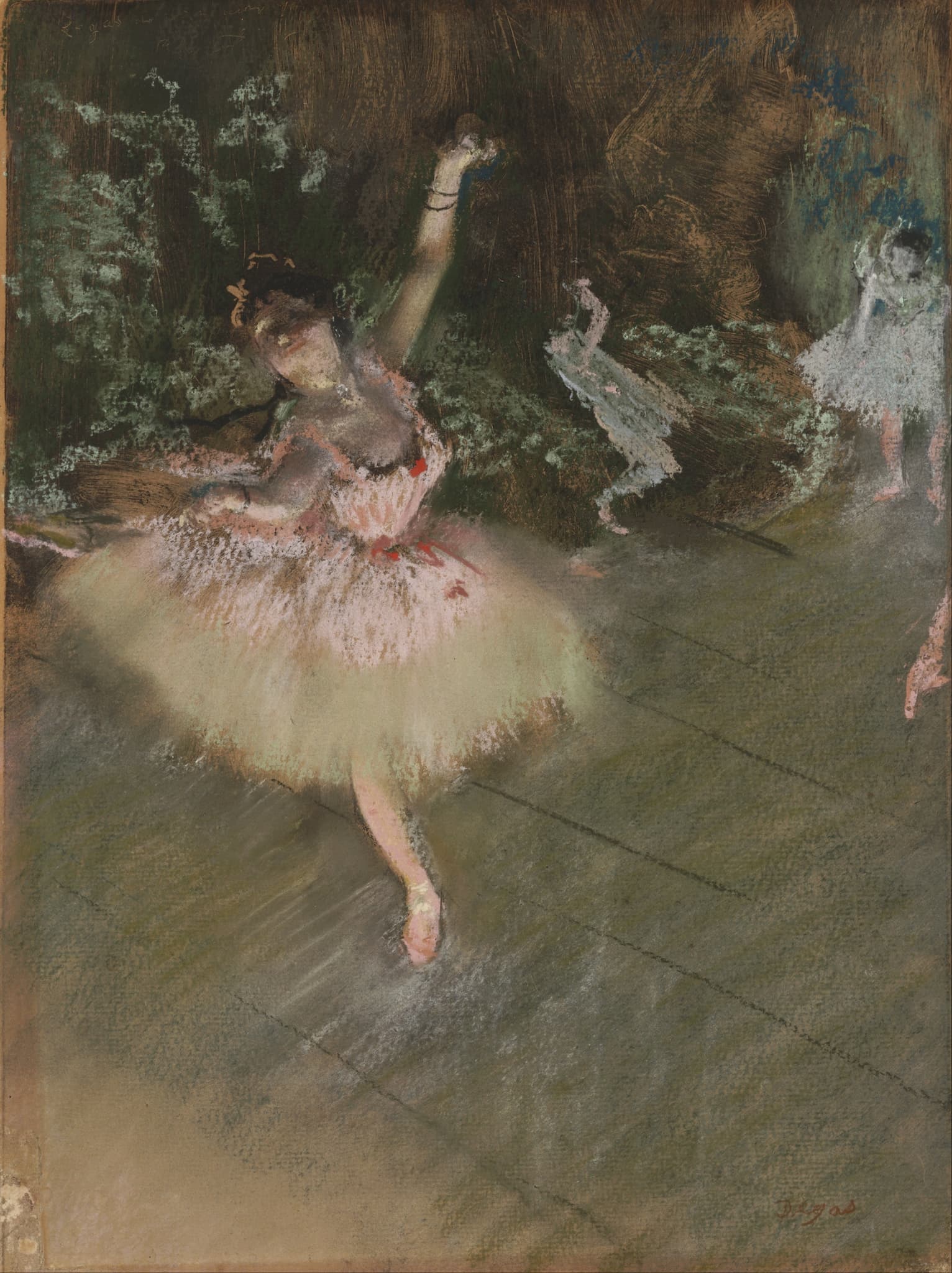
The Star (Danseuse au bouquet, saluant sur la scène, 1878) is a canonical Degas dancer pastel in the Musée d’Orsay and one of the most recognized images in his oeuvre. Extrapolating from the artist’s record and the performance of top-tier dancer pastels, its hypothetical market value is estimated at $80–120 million. Its prime date, iconic subject, scale, and institutional stature would position it at the very top of the Degas market.
Valuation Analysis
Work identified. The Star—catalogued by the Musée d’Orsay as Danseuse au bouquet, saluant sur la scène (1878), pastel on paper laid on canvas, 72 × 77.5 cm, inv. RF 4039—is a flagship Degas dancer image from the artist’s prime years and among the most reproduced stage compositions in his oeuvre [1]. The work has been in the French national collections since the Camondo bequest (1911) and is inalienable under French law, so any price is necessarily hypothetical [2].
Method and anchor points. The valuation here uses extrapolation anchored to high-confidence comparables and recent market behavior. Degas’s overall auction record is $41.61 million for Petite danseuse de quatorze ans (posthumous bronze) at Christie’s in 2022, establishing the ceiling for his ballet imagery across media [3]. Historically, prime dancer pastels have achieved very high eight-figure prices, with a late-1990s pastel result at $27.9 million setting an early benchmark for the medium [4]. More recently, quality dancer pastels continue to transact strongly—e.g., Trois danseuses (c. 1897) at $5.78 million in 2025—and related stage-view works on paper at seven figures, reaffirming depth of demand for the theme [5][6].
Why $80–120 million. The Star combines the elements that maximize Degas pricing: a canonical ballet subject, a prime 1870s date, a substantial pastel mounted to canvas (a technically ambitious format), exhibition fame, and an indelible composition. Compared with past auction benchmarks, it is more iconic and narratively charged than most privately traded sheets. In a contemporary marquee setting with global bidding, those attributes—plus extreme scarcity of works at this level—would support a step-change above the artist’s existing record, placing a plausible outcome in the $80–120 million range.
Institutional status and market effect. Although the work’s inalienability under French patrimony law means it is not marketable in the ordinary course [2], the museum provenance itself amplifies perceived importance and trophy desirability were a hypothetical sale ever permitted. Buyers at the very top end pay for cultural resonance as much as for medium and scale; The Star’s museum identity and publication history deliver precisely that.
Positioning within the category. Impressionist masterworks with iconic imagery remain highly competitive, and Degas’s dancer pastels are the core of his market narrative. Against the backdrop of resilient demand for blue-chip Impressionist/Modern material and selective strength for best-in-class works, The Star would be expected to reset the pastel segment for Degas and credibly challenge his overall auction peak [3][5][6].
Key Valuation Factors
Art Historical Significance
High ImpactThe Star is a touchstone of Degas’s theater imagery: an on‑stage, full‑figure dancer in a dramatic bow, with the shadowed patron at the wing. Dancer subjects from the mid‑to‑late 1870s are central to Degas’s identity, and this composition is among the most reproduced and exhibited. It encapsulates Degas’s synthesis of modern life, artificial light, and movement at precisely the moment his pastel technique matured. Works that define an artist’s public image and scholarship command the strongest premiums, especially when they have served as canonical references in exhibitions and literature. That art historical centrality strongly supports a value at the very top of the artist’s market.
Medium, Date, and Scale
High ImpactPastel was Degas’s favored medium for the ballet, and large, saturated sheets mounted to canvas from the 1870s–80s are the apex of collector demand. The Star (1878) sits in this prime window and at an imposing size (c. 72 × 77.5 cm), enabling expansive color, dramatic lighting, and complex spatial staging. Collectors prize the technical bravura of layered pastel handling, which yields a painterly depth comparable to oil while remaining unmistakably Degas. The combination of prime date, substantial scale, and technically ambitious support elevates this work within the medium hierarchy, justifying a pricing tier materially above routine dancer pastels.
Provenance and Institutional Status
High ImpactThe work’s provenance—from a 19th‑century Paris sale, into the Camondo collection, and then by 1911 bequest to the French state—confers unimpeachable pedigree. Its long residence in a national museum underscores both rarity and cultural importance. Although French public collections are inalienable, which makes actual sale improbable, such institutional anchoring heightens the work’s symbolic capital and trophy appeal in any hypothetical offering. In the rare instances when museum‑level masterpieces surface, bidding competition tends to transcend ordinary comparables, with buyers paying for public recognition and curatorial validation as much as for object quality.
Comparables and Demand Depth
High ImpactDegas’s top market results cluster around his ballet imagery. The artist’s overall auction record is $41.61 million for the Little Dancer bronze (2022), and prime dancer pastels have reached very high eight figures historically, establishing a robust ceiling for the category. Recent sales show continued liquidity for quality dancer pastels and stage‑view compositions, indicating durable, global demand. The Star surpasses typical offerings in fame, date, and scale, warranting an upward adjustment above both the bronze record and historical pastel peaks. Given current trophy‑chasing dynamics for iconic Impressionist masterpieces, competition would plausibly carry this work into the $80–120 million band.
Sale History
The Star has never been sold at public auction.
Edgar Degas's Market
Edgar Degas is a top‑tier Impressionist with deep, global demand across media. His market leadership centers on ballerinas—pastels and related sculptures—supplemented by racing and bathers. The artist’s overall auction record stands at $41.61 million for Petite danseuse de quatorze ans (posthumous bronze), set at Christie’s in 2022, evidencing the premium for ballet subjects. Prime dancer pastels have historically reached the high eight figures, and recent seasons confirm continued appetite for best‑in‑class sheets, with late 19th‑century examples achieving multimillion‑dollar results. While mid‑tier drawings can be selective, museum‑caliber, prime‑date dancer pastels remain among the most liquid and competitive segments of the Impressionist field.
Comparable Sales
Danseuse au repos
Edgar Degas
Prime-period dancer pastel (c. 1879); top historical auction result for a Degas pastel; closest high-end market proxy for a major, iconic ballerina pastel like The Star.
$37.0M
2008, Sotheby's New York
~$54.8M adjusted
Danseuse attachant son chausson
Edgar Degas
Pastel of a single dancer from a prime series (1887); strong, recent top-tier pastel benchmark from a blue-chip single-owner sale.
$9.0M
2022, Christie's New York
~$9.8M adjusted
Trois danseuses
Edgar Degas
Pastel of dancers (c. 1897) with competitive bidding; a current-market indicator for quality dancer pastels (albeit later in date than The Star).
$5.8M
2025, Sotheby's New York
Danseuses sur la scène
Edgar Degas
Stage-view composition (c. 1879) closely aligned to The Star’s subject; smaller and mixed media, but useful for subject-matter proximity.
$1.1M
2025, Christie's New York
Deux danseuses
Edgar Degas
Counterproof enhanced with pastel/charcoal (c. 1897); demonstrates the market floor for later, secondary-quality dancer sheets.
$204K
2024, Bonhams New York
~$210K adjusted
Petite danseuse de quatorze ans (bronze, cast 1927)
Edgar Degas
Artist’s overall auction record in the core ballet theme; cross-medium anchor showing demand ceiling for iconic Degas ballet imagery.
$41.6M
2022, Christie's New York
~$45.4M adjusted
Current Market Trends
Blue‑chip Impressionist/Modern material remains resilient, with buyers concentrating capital on historically important, instantly legible images by brand‑name artists. Within Degas’s oeuvre, prime‑date dancer pastels continue to outperform, while later or secondary‑quality works show greater price sensitivity. The trophy market has become more selective, but fresh, iconic masterpieces with strong literature and institutional narratives still draw aggressive bidding and private‑sale demand. Against this backdrop, a canonical, large‑scale ballet pastel from the 1870s positions at the category’s apex and would be expected to command a record‑challenging outcome.
Sources
- Musée d’Orsay — Danseuse au bouquet, saluant sur la scène (RF 4039)
- Legifrance — Code du patrimoine, Art. L451‑5 (inalienability of public collections)
- Christie’s — Anne H. Bass Collection press release (Degas record $41.61m)
- The Washington Post — “Degas Pastel Sets Record” (1999)
- Sotheby’s — Trois danseuses (Modern Evening Auction, 2025)
- Christie’s — Impressionist & Modern Works on Paper (Nov 2025) Top Lot: Degas