Nighthawks
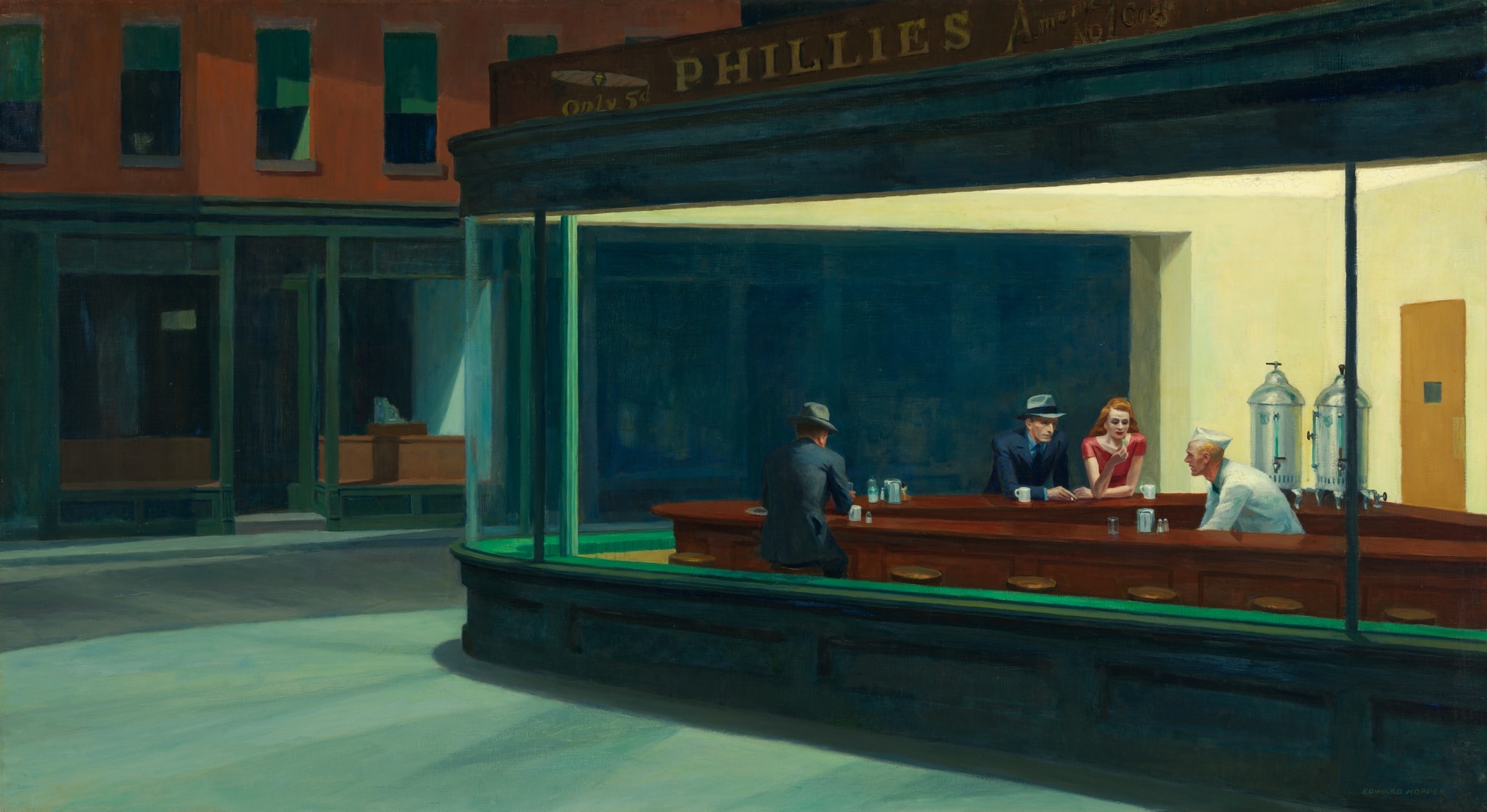
Edward Hopper’s Nighthawks turns a corner diner into a sealed stage where fluorescent light and curved glass hold four figures in suspended time. The empty streets and the “PHILLIES” cigar sign sharpen the sense of urban solitude while hinting at wartime vigilance. The result is a cool, lucid image of modern life: illuminated, open to view, and emotionally out of reach.
Fast Facts
- Year
- 1942
- Medium
- Oil on canvas
- Dimensions
- 84.1 × 152.4 cm
- Location
- The Art Institute of Chicago, Chicago
Click on any numbered symbol to learn more about its meaning
Meaning & Symbolism
Hopper engineers separation through design. The continuous, curved glass makes the diner a seamless wedge, denying the viewer any visible entrance; our vantage is pressed to the pane, like a late passerby who can only watch 13. Inside, the white fluorescent wash falls hard on the counter and faces, bleaching color toward the greenish end of the spectrum and giving the light an almost clinical authority 1. That light fixes the figures in place: a man with his back turned becomes an opaque silhouette; the couple angle toward one another yet do not truly meet; the attendant leans in, but the counter’s long mahogany run and its punctuation of cups, shakers, and a chrome sugar dispenser act like small sentinels that keep everyone slightly fenced off 3. Behind them, two tall metal urns glint like apparatus more than hospitality, and a shut, featureless door further insists on enclosure. Outside, storefronts sit dark and unpeopled. The “PHILLIES” sign—advertising five‑cent cigars—dominates the fascia, reminding us that in the modern city, commercial text often outshouts human speech 5. The streets form cool geometries, all right angles and empty planes, so the diner’s glow reads as a beacon without being a welcome.
This is why Nighthawks is important: it reframes the American realist city as a psychological architecture. Hopper painted it in winter 1941–42, amid blackout drills just after Pearl Harbor; curators have read the diner’s lit island as a wartime signal—an enclave of continuity discovered within a darkened metropolis 2. Yet Hopper also cautioned he did not intend the picture as “particularly lonely,” even as he conceded it likely carries the “loneliness of a large city” unconsciously—a tension that fits the image’s cool poise between contact and remove 4. The composition borrows from the movies he loved: a panoramic, slightly lowered angle, deep shadows, and crisp window framings that anticipate film noir’s moral chiaroscuro 13. Literature feeds it, too: Hopper admired Hemingway’s “The Killers,” a diner‑bound tale where suspense accrues from what is withheld; Nighthawks similarly stages the moment after the story should start, but before anything can change 1. The scene’s power comes from such postponement. We see the man’s immaculate brim, the woman’s red dress catching the light, the white counterman’s cap—details Hopper rehearsed in preparatory studies down to the coffee urns—yet nothing tips toward resolution 3. The artist has “simplified the scene” and “made the restaurant bigger,” he said, to let form do the arguing: glass, light, counter, and signage compose a grammar in which people speak quietly if at all 4.
What emerges is a concise ethics of looking. By eliminating the door, Hopper makes spectatorship the only available action; we cannot enter, only interpret 1. The fluorescent glow exposes everything yet confirms how little can be shared. In this way the painting articulates a modern paradox: technology promises connection and clarity, but the systems that illuminate us—commercial signage, engineered lighting, streamlined interiors—also standardize and separate. Nighthawks endures because it makes that paradox visible with unblinking calm, turning a late‑night diner into America’s most lucid allegory of public intimacy and private distance 123.
Explore Deeper with AI
Ask questions about Nighthawks
Popular questions:
Powered by AI • Get instant insights about this artwork
💬 Ask questions about this artwork!
Interpretations
Historical Context
Read through wartime New York, Nighthawks turns civil‑defense darkness into dramaturgy. Curator Sarah Kelly Oehler frames the diner’s fluorescent field as a wartime beacon—a modest promise of continuity shining in a city practicing blackout drills after Pearl Harbor 2. The newness of fluorescent light matters here: it is both technological bravura and a sign of normal commerce persisting under stress. Rather than pure alienation, the painting stages a home‑front poise, where routine (coffee, cigarettes, late hours) endures in an altered world. The glow is less comfort than sentry, holding the line between interior order and exterior void, giving the image its taut balance of vulnerability and resolve 24.
Source: Art Institute of Chicago (Oehler)
Cinematic/Noir Lens
Hopper adapts movie grammar—low panoramic vantage, hard key light, deep shadow—to build a noir ethics of space. The continuous glass reads like a screen; window frames become shot/reverse‑shot architecture; the counter’s diagonal is a tracking line that goes nowhere 1. Early film noir’s moral chiaroscuro is translated into spatial chiaroscuro: the light exposes yet withholds, fixing bodies in legible poses while evacuating backstory. This is not illustration but cinematic thinking in paint, where mise‑en‑scène carries the drama and the viewer is cast as a passerby‑detective, parsing clues that decline to resolve into plot 14.
Source: Art Institute of Chicago
Literary Intertext
Hopper’s admiration for Hemingway’s The Killers clarifies the painting’s suspense-by-omission. Like Hemingway’s diner, this scene stockpiles ordinary props—counterware, caps, cigarette ads—while deferring the event they seem to promise 1. The figures are poised in a post‑incipit moment: after the story should have begun but before change can occur. Hopper’s paring of language into objects—cups as commas, the counter as a clause—creates a stripped, unsentimental syntax where tension accrues from what is withheld. The result is a visual counterpart to Hemingway’s iceberg style: the surface is all there is, and that is precisely why it feels so inexhaustible 1.
Source: Art Institute of Chicago
Process & Constructed Realism
Nighthawks is less a transcript of a place than a purpose-built set. Studies show Hopper refining the counter plan, urns, and figure angles; he later noted he “simplified the scene” and “made the restaurant bigger,” prioritizing formal argument over reportage 34. Jo Hopper’s letters add that she posed for the woman and Hopper for the men, underscoring the work’s studio-made character even as it feels observed from life 6. This synthesis—memory plus invention—yields a realism of effect: engineered glass, regimented objects, and scaled space are tuned to produce an atmosphere where narrative seems imminent but remains held in suspension 346.
Source: Whitney Museum of American Art; Art Institute of Chicago; Gail Levin (via Christie’s)
Urban Semiotics of Advertising
The PHILLIES sign is not a diner name but an advertisement, and it dominates the fascia like a corporate marquee 5. Its oversized presence shifts the hierarchy of the scene: text outshouts talk, branding supersedes social exchange. Set at five cents, the cigars index a consumer economy whose prices and pitches anchor time even as people drift. Hopper’s placement of this sign turns the facade into a commercial palimpsest, a reminder that modern urban vision is routed through typography and commodity display. The humans below it become figures within a larger system of circulation—of light, goods, and messages—that frames and limits their encounters 15.
Source: PBS American Masters; Art Institute of Chicago
Spectatorship & the Ethics of Looking
By eliminating any visible entrance and stretching a single pane around the corner, Hopper enforces a vitrine effect: we can see everything, enter nothing 4. That architectural denial converts the viewer into a night stroller pressed to glass, foregrounding the painting’s reflexive question—what does looking do? The fluorescent wash promises revelation but delivers nontransferable clarity: forms are crisp, meanings withheld. In this scheme, modern technologies of exposure—lighting, plate glass, signage—double as systems of separation. The work therefore models a spectatorship that is ethically uneasy: to look is to witness, but also to accept a boundaried relation to others’ solitude 14.
Source: Art Institute of Chicago
Related Themes
About Edward Hopper
Edward Hopper (1882–1967) trained in New York and fused close observation with selective invention, constructing spaces that feel factual yet are composites tuned to mood [3]. Living in Manhattan, he translated urban light, windows, and architecture into a spare, cinematic realism that resists prescriptive messages [3]. His methodical studies for Nighthawks show how he built atmosphere through vantage, lighting, and even small fixtures [3].
View all works by Edward Hopper →