How Much Is Nighthawks Worth?
Last updated: February 6, 2026
Quick Facts
- Last Sale
- $3K (1942, Rehn Gallery, New York (to the Art Institute of Chicago))
- Methodology
- extrapolation
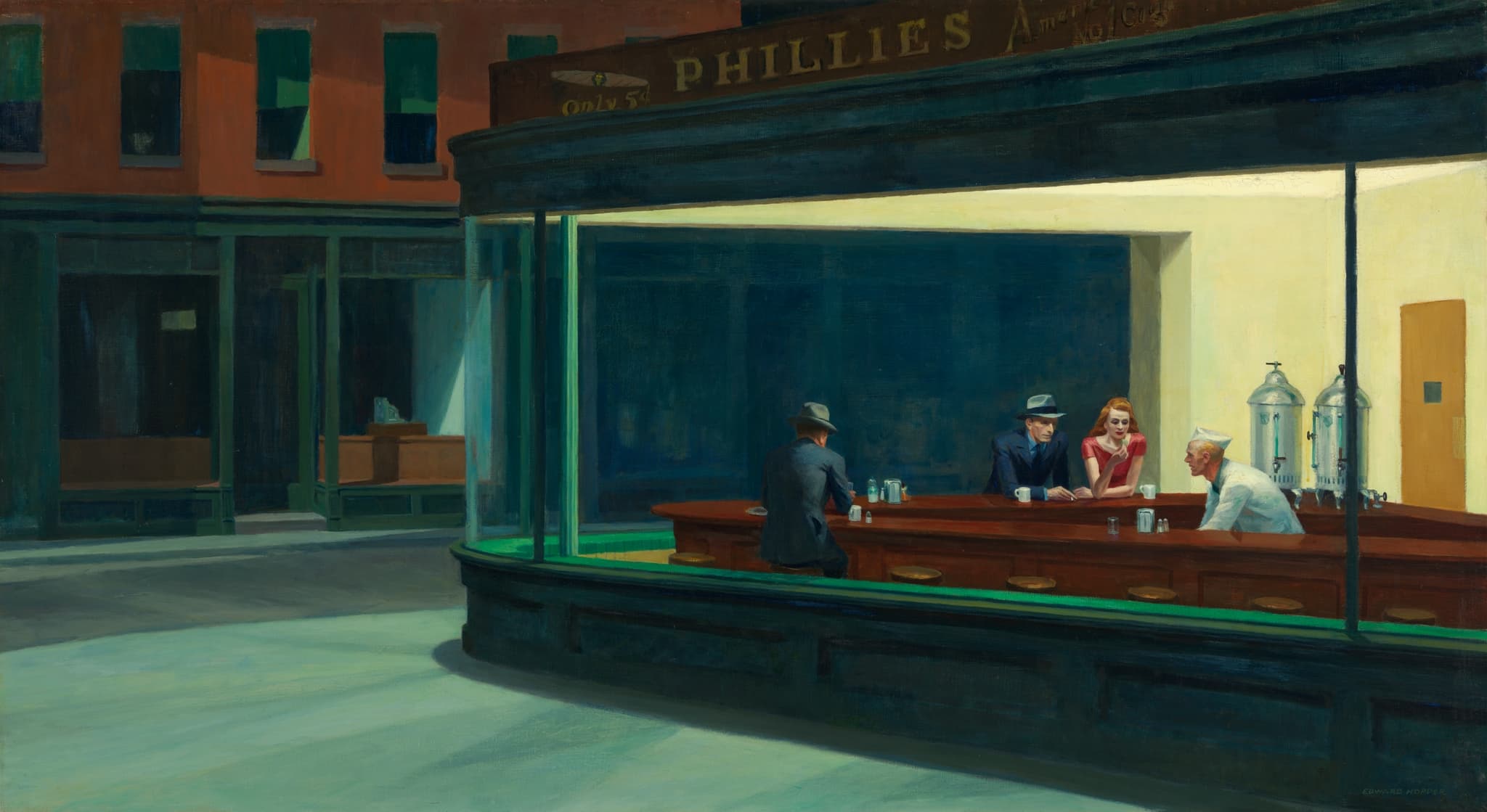
Nighthawks is the definitive Edward Hopper and one of the most recognizable images in American art. Extrapolating from Hopper’s $91.9m auction record for Chop Suey and applying a substantial icon premium supported by cross-category trophy results, a realistic open‑market estimate is $250–350 million. Museum-grade provenance, cultural ubiquity, and extreme scarcity support the top end of the range.
Valuation Analysis
Conclusion: If Edward Hopper’s Nighthawks (1942) were hypothetically offered on the open market today, a defensible valuation is $250–350 million. This estimate extrapolates from Hopper’s standing auction record for Chop Suey at $91.875 million with premium and applies an “icon premium” appropriate to a singular, canon-defining image with cross‑category appeal [2][3]. The result is also benchmarked against recent trophy outcomes for universally recognized 20th‑century works, such as Warhol’s Marilyn at $195 million, which confirms the depth of global demand at the very top end [4].
Why this band: Nighthawks is universally regarded as Hopper’s masterpiece—an apex of American realism and a cultural emblem whose recognition extends far beyond art‑historical circles. It has been held by the Art Institute of Chicago since 1942, with impeccable institutional provenance, exhaustive publication and exhibition history, and a scale and pictorial clarity that have made it one of the most reproduced paintings in American art [1][5]. Major Hopper oils—especially iconic, prewar urban interiors—are exceptionally scarce on the market; when prime examples do appear, they reset the artist’s price levels (e.g., Chop Suey in 2018) [2][3].
Methodology: We start with the artist’s top public price (Chop Suey at $91.875m) and recognize that Nighthawks sits at the absolute apex of the oeuvre in art‑historical importance and cultural reach. We then apply an icon‑level uplift informed by cross‑category trophies (Warhol’s Marilyn at $195m) and the broader pricing of singular 20th‑century images. This yields a central tendency near $300m, with a reasonable market band of $250–350m to reflect sale structure (guarantees, marketing), currency conditions, and the competitive intensity a once‑in‑a‑generation offering would elicit [2][3][4].
Positioning and caveats: Because Nighthawks is museum-held with no credible prospect of deaccession, price discovery remains theoretical; museums also do not publish insured values for such works [1][5]. Nevertheless, the combination of unrivaled significance, extreme scarcity, blue‑chip institutional provenance, and vast cultural recognition situates Nighthawks alongside the most valuable American paintings that could plausibly transact privately. In that context, the $250–350m range reflects both the ceiling implied by recent trophy comparables and the substantial premium warranted by this image’s singular status.
Key Valuation Factors
Art Historical Significance
High ImpactNighthawks is widely regarded as Hopper’s definitive masterpiece and one of the most iconic paintings in American art. Painted in 1942, it crystallizes Hopper’s exploration of urban isolation, cinematic light, and psychological suspense in a single, immediately legible image. Its subject, scale, and composition are among the most reproduced and discussed in 20th‑century art, taught at every level from survey courses to graduate seminars. This apex status within Hopper’s oeuvre—and its importance within American modernism more broadly—supports a valuation far above the artist’s already‑high benchmarks. Among major 20th‑century images, Nighthawks’ cultural footprint rivals the most celebrated works, warranting a substantial icon premium over standard artist‑record extrapolations.
Scarcity of Comparable Works
High ImpactTop‑tier Hopper oils—especially large, prewar urban interiors with figures—almost never reach the market. The handful of major oils that have surfaced over the last decade have produced step‑change prices, led by the 2018 record for Chop Suey. Nighthawks is not merely a best‑in‑class example; it is the singular image by which the artist is most commonly identified. With apex Hopper subjects effectively locked in museums, a hypothetical offering would confront extraordinary pent‑up demand from both American‑art specialists and cross‑category trophy buyers. This extreme supply constraint materially elevates achievable pricing and narrows the likely outcome toward the upper end of a nine‑figure range.
Provenance, Publication, and Exposure
High ImpactOwned by the Art Institute of Chicago since 1942, Nighthawks carries unimpeachable provenance and a publication/exhibition history few American paintings can match. Continuous institutional ownership, extensive scholarly literature, and broad public display reduce transactional risk and enhance buyer confidence. The image’s ubiquitous reproduction in books, films, and media further amplifies its brand value and instant recognizability. In trophy markets, such institutional pedigree and cultural saturation typically command material premiums, reflecting both the reputational assurance and the immediate symbolic capital conferred on any future owner, public or private.
Cross-Category Trophy Demand and Benchmarks
High ImpactThe top end of the art market increasingly prices singular, culturally resonant images across categories. Warhol’s Shot Sage Blue Marilyn at $195m exemplifies how universally recognized 20th‑century icons attract global competition beyond specialist circles. Hopper’s Chop Suey at $91.875m set a robust artist benchmark; Nighthawks warrants a significant uplift as the artist’s most famous image with broader cultural reach. In a well‑structured sale with global marketing and competitive guarantees, cross‑category trophy buyers would likely drive pricing into the mid‑nine figures, consistent with the proposed $250–350m range.
Sale History
Rehn Gallery, New York (sold to the Art Institute of Chicago)
Dealer sale recorded in Jo Hopper’s journal; accessioned by AIC as Friends of American Art Collection, 1942.51.
Edward Hopper's Market
Edward Hopper is a blue‑chip, category‑defining American modernist whose market is anchored by a small number of landmark oils and a deeper, steadier trade in watercolors and prints. The artist’s auction record is $91.875 million for Chop Suey (Christie’s, 2018), with East Wind Over Weehawken previously holding the record at $40.485 million (2013). Since 2018, few substantial oils have surfaced, underscoring tight supply; recent public activity has centered on watercolors in the $0.6–2.0 million range and prints in the five‑ to low six‑figure band. Collector demand is strongest in the U.S. but meaningfully international, with institutions and top private collections competing aggressively when major oils appear. Scarcity, brand recognition, and art‑historical importance drive pricing.
Comparable Sales
Chop Suey
Edward Hopper
Same artist; pre-war urban interior with figures; oil on canvas; major, widely published image and current artist auction record. Though smaller than Nighthawks, it is the closest market anchor for a top-tier Hopper oil.
$91.9M
2018, Christie's New York
~$116.7M adjusted
East Wind Over Weehawken
Edward Hopper
Same artist; 1930s urban subject; large horizontal format comparable in width to Nighthawks; landmark oil that set the artist’s record before 2018.
$40.5M
2013, Christie's New York
~$55.1M adjusted
Cobb’s Barns, South Truro
Edward Hopper
Same artist; early-1930s oil on canvas; recent public sale showing current demand for non-iconic but substantial Hopper oils. Useful for bounding the lower tier of major Hopper oils relative to trophies.
$7.2M
2023, Sotheby's New York
~$7.6M adjusted
Shot Sage Blue Marilyn
Andy Warhol
Cross-category trophy benchmark: a universally recognized 20th‑century icon that set the postwar/American record. Relevant for the ‘icon premium’ Nighthawks would command as a singular cultural image.
$195.0M
2022, Christie's New York
~$212.6M adjusted
Four Dead Trees
Edward Hopper
Same artist and year (1942) as Nighthawks; watercolor on paper rather than oil, but demonstrates market depth for same‑year works and provides context for the medium/subject premium held by major oils.
$1.5M
2023, Christie's New York
~$1.6M adjusted
Current Market Trends
After a softer 2024, the high end of the market showed renewed strength in late 2025, with select Modern trophies achieving landmark prices while buyers remained highly selective. The mid‑market (especially $100k–$2m) held comparatively steady, but the $10m+ segment favored museum‑grade consignments supported by thoughtful estimates and strategic guarantees. Cross‑category appetite for canonical 20th‑century images remains deep, though supply is thin. In this context, a singular, globally recognized icon like Nighthawks would likely attract broad trophy demand, with price determined more by competition and sale structure than by conventional comparables—consistent with the proposed $250–350 million range.