The Diner's Green Glow in Nighthawks
A closer look at this element in Edward Hopper's 1942 masterpiece
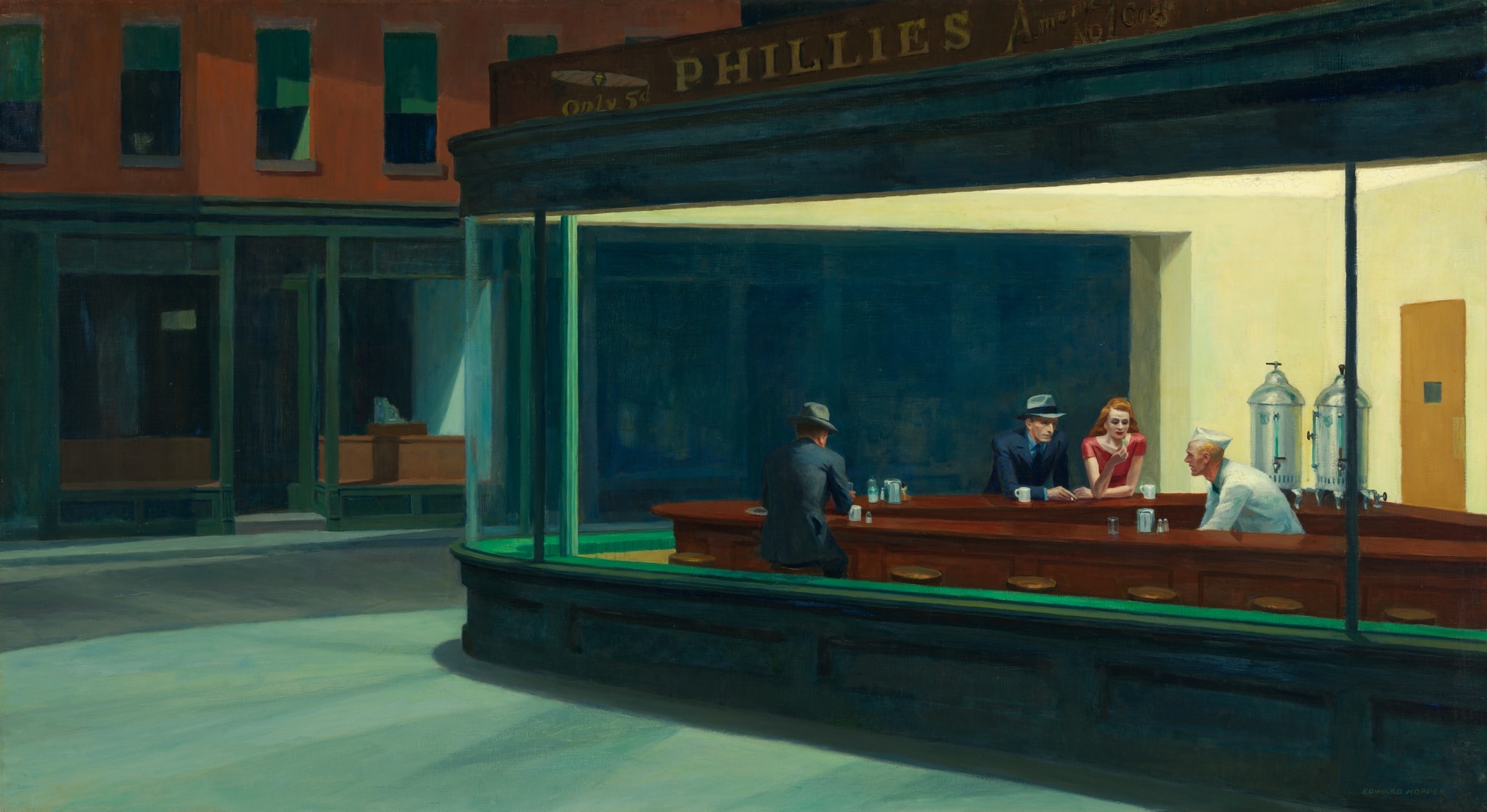
The diner’s greenish fluorescence is the drama of Nighthawks: a hard, modern light that floods the counter, seals the glass, and leaves the street in shadow. At once clinical and inviting, this glow stages the figures as if on a set—signaling 1942 modernity while holding viewers at a cool remove.
Historical Context
Fluorescent lighting had only just entered everyday American life. Publicly unveiled in 1939 at the New York and San Francisco world’s fairs, the new lamps spread rapidly during the war for their efficiency. When Hopper painted Nighthawks in the winter of 1941–42, that cool, sometimes green‑tinged wash still felt startlingly new—unlike the warmer glow of incandescent bulbs 1.
New York, meanwhile, was conducting blackout drills and dimming streetlights after Pearl Harbor. Against those darker streets, a diner blazing with fluorescence could register as both literal and psychological beacon. Art Institute curators connect the painting’s conception to this wartime atmosphere and propose the interior’s radiance as a potential refuge; Hopper later allowed he may have “unconsciously” painted big‑city loneliness, sharpening the tension between refuge and isolation that the glow embodies 2.
Symbolic Meaning
As a sign of modernity, the fluorescent glow epitomizes artificial illumination that reveals without warming. In Nighthawks it makes the diner look clinical and staged, isolating the figures and turning the passerby into a voyeur. The Whitney underscores that this “intensely bright and completely modern” light positions us outside, held at a distance by glass; Smarthistory links the single fluorescent source to a mood of silence and separation, noting the absence of any streetlamp or competing light 34.
Yet the same brightness invites a counter‑reading: in a city shadowed by wartime blackouts, the glow gathers strangers into a provisional community, a beacon of visibility and order. The Art Institute frames it as a possible image of hope, even as Hopper acknowledged urban loneliness—an ambiguity that keeps the light humane and unsettling at once 2. PBS American Masters adds that Hopper sanitized the streetscape—stripping signage and visual clutter—so the immaculate, glowing interior carries the psychological charge; the fluorescent bands thus become the painting’s emotional register, at once consoling and estranging 8.
Artistic Technique
Hopper organizes the scene around a single artificial source. Ceiling tubes cast an even, cool wash that spills along the counter, travels through the curved plate glass, and puddles onto the sidewalks—binding the wedge‑shaped corner to the sweeping counter and the pale faces and hands it spotlights 4.
He engineered this effect in advance. In the final study, white chalk maps the “harsh fluorescent light” against surrounding darkness, fixing where reflections and shadows will fall 5. On canvas he heightens the sensation with sour greens and yellow‑greens for walls, counter base, and window framing, set against deeper blue‑greens outdoors and the snap of brick red and the woman’s dress—a green–red tension that makes the interior feel exposed, even sterile 4.
Connection to the Whole
The diner’s greenish fluorescence is the engine of Nighthawks’ mood. It dictates what we can see—faces, cups, chrome—and what remains unknowable beyond the glass, establishing a lucid yet withholding theater of looking 34.
By making that glow the painting’s only illumination and denying a visible door, Hopper locks viewers on the pavement, peering into a box of light that both assembles and isolates the “nighthawks” 6. The result is a portrait of modern life under pressure: new technology blazing indoors while the city recedes to quiet darkness. The glow unifies the geometry, sets the tempo of stillness, and becomes the work’s subject as much as its setting 37.
Explore the Full Painting
This is just one fascinating element of Nighthawks. Discover the complete interpretation, symbolism, and hidden meanings throughout the entire work.
← View full analysis of NighthawksSources
- Smithsonian National Museum of American History — General Electric Demonstration Fluorescent Lamp (1939 introduction; early “green” demonstrations)
- Art Institute of Chicago — Nighthawks as a Symbol of Hope (wartime blackout context; beacon reading; Hopper on loneliness)
- Whitney Museum of American Art — Nighthawks audio guide (fluorescent light as intensely bright and modern; viewer as outsider)
- Smarthistory — Edward Hopper, Nighthawks (single fluorescent source; light spill, reflections, absence of streetlamp)
- Whitney Museum — Study for Nighthawks audio (Carter E. Foster on mapping the “harsh fluorescent light”)
- Art Institute of Chicago — Nighthawks (archival object text; glass barrier, lack of entrance, fluorescent emphasis)
- Art Institute of Chicago — Acquiring Nighthawks (early‑1940s fluorescence; eerie glow; no entrance)
- PBS American Masters — What’s Missing from Edward Hopper’s Nighthawks? (sanitized streetscape; bright fluorescent highlight)