The Faceless Soldiers in The Third of May 1808
A closer look at this element in Francisco Goya's 1814 masterpiece
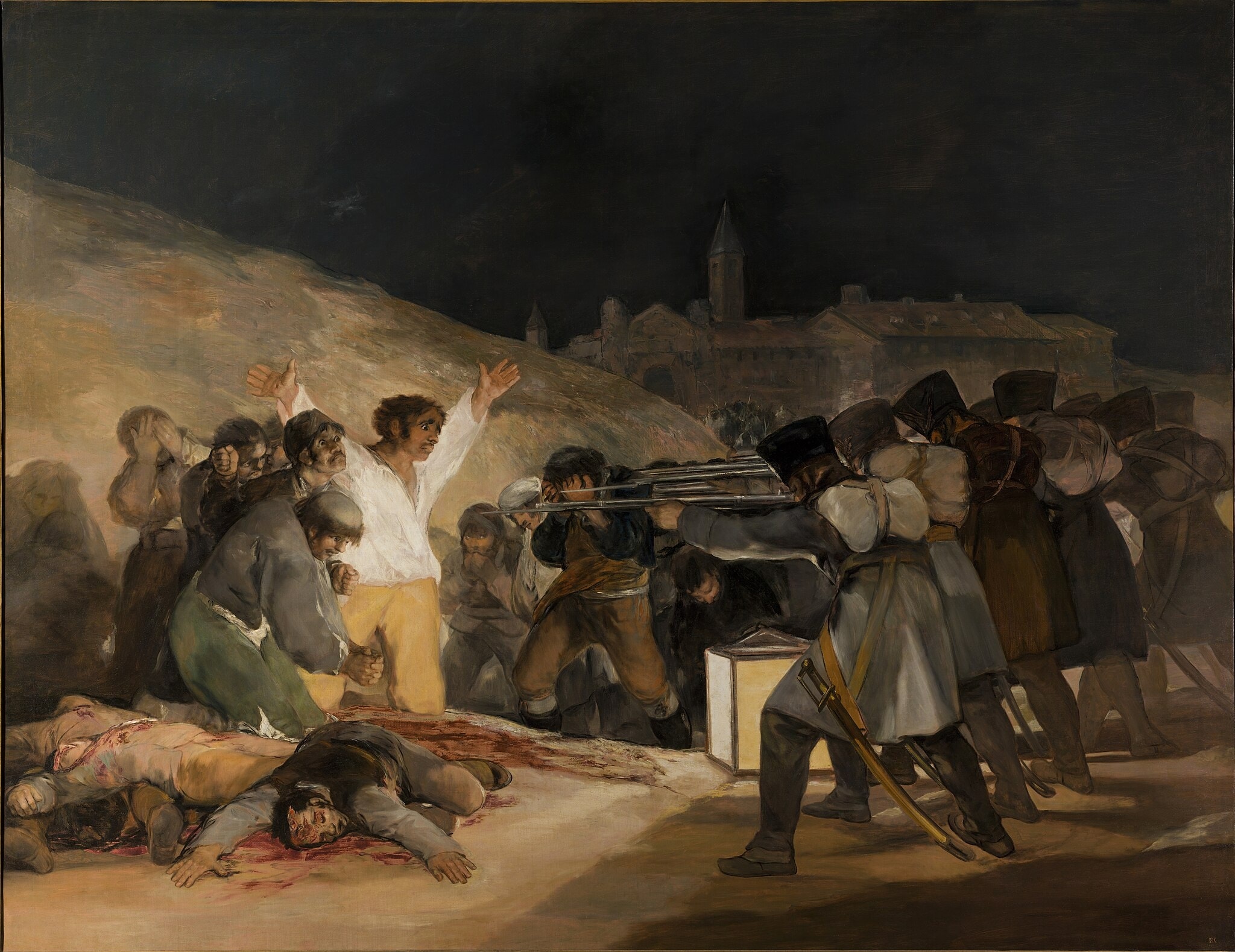
Goya’s firing squad marches as a single, faceless machine: a dark block of bodies whose rifles slice toward the condemned. By stripping the soldiers of individuality and burying them in shadow, Goya converts a specific execution in occupied Madrid into a timeless image of state violence and dehumanized war.
Historical Context
In May 1808, Madrid’s popular uprising against Napoleonic occupation was met with swift reprisals; through the night of May 3, French troops executed suspected insurgents outside the city. In early 1814, as Ferdinand VII returned to the throne, the Regency commissioned Goya to memorialize these events in two monumental canvases: The Second of May (the revolt) and The Third of May (the executions). The Prado identifies the right-hand figures as a French firing squad—battle grenadiers and guard sailors in campaign dress—organized into a tight column that advances and shoots in unison 1.
Goya painted the scene not as a heroic battle but as a chilling record of occupation and reprisal. His treatment echoes the moral witness of his Disasters of War prints (1810–1820), which, like this canvas, rejects triumphalism to expose atrocity and civilian suffering. The Met underscores how these works together announce a modern consciousness about war—focused on victims and bureaucratized killing rather than glory or commanders 2.
Symbolic Meaning
Goya turns the executioners into a study of anonymity and dehumanization. The soldiers’ faces are hidden; their bodies lock into a single mass whose purpose is to fire, reload, and fire again. The Prado’s accessible text describes them explicitly as ‘killing machines,’ while Britannica calls them ‘inhuman, faceless, and uniform’—language that captures Goya’s indictment of modern, impersonal force 35. Smarthistory sharpens this reading by likening the squad to a fused, creature-like organism incapable of empathy 4.
This facelessness also universalizes violence. Fundación Goya en Aragón stresses that because the killers are interchangeable, the question of “who” is secondary to the irrational system that produces atrocity; the soldiers become an instrument of the state rather than characters with motives 6. Set against individualized Spaniards—especially the kneeling man in white, whose raised arms and bright shirt evoke a martyred saint—the squad’s uniformity dramatizes the moral polarity between mechanical power and human life 45. By refusing viewers the solace of personal villainy, Goya condemns the structure of organized violence itself, a stance that would shape the visual language of war for generations 34.
Artistic Technique
Goya forges the squad into a compact, rhythmically repeating wall of backs. Their shouldered muskets create a hard diagonal that drives into the victims—an effect Kenneth Clark praised as a ‘steely line,’ here captured by the closed, impersonal alignment noted by the Web Gallery of Art 74. A single ground lantern supplies the glare that overexposes the civilians while plunging the soldiers into shadow; the tonal split turns the executioners into a dark silhouette more mass than men. Grey capes standardize their forms, further erasing individuality 34.
Goya’s direct, economical brushwork and tenebrist contrasts intensify the night scene’s immediacy. The Prado’s restoration campaign recovered the canvas’s original chromatic force, clarifying the stark interplay of warm lamplight and the cold, muted palette that binds the firing line into one mechanical body 18.
Connection to the Whole
The faceless soldiers anchor the painting’s ethical and visual architecture. Their dark, mechanical block confronts a frayed, human group lit with brutal clarity; the central victim in white becomes a beacon of individuality and conscience. This opposition—anonymous force versus singular humanity—transforms a Madrid reprisal into a universal charge against state brutality and modern, depersonalized killing 41.
Formally, the squad’s diagonal rifles, synchronized stances, and pooled shadows counter the victims’ irregular poses and open faces, generating a composition of collision rather than combat. The result is a new, anti‑heroic image of war, aligned with Goya’s broader project to witness and condemn atrocity rather than celebrate victory 24.
Explore the Full Painting
This is just one fascinating element of The Third of May 1808. Discover the complete interpretation, symbolism, and hidden meanings throughout the entire work.
← View full analysis of The Third of May 1808Sources
- Museo Nacional del Prado – Collection record: The 3rd of May 1808 in Madrid, or The Executions
- The Metropolitan Museum of Art – Heilbrunn Timeline: Francisco de Goya (1746–1828) and the Spanish Enlightenment
- Museo Nacional del Prado – Easy-to-read: The Third of May 1808 or the Executions (Goya)
- Smarthistory – Francisco Goya, The Third of May, 1808
- Encyclopaedia Britannica – The Third of May 1808
- Fundación Goya en Aragón – El tres de mayo de 1808 (work entry)
- Web Gallery of Art – Goya, The Third of May 1808 (formal analysis note)
- Museo Nacional del Prado – Research/Restoration: The restoration of the 2nd and 3rd of May