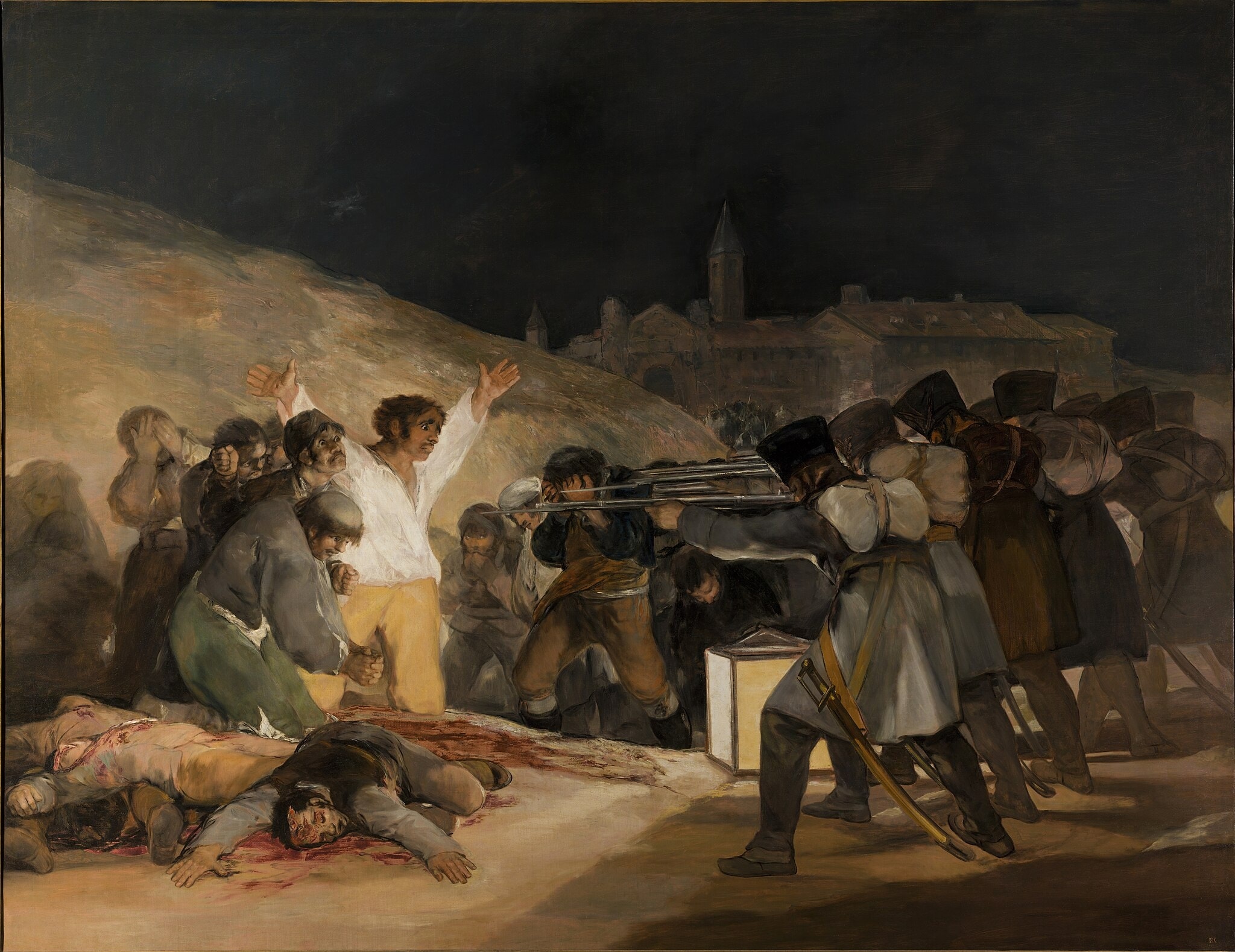
The Third of May 1808

by Francisco Goya

Francisco Goya’s The Third of May 1808 turns a specific reprisal after Madrid’s uprising into a universal indictment of state violence. A lantern’s harsh glare isolates a civilian who raises his arms in a cruciform gesture as a faceless firing squad executes prisoners, transforming reportage into modern anti-war testimony [1][2].
💰

Market Value

$500-700 million

How much is The Third of May 1808 worth?

Fast Facts

Year
1814
Medium
Oil on canvas
Dimensions
268 x 347 cm
Location
Museo Nacional del Prado, Madrid
The Third of May 1808 by Francisco Goya (1814) featuring Firing squad as faceless mechanism, Corpses and blood pool

Click on any numbered symbol to learn more about its meaning

Meaning & Symbolism

Goya constructs meaning through a clash of forms, lights, and gazes. On the right, the soldiers are rendered as a single instrument: backs turned, faces hidden under shakos, bodies locked into one slanted mass, their muskets aligned like an industrial press. They are not characters but a mechanism, the anonymous arm of the state. Opposite them, the prisoners are individualized through varied expressions and poses—fear, prayer, defiance—insisting on their humanity. The central man, in a brilliant white shirt and yellow trousers, raises his arms wide, palms exposed to the muzzles; a small mark in his right hand reads as a stigmata, and his stance recalls a crucifixion. Goya lets this man absorb the lantern’s glare so that he becomes both target and beacon, the moral center irradiating the surrounding despair. The light is not divine; it is a boxy, man-made lantern that both reveals and enables killing, a deliberate inversion of Baroque sacred light. In the foreground, two corpses bleed into a raw, red pool, foreshortened to thrust the viewer into the execution’s immediate aftermath; behind them, a kneeling friar clasps his hands, signaling that the victims encompass both clergy and commoners—repression without distinction 12. Space and time are engineered to emphasize inevitability. The barren slope of Príncipe Pío pushes diagonally up from left to right, channeling our eye from the dead to the doomed to the firing line. The black sky swallows the scene, denying any celestial intervention and isolating the act from the city’s distant silhouette. This void, paired with the steep hillside, reads as historical fact—the night executions outside Madrid after the uprising—and as existential stage: there is nowhere else to look but at the faces about to vanish. The composition’s two main diagonals—rifles toward the victim, hillside toward the soldiers—cross at the lantern, a visual pivot that equates illumination with procedural murder. Goya thickens paint where blood congeals and lets brushwork fray along garments and faces, a surface that, as later critics observed, strips away academic polish to expose raw sensation; this material bluntness becomes part of the argument against heroized war 28. Historically, the painting emerged in 1814, when Goya petitioned to commemorate the uprising and its reprisals soon after Ferdinand VII’s restoration. That context can imply patriotic propaganda, but the picture exceeds triumphal narrative. There are no named heroes, no rescuers, no consoling allegory—only the reckoning of victims and the routine of executioners. By fusing Christian martyr codes with contemporary clothing and weaponry, Goya updates sacrifice from sanctified legend to civic catastrophe. The result is a durable paradigm: a modern image of war where the central questions are culpability and empathy rather than victory and glory. In the central figure’s illuminated body—arms outstretched, eyes wide, mouth open—Goya gives us a witness who sees us seeing him, forcing an ethical response. That gaze, returned across the barrels, is the painting’s final indictment: violence here is not an episode of history but a structure—uniformed, ordered, repeatable—and The Third of May 1808 is Goya’s refusal to let it pass unjudged 12345.

Explore Deeper with AI

Ask questions about The Third of May 1808

Popular questions:

Powered by AI • Get instant insights about this artwork

💬 Ask questions about this artwork!

Interpretations

Historical Context: Commission, Compliance, and Contradiction

Goya petitioned in early 1814 to “perpetuate…our glorious insurrection,” securing funds and materials to commemorate the Dos and Tres de Mayo; yet the picture he delivered eludes simple patriotic uplift 5. Instead of heroes and banners, we get an execution protocol, a ledger of accountability that makes the new Bourbon order complicit by proximity in the language of state force 3. This duality—official commission versus moral witness—aligns the canvas with Enlightenment skepticism in Goya’s milieu while acknowledging Restoration politics 4. The result is an image that can serve a nation-building display and simultaneously undermine triumphal propaganda by centering civilian death, thereby reframing patriotism as an ethics of remembrance rather than victory 354.

Source: Fundación Goya en Aragón

Formal Analysis: Anti-Baroque Nocturne and the Technology of Light

Goya replaces the Baroque’s transcendent chiaroscuro with a squat ground lantern whose glare both reveals and authorizes killing 2. The lantern sits at the pivot of crossing diagonals, making illumination itself procedural and forensic. Its planar, boxy geometry rhymes with the rigid gun barrels, fusing optics and ordnance into a single apparatus; light becomes logistics. Around it, he scumbles paint on clothing and faces, letting facture fray where sensation is raw, while blood pools are thickened into coagulated impasto—surface as evidence 2. The black sky functions as a negative field, a total eclipse of metaphysical light, so that visibility equals exposure and death rather than grace. This is not a night of revelation but of administrative clarity—an anti-altar where the sacrament is execution 23.

Source: Smarthistory

Material Modernity: Surface, Speed, and the Birth of the Anti-Heroic

Critics like Robert Hughes have argued that the painting’s unvarnished facture—scraped passages, clotted reds, and abrupt transitions—makes it a template for the modern war image, rejecting academic finish in favor of raw sensation 6. Paint behaves like matter-in-crisis: viscous, pooled, and pressed, echoing the mechanical alignment of muskets. The central figure is not monumentalized through polish but through contrast—chalky whites popping from a dark field—an optical urgency closer to reportage than to epic 2. In this register, Goya invents an anti-heroic grammar in which surface itself testifies. The “anonymous machine” of soldiers reads as a design system, while the victims are rendered through destabilized brushwork, emphasizing individuality as resistance to standardization 26.

Source: Robert Hughes (Penn Today lecture summary)

Symbolic Reading: Secular Martyrdom and the Crisis of the Sacred

The outstretched arms, exposed palms, and punctum-like mark in the right hand mobilize Christian martyr iconography, but the halo is replaced by gaslit glare, the cross by a firing line 2. In Enlightenment Spain, where reformist and reactionary currents collided, Goya’s substitution of a lantern for divine radiance stages a theological crisis: sanctity is relocated to civic bodies, and redemption is displaced by testimony 4. The victim becomes a modern martyr whose sanctity derives from suffering under political violence, not ecclesial ritual. This hybrid coding—devotional form, contemporary content—bridges sacred art and journalism, forcing viewers to measure inherited symbols against present atrocity and exposing how the sacred can be co-opted or emptied by procedure 24.

Source: Smarthistory

Social History: Indiscriminate Repression and the Collapse of Status

The kneeling friar clasping his hands among laborers compresses Spain’s social pyramid into a single queue for death, visualizing repression without distinction 2. By placing clergy and commoners together, Goya denies the consolations of estate privilege or intercession; the queue extends into the gloom, implying an expandable roster of bodies. This is a penal landscape, not a battlefield: the hillside’s incline and the city’s distant silhouette situate punishment at the edge of civic life, where law and violence merge 3. The soldiers’ synchronized posture contrasts with the victims’ varied habitus—prayer, terror, defiance—registering individuality as the last social difference recognized before erasure 2. In this reading, class becomes visible only at the moment of its annulment.

Source: Britannica

Related Themes

About Francisco Goya

Francisco Goya, court painter turned unsparing observer, emerged from Enlightenment Spain but, after illness left him deaf, developed a darker, critical vision of society and power. The Peninsular War shaped his Disasters of War prints and culminated in these May canvases, where witness supplants heroics [5].
View all works by Francisco Goya