The Lantern Light in The Third of May 1808
A closer look at this element in Francisco Goya's 1814 masterpiece
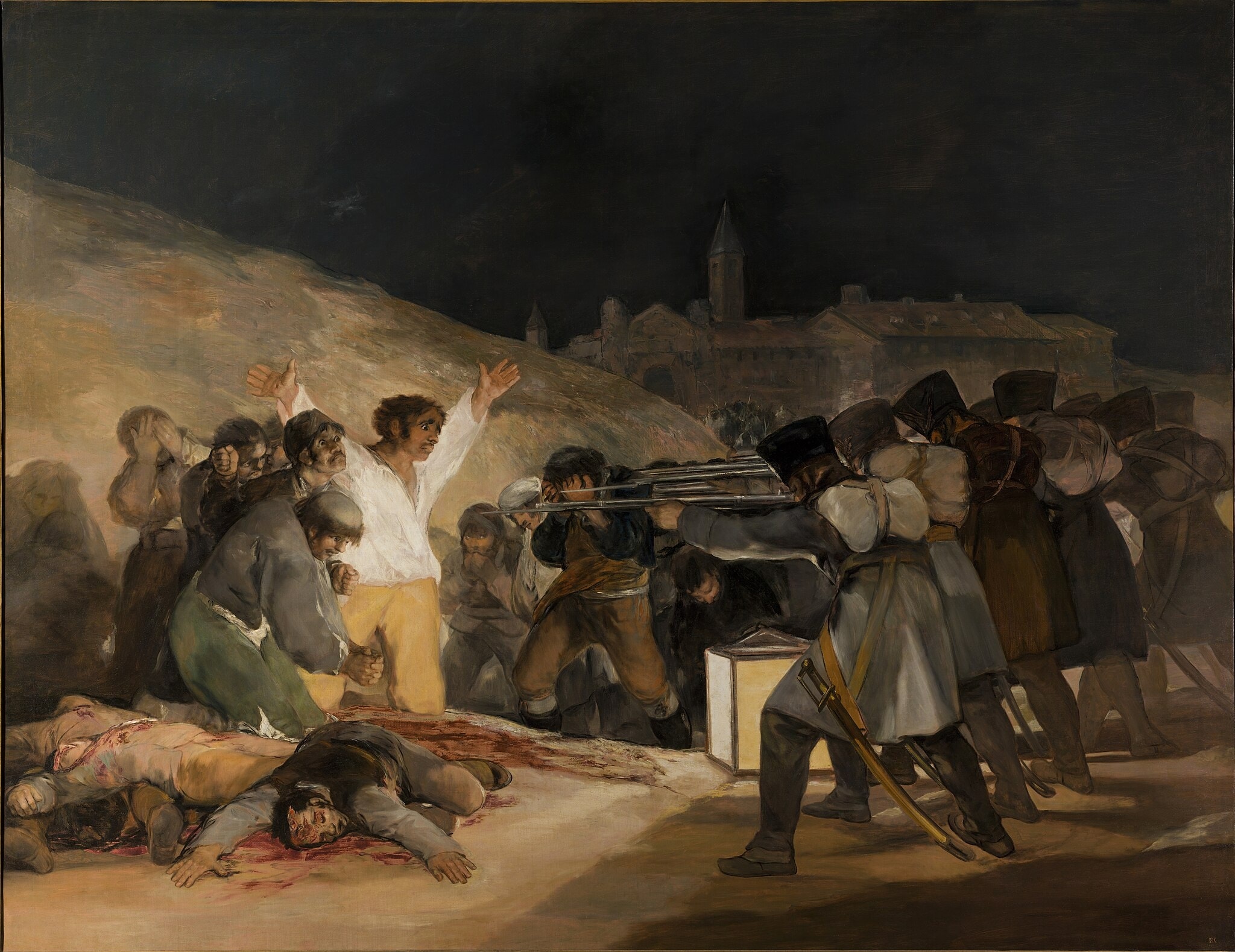
Goya’s square ground lantern is the painting’s lone, man‑made sun—thrown between firing squad and captives to flood the condemned with merciless clarity. By forcing the night into visibility, it turns a historical atrocity into a scene the viewer must witness, not avert.
Historical Context
Painted in 1814 after the French occupation of Spain, The Third of May 1808 depicts the summary executions that followed the Madrid uprising of May 2. The scene unfolds before dawn; Goya anchors this nocturnal reality with a large, square farol set on the ground between the soldiers and their prisoners. The Museo del Prado’s collection record identifies the device explicitly as a “Farol cuadrangular,” confirming its man‑made, practical function within the mise‑en‑scène 1.
Contemporary didactics from the Prado stress how the nighttime staging and the powerful light from the lantern intensify tension and drama. Its glare provides the necessary illumination for the reprisals “in the early hours,” making the act legible and immediate to viewers while rooting the event in documentary plausibility 2. By placing this light source at the center of action, Goya both explains how such executions could proceed in darkness and creates a visual logic that directs attention to the victims rather than the faceless firing line. The lantern thereby fuses historical circumstance with pictorial necessity—a pragmatic prop that becomes the scene’s engine of visibility 12.
Symbolic Meaning
The lantern’s meaning exceeds description. Borrowing a Baroque, Caravaggesque scheme of concentrated illumination, Goya pointedly overturns its traditional sacred connotations. As Fred Licht argues, the device is central not only compositionally but thematically: it provides a focused, secular light that reveals no grace—only atrocity 4. Kenneth Clark and subsequent scholarship echo this inversion, noting that where torchlight once announced divine presence, here it enables a mechanical execution and compels our witness 5.
Yet the beam’s effect on the man in white—arms outstretched, wounds anticipating stigmata—courts a martyr reading. Smarthistory describes how the lantern’s single blaze dazzles the central figure, elevating him without invoking a miracle; the “halo” is manufactured, not metaphysical 3. This tension is productive: a modern technology generates a quasi‑sacred aura, relocating sanctity from heaven to civic suffering. Critics have also traced the motif’s legacy forward. Robert Hughes saw in Goya’s pitiless cube a precursor to the stark light bulb of Picasso’s Guernica, a lineage of cold, modern illumination used to expose state violence rather than console it 6. In sum, the lantern reframes sacred light as forensic truth-telling—an ethical spotlight that denies transcendence while insisting on memory 3456.
Artistic Technique
Goya renders the lantern as a compact, geometric box whose white planes blast outward, organizing the composition into hard bands of illumination and engulfing shadow—a modern reworking of tenebrism 7. The captives nearest the lantern are modeled in high contrast, while the firing squad retreats into a collective silhouette, their faces withheld from the light’s reach 7.
Within the lit zones, Goya’s brushwork grows visibly agile and abrasive, especially across cloth, flesh, and the bloodied ground, amplifying immediacy and emotional charge 8. The Prado notes that conservation has clarified these effects, restoring the brisk facture that lets the glare read crisply across surfaces and edges 1. The result is a stage-like spatial cone: a forensic beam that both describes forms and dictates where our eye must go.
Connection to the Whole
Placed like a hinge between two masses—victims on the left, soldiers on the right—the lantern binds lighting, staging, and meaning. It concentrates moral attention on the condemned, while the executioners remain dehumanized in shadow, aligning the painting’s ethics with its optics 2.
Formally, the cube is the fulcrum for the narrative’s tempo: our gaze moves from the corpses at front left, through the blinding center, to the rifles poised for the next volley. By recasting Baroque chiaroscuro as a secular spotlight, the lantern powers the work’s modernity—part Romantic pathos, part proto‑photojournalistic testimony 47. It is the painting’s compositional keystone and its ethical instrument, transforming a nighttime reprisal into an unforgettable act of witnessing.
Explore the Full Painting
This is just one fascinating element of The Third of May 1808. Discover the complete interpretation, symbolism, and hidden meanings throughout the entire work.
← View full analysis of The Third of May 1808Sources
- Museo del Prado, collection record (Objeto de iluminación: Farol cuadrangular)
- Museo del Prado, didactic page on May 2–3 (nocturnal setting and ground lantern)
- Smarthistory, Francisco Goya, The Third of May, 1808
- An Introduction to 19th‑Century Art (Facos), entry with Fred Licht quotation
- Wikipedia, The Third of May 1808 (consolidated scholarly summary, incl. Clark)
- Robert Hughes, The Guardian, on the lantern’s legacy and Guernica’s bulb
- Artchive, analysis emphasizing compositional division by the lantern’s light
- Art in Context, note on visible brushwork in zones lit by the lantern