The Man in White in The Third of May 1808
A closer look at this element in Francisco Goya's 1814 masterpiece
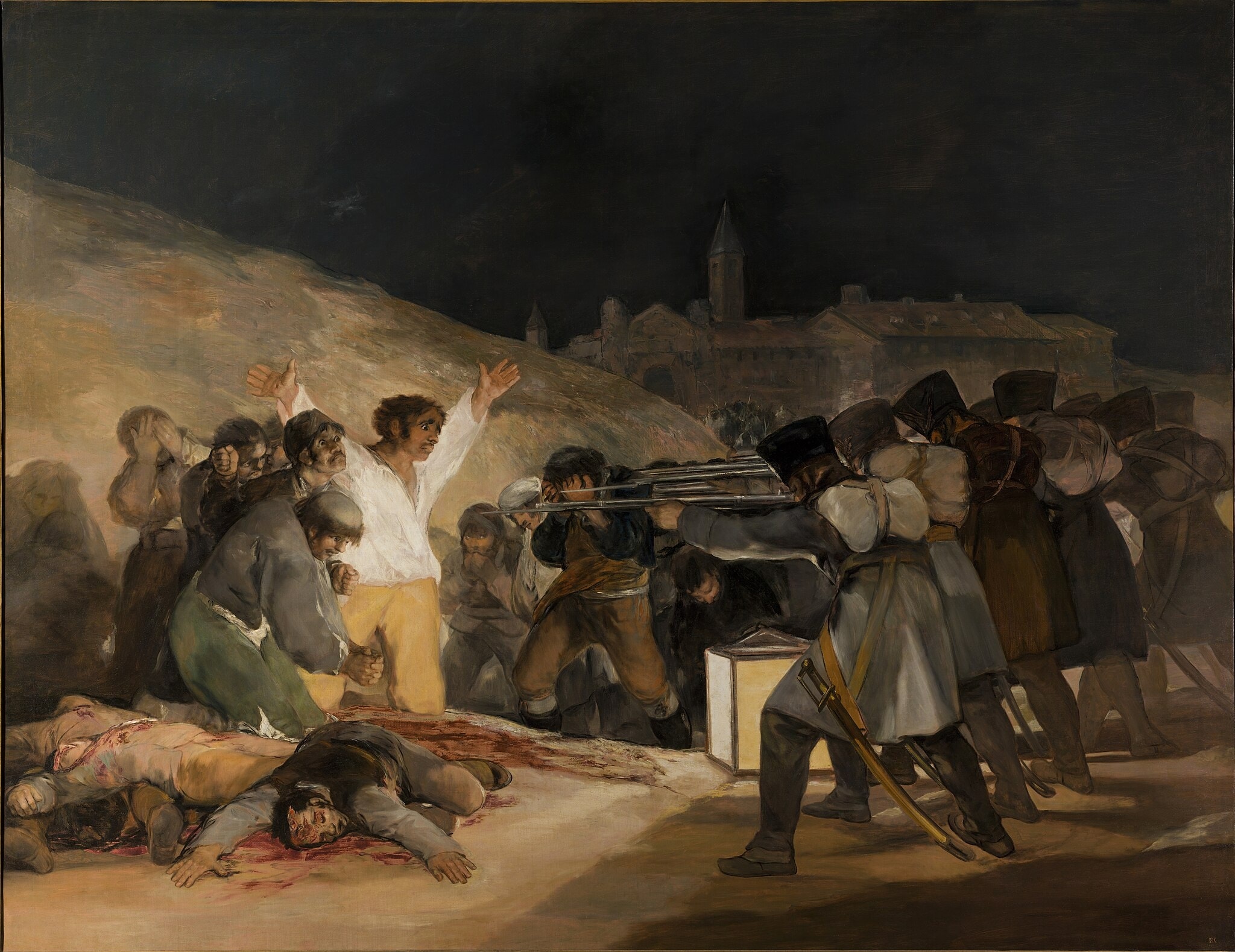
At the heart of Goya’s The Third of May 1808 stands the man in white—arms flung wide, palms exposed—who confronts the rifles and our gaze at once. Cast in stark light, he becomes both the memorial face of Madrid’s reprisals and a universal emblem of the innocent under the machinery of state violence.
Historical Context
In early 1814, with French forces expelled and the restoration of Ferdinand VII imminent, Spain’s Regency Council asked Francisco Goya to commemorate the Madrid uprising and its brutal aftermath. He delivered a pair of canvases—The Second of May and The Third of May—documented by payments that year; their frames were completed on November 29, 1814. The night scene’s central victim, the man in white, crystallizes the commission’s purpose: to fix public memory on the executions carried out after the May 2 revolt and to mourn the city’s anonymous dead 1.
As the pendant to the daytime combat of The Second of May, this canvas turns from heroic clash to retaliatory slaughter at the outskirts of Madrid. The Metropolitan Museum’s overview situates the picture within the Peninsular War, linking the canvas to Goya’s lifelong scrutiny of wartime atrocity, also explored in his Disasters of War prints. By centering a single, illuminated civilian at the moment before death, Goya transforms recent history into an ethical indictment that Spain’s post‑Napoleonic audience would immediately recognize and remember 2.
Symbolic Meaning
The figure in white is a deliberate martyr. His raised, outstretched arms echo the geometry of the Crucifixion, while small marks on his right palm read as stigmata—a pointed Christological sign. Goya fuses sacred iconography with a contemporary execution, translating a long tradition of Christian suffering into modern, civilian terms legible to a Catholic public 36. Smarthistory underlines how his frontal pose and exposed palms create an unmistakable appeal to empathy, making him the painting’s emotional and moral axis 4.
Fred Licht has shown how Goya overturns Baroque convention: the lantern placed with the firing squad provides a pitiless, man‑made glare, not divine illumination. Light here serves the mechanics of killing, producing what Licht calls a “martyr without miracle” 5. The white shirt and direct gaze elevate him from “one among many” to a national witness—embodying the human, individual Spaniard—while simultaneously standing for every innocent caught before faceless power 34. By assigning sanctity’s visual language to a commoner and pairing it with a utilitarian lantern, Goya indicts the modern state’s capacity to profane the sacred value of life.
Artistic Technique
Goya isolates the figure through severe chiaroscuro: a ground lantern blasts the man in white into stark relief while the hillside and sky recede into darkness. Loose, urgent brushwork animates his shirt and hair, catching the instant before the volley and heightening the sense of breath and terror 47. Color operates as emphasis—the brilliant white shirt and yellow trousers flare against dun earth tones—an effect made legible again by the Prado’s restoration, which recovered the canvas’s original luminosity 8. Compositional vectors—the uphill slope and the diagonal of leveled rifles—converge upon his torso and open palms, fixing the eye on the human target even as the soldiers’ backs deny us their faces.
Connection to the Whole
The man in white is the painting’s ethical engine. His illuminated, frontal humanity is locked in formal opposition to the soldiers’ synchronized backs and anonymous muskets, staging a clear moral contrast that structures the entire canvas 34. As the emblematic victim within the pair of May 2/May 3 paintings, he converts commemoration into witness, giving the reprisals a face and a voice 1. By recasting sacred martyr imagery onto a modern civilian under artificial light, Goya shifts history painting from heroic myth to moral testimony—an innovation that made this work a touchstone for later representations of state violence 5.
Explore the Full Painting
This is just one fascinating element of The Third of May 1808. Discover the complete interpretation, symbolism, and hidden meanings throughout the entire work.
← View full analysis of The Third of May 1808Sources
- Museo Nacional del Prado – Collection entry for The Third of May 1808 (commission, dating, context)
- The Metropolitan Museum of Art – Essay: Francisco de Goya and the Spanish Enlightenment (Peninsular War context)
- Encyclopaedia Britannica – The Third of May 1808 (martyr figure, stigmata, individualized Spaniards)
- Smarthistory – Art historical analysis with Goya’s Third of May, 1808 (composition, empathy, brushwork)
- An Introduction to Nineteenth-Century Art (citing Fred Licht) – Lantern’s inverted Baroque meaning
- OUPblog (Oxford Art Online) – Goya’s use of Crucifixion imagery
- Museo Nacional del Prado – Easy-to-read didactic note (crucifixion pose, lantern)
- Museo Nacional del Prado – Restoration background for the May canvases (original brightness/technique)
- The Guardian – Robert Hughes on Goya (central figure’s Crucifixion gesture and impact)