The Stigmata Pose in The Third of May 1808
A closer look at this element in Francisco Goya's 1814 masterpiece
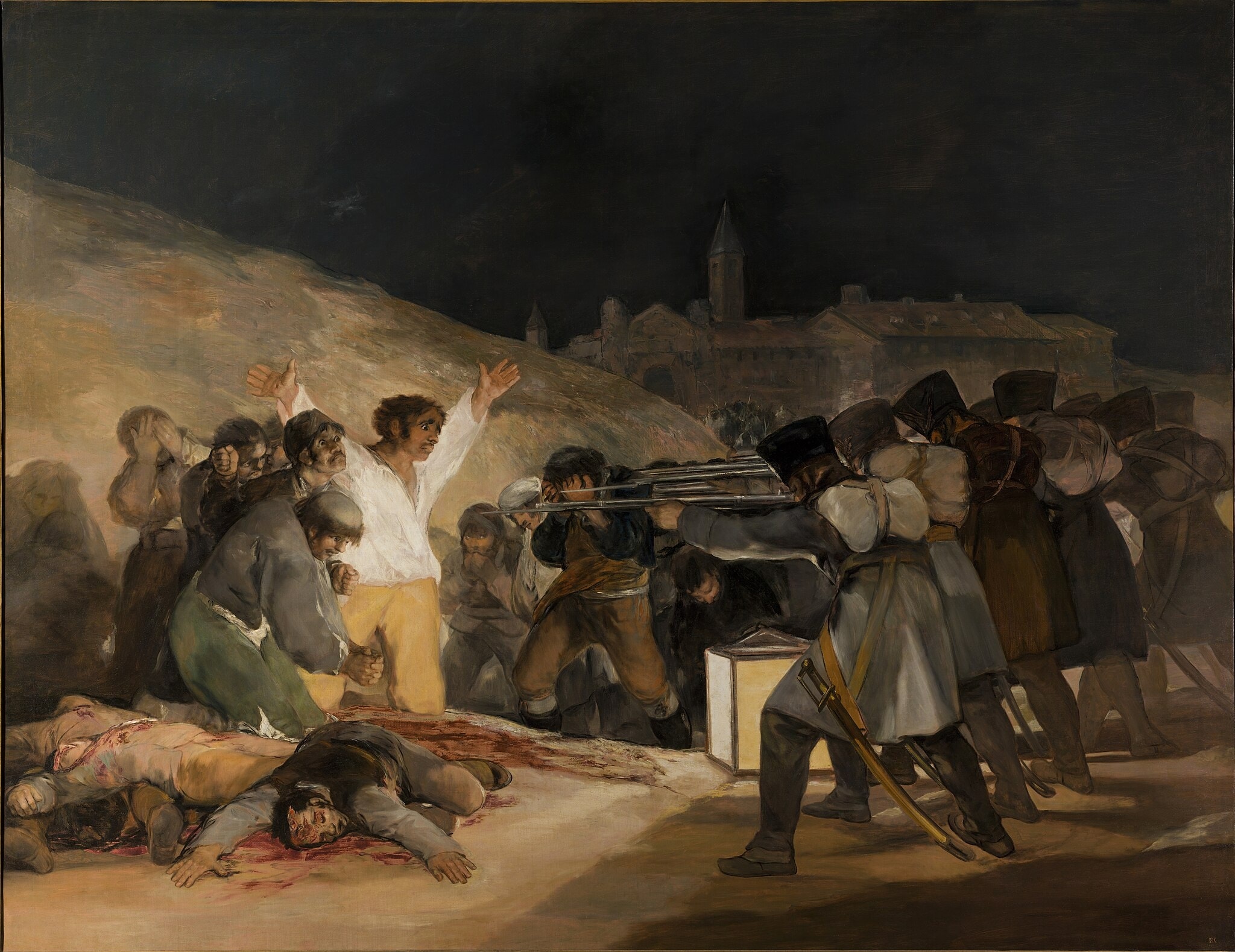
At the center of Goya’s The Third of May 1808, a white‑shirted man throws his arms wide, palms upturned, a red wound pricking his right hand. This deliberate “stigmata pose” recasts a condemned Madrileño as a modern Christ, using familiar sacred codes to indict mechanized, state violence.
Historical Context
Goya painted The Third of May 1808 in 1814, immediately after Spain expelled Napoleon’s troops and the Bourbon monarchy returned. The canvas commemorates the summary executions that followed the Madrid uprising of May 2, 1808, transforming a documented atrocity into an image with lasting civic force. Commissioned in the year of restoration, the work was conceived alongside its companion, The Second of May, as a diptych of resistance and reprisal. Within this charged postwar moment, Goya’s central figure—kneeling, arms flung open—adopts a pose drawn from Crucifixion imagery, allowing viewers to read the anonymous victim as a martyr for the Spanish people. The Prado underscores the painting’s public purpose and the white‑clad protagonist’s status as an “anonymous hero,” while Smarthistory points to the small blood mark on the right palm that seals the stigmata allusion. By importing this Christian code into contemporary history, Goya aligned national remembrance with a universally legible language of sacrifice and innocence 12.
Symbolic Meaning
The “stigmata pose” fuses Catholic iconography with modern reportage. The spread arms and exposed palms mirror the Crucifixion schema; the tiny crimson spot on the right hand operates as a clear sign of stigmata, binding the kneeling man to Christ’s wounds and declaring his innocence and sanctity. Smarthistory makes this linkage explicit, reading the hands as the crucial carriers of meaning, while the Prado’s accessible text affirms that the man’s gesture and posture imitate the crucified Christ 24.
Light intensifies the symbolism. Instead of a heavenly aureole, a workman’s lantern blasts harsh illumination across the man’s white shirt and upturned hands, a secular “halo” that relocates sanctity to the killing ground. Critics have called this a lay transfiguration, with The New Yorker describing a “lay‑Christliness, even the stigmata,” and noting how earthly light replaces divine radiance 5. The white garment, singled out by Prado scholars, proclaims purity and turns an individual into a collective emblem—the Spanish people enduring martyrdom under occupation 13. In short, the pose converts a specific execution into a modern Passion, a visual theology of resistance rendered instantly legible to a Catholic audience and still forceful today 23.
Artistic Technique
Goya engineers the pose’s impact through tenebrism and economy of focus. A single lantern throws Caravaggesque light that detonates against the high‑value white shirt and the splayed, upturned hands; the right palm faces viewer and rifles alike so the blood mark reads unmistakably 2. The soldiers form a hard diagonal wedge, their backs fused into a faceless machine, while the victim’s body opens into a cruciform triangle, its apex the illuminated hands 12. Brushwork is rapid, loaded, and raw—thick reds and ochres around the corpses, quick wet‑in‑wet passages on the shirt and skin—which conservation and close study at the Prado have clarified, revealing Goya’s direct, vigorous handling that heightens immediacy at the scene’s center 17.
Connection to the Whole
The hands are the painting’s ethical hinge. Their open, wounded display sanctifies the victim even as the rifles advance, converting the firing line’s bureaucracy into a confrontation with human dignity. The contrast between the rigid, anonymous squad and the expressive, cruciform figure organizes the entire composition and channels the viewer’s sympathy through the lit palms 23. Within the diptych of May 2 and May 3, this pose is the culminating image: resistance answered by martyrdom. It universalizes the event beyond Madrid and 1808, aligning civic memory with a powerful Christian code and articulating the work’s enduring antiwar charge 123.
Explore the Full Painting
This is just one fascinating element of The Third of May 1808. Discover the complete interpretation, symbolism, and hidden meanings throughout the entire work.
← View full analysis of The Third of May 1808Sources
- Museo del Prado – The 3rd of May 1808 in Madrid (collection record)
- Smarthistory – Goya, The Third of May 1808 (essay and video)
- Museo del Prado Encyclopedia – 3 de mayo de 1808 en Madrid (Manuela B. Mena Marqués)
- Museo del Prado – Easy-to-read: The Third of May 1808 or The Executions
- The New Yorker – "Goya" (review of scholarship; lay‑Christliness and stigmata)
- The Met – Heilbrunn Timeline: Goya and the Spanish Enlightenment
- Museo del Prado – Video: La pincelada de Goya en El 3 de mayo de 1808