How Much Is The Third of May 1808 Worth?
Last updated: February 6, 2026
Quick Facts
- Methodology
- comparable analysis
Hypothetical valuation: $500–700 million. This reflects the painting’s singular, canonical status in Western art, scarcity of true peers, and cross-category price benchmarks for museum-level masterpieces. While legally inalienable in Spain, a forced or indemnity context would likely price it at the high end of global art-market records.
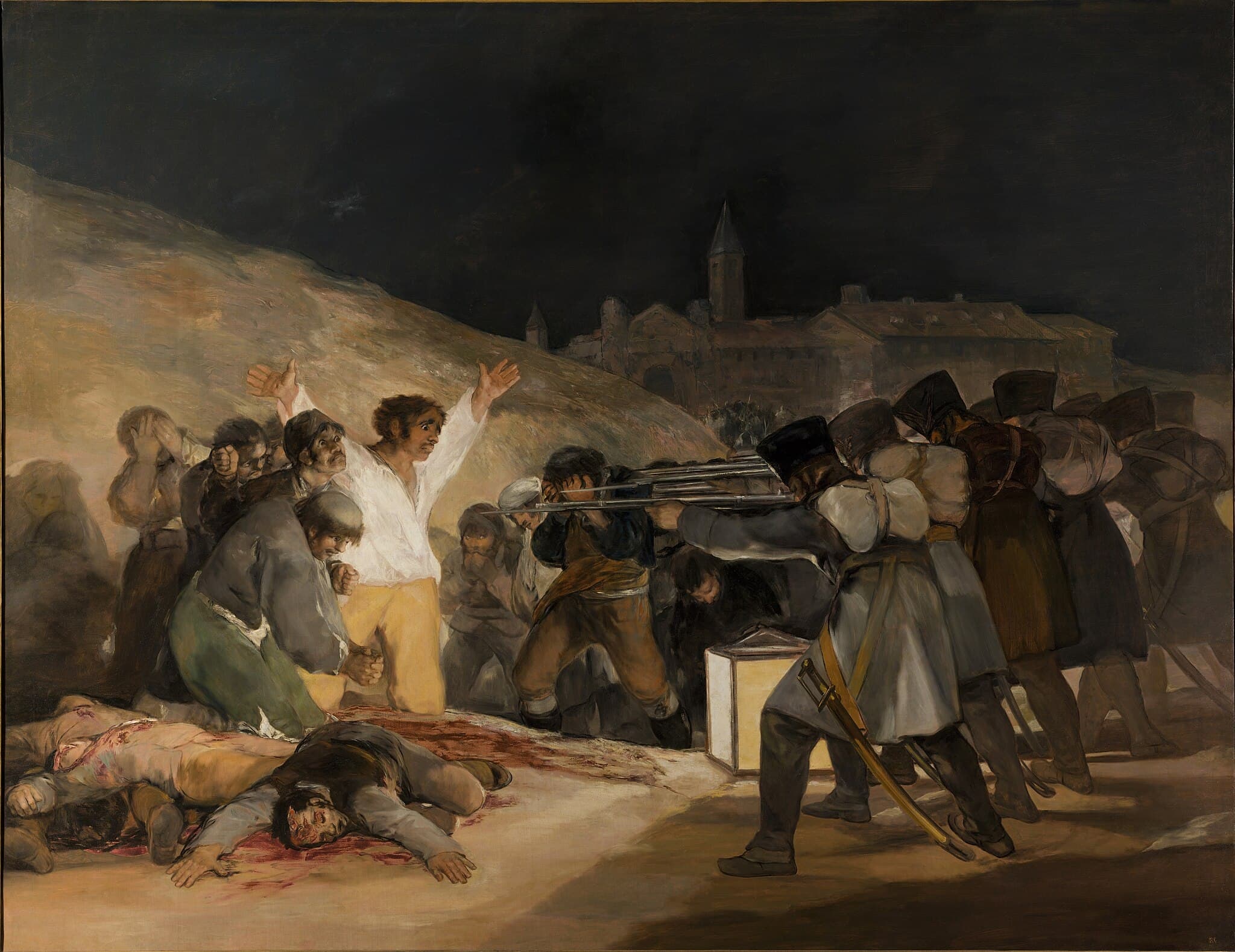
The Third of May 1808
Francisco Goya, 1814 • Oil on canvas
Read full analysis of The Third of May 1808 →Valuation Analysis
Conclusion: A prudent hypothetical valuation for Francisco Goya’s The Third of May 1808 is $500–700 million. This figure positions the work above most recent trophy results and in line with the very top of the global market for singular, museum-defining masterpieces. The painting is a cornerstone of the Prado and inalienable by Spanish law, so any figure is not a sale estimate but a defensible indemnity/insurance proxy or theoretical private-treaty valuation in an extraordinary, sovereign-level context [1][2][3].
Method and comps: We benchmark against the highest-profile transactions for canonical works. Leonardo da Vinci’s Salvator Mundi realized $450.3 million at auction (2017) and remains the modern ceiling for an Old Master at public sale [4]. The Dutch state’s €175 million (c.$198m) acquisition of Rembrandt’s The Standard Bearer (2022) demonstrates sovereign willingness to pay for national icons [8]. Recent apex prices for blue-chip masterpieces include Klimt’s Portrait of Elisabeth Lederer at $236.4 million (2025) and Botticelli’s Portrait of a Young Man Holding a Roundel at $92.2 million (2021) [7][6]. Given Goya’s Third of May surpasses most of these in cultural weight and uniqueness, a high-hundreds-of-millions valuation is justified.
Why this band: The Third of May 1808 is arguably Goya’s defining masterpiece and a foundational image of modern history painting and anti‑war art, taught and reproduced globally [1]. Its fame, singularity (no substitutes exist), and institutional demand create an exceptional scarcity premium. Although Goya’s public auction record for paintings is far lower ($16.42m for pendant portraits in 2023), such artist records are not the right anchor for nationally emblematic, era-defining pictures; cross-category trophy benchmarks are the relevant yardstick [5]. The $500–700 million range situates the work above most recent masterpieces and acknowledges the post‑2017 price climate while staying credible relative to the Leonardo benchmark [4].
Market context and risk: Old Masters saw a slower 2024 amid a shortage of trophies, then a mid‑market rebound in 2025; prime material still commands strong bidding when available [9]. The recent $17.9m Rembrandt drawing record (2026) underscores deep connoisseur demand for rarity and quality [10]. Key sensitivities for any notional value would be structural condition and risk profile; however, the painting is maintained in a top-tier museum setting and has not circulated widely, limiting transit risk [1].
Legal status: The Prado’s collections are public-domain property—inalienable and unseizable—under Real Decreto 433/2004, and Spanish export controls further restrict permanent export of protected cultural goods [2][3]. This eliminates true market price discovery but, paradoxically, reinforces the scarcity premium that supports a valuation within the top echelon of global art prices.
Key Valuation Factors
Art Historical Significance
High ImpactThe Third of May 1808 is widely recognized as Goya’s supreme masterpiece and a foundational image of modern history painting and anti‑war art. Its stark depiction of state violence and the martyr-like central figure shaped the visual language for later artists (e.g., Manet and Picasso) and remains an emblem in textbooks, exhibitions, and public consciousness. The painting’s pedagogical ubiquity and enduring cultural relevance confer a level of international recognition few works achieve. This centrality within both Goya’s oeuvre and Western art history drives demand from the most prestigious institutions and would, in any hypothetical scenario, command a valuation at the apex of the market [1].
Rarity and Scarcity
High ImpactThere is no true substitute for this painting in Goya’s corpus or in the canon of European art. Major Goya masterworks are overwhelmingly in public collections; works of comparable historical gravitas and scale virtually never come to market. This extreme scarcity amplifies competitive tension in a hypothetical setting—not only among the wealthiest private collectors but, more decisively, among sovereign and institutional buyers whose mandates include national icons. Scarcity premiums of this magnitude explain why cross‑category trophies such as Leonardo’s Salvator Mundi and Klimt’s portraits have redefined price ceilings, and they directly inform the upper‑hundreds‑of‑millions value range for The Third of May [4][7].
Legal and Export Constraints
High ImpactThe work resides in the Museo Nacional del Prado and is inalienable under Spanish law; permanent export of protected cultural goods is also effectively barred. This removes normal market liquidity and public price discovery, ensuring that any valuation is theoretical or for state indemnity/insurance purposes. However, the same legal protections intensify long‑term scarcity and heritage value, reinforcing the picture’s status as a national and international treasure. In a forced or extraordinary sovereign context, such constraints would likely result in premium pricing, as seen in government-backed acquisitions of national icons like Rembrandt’s The Standard Bearer [2][3][8].
Market Benchmarks and Demand
High ImpactCross‑category comparables demonstrate the bandwidth for singular masterpieces: Leonardo at $450.3m (2017) sets the modern auction apex, while sovereign purchases (Rembrandt’s The Standard Bearer at ~€175m) and blue‑chip results (Klimt $236.4m; Botticelli $92.2m) show depth across eras. Recent market data indicate resilient demand for top-tier rarity despite cyclical softness, with connoisseurship driving aggressive bidding for prime works—including new records for Old Master drawings. Collectively, these signals support a high‑hundreds‑of‑millions valuation for Goya’s defining history painting, with competition led by institutions and states rather than typical private buyers [4][8][7][6][9][10].
Sale History
The Third of May 1808 has never been sold at public auction.
Francisco Goya's Market
Francisco Goya is a blue‑chip Old Master with global institutional demand. His masterpiece‑level paintings are largely in museums, and supply to market is minimal. The artist’s auction record for paintings is $16.42 million (Christie’s New York, Jan 25, 2023, for a pair of portraits), while top drawings and exceptional print sets continue to perform strongly, with a standout drawing achieving $3.196 million in 2023. These public records, though, reflect the scarcity of major canvases rather than Goya’s cultural weight. Spanish heritage and export laws further constrain supply of significant works, channeling market activity toward drawings and prints while reinforcing the notional value of canonical paintings in public collections [5].
Comparable Sales
Salvator Mundi
Leonardo da Vinci (attributed)
A once-in-a-generation Old Master trophy that demonstrates the current ceiling for globally iconic, museum-level works entering public auction; used to bracket the upper bound for a singular historical masterpiece like Goya's.
$450.3M
2017, Christie's New York
~$567.4M adjusted
Portrait of Elisabeth Lederer
Gustav Klimt
Recent top-tier result for a canonical, museum-caliber painting. While later in period than Goya, it evidences the depth of demand for true cultural trophies and helps define today’s pricing bandwidth for singular icons.
$236.4M
2025, Sotheby's New York
Portrait of a Young Man Holding a Roundel
Sandro Botticelli
Peak Old Master portrait sale in the contemporary market era; demonstrates how a masterpiece by a canonical European artist can transcend typical Old Master price bands—relevant as a category benchmark for an era-defining Goya.
$92.2M
2021, Sotheby's New York
~$110.6M adjusted
The Massacre of the Innocents
Peter Paul Rubens
Large-scale Baroque tour-de-force depicting state violence against civilians; one of the closest subject-matter analogues with a public sale, showing what the market has paid for a canonical, violent history scene.
$76.2M
2002, Sotheby's London
~$134.1M adjusted
The Standard Bearer (De Vaandeldrager)
Rembrandt van Rijn
Sovereign-level purchase of a national icon by a foundational Old Master; signals what governments/institutions will pay for culturally defining paintings, a relevant proxy for Goya’s nationally emblematic status.
$198.0M
2022, Private treaty (Rijksmuseum acquisition, Dutch State)
~$213.8M adjusted
Portrait of Dr. Gachet
Vincent van Gogh
Legendary benchmark for a culturally iconic, museum-level picture; while later in period and a portrait, it demonstrates how singular masterpieces with profound emotional/historical resonance can command category-transcending prices.
$82.5M
1990, Christie's New York
~$199.7M adjusted
Current Market Trends
Old Masters experienced a muted 2024 due to a shortage of trophy consignments, followed by a mid‑market rebound in 2025 as quality material below the ultra‑trophy tier found strong demand. The top end remains highly selective but demonstrably deep when singular works appear, evidenced by sovereign acquisitions and record prices in adjacent sub‑categories (e.g., Old Master drawings). In this environment, a unique, museum‑defining picture like Goya’s Third of May would almost certainly command an exceptional premium, benchmarking to cross‑category icons rather than typical Old Master pricing bands [9][10].
Sources
- Museo Nacional del Prado – Object record for The Third of May 1808
- Estatuto del Museo Nacional del Prado (Real Decreto 433/2004), Art. 13.4
- Spain’s cultural export controls – Ministry of Culture
- Christie’s – Leonardo da Vinci’s Salvator Mundi sells for $450.3m (2017)
- The Art Newspaper – Goya painting record at Christie’s (Jan 2023)
- Sotheby’s – Botticelli Portrait of a Young Man Holding a Roundel achieves $92.2m (2021)
- Washington Post – Klimt portrait sells for $236.4m (Nov 2025)
- Government of the Netherlands – Acquisition of Rembrandt’s The Standard Bearer (Jan 2022)
- Observer – Old Masters market overview and rebound in 2025
- Wall Street Journal – Rembrandt drawing record (Feb 2026)