The Cameo Brooch in American Gothic
A closer look at this element in Grant Wood's 1930 masterpiece
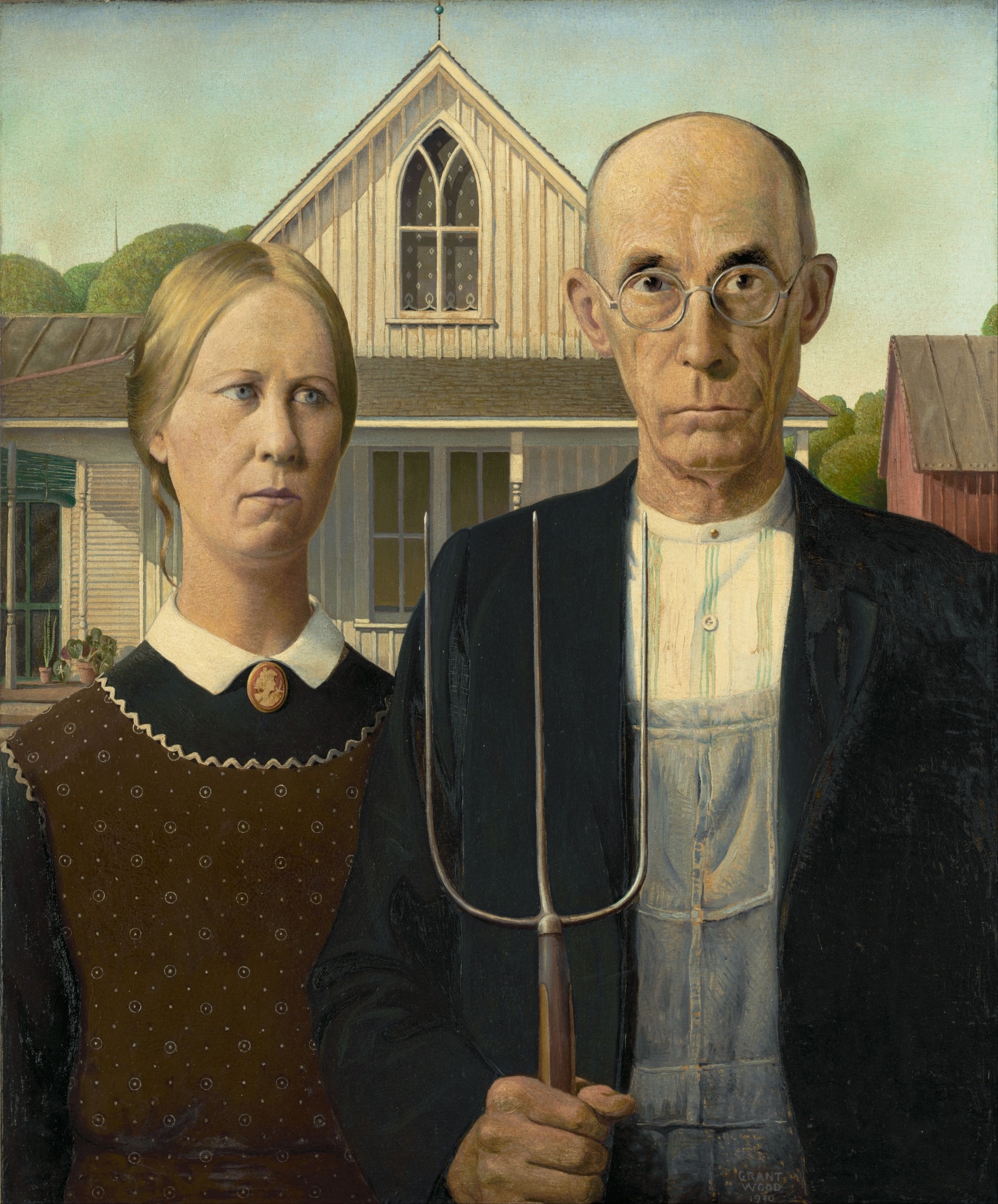
Pinned at the woman’s throat in American Gothic, the small oval cameo brooch is both a family heirloom and a narrative key. Identified by the Figge Art Museum as a Persephone cameo worn by Wood’s sister for the sitting, the jewel anchors the painting’s blend of Midwestern reality, classical memory, and immaculate design.
Historical Context
Grant Wood painted American Gothic in 1930, outfitting his models—his sister Nan and his dentist—with real objects to authenticate a deliberately old-fashioned Midwestern world. The woman’s high collar fastens with a classical-style cameo that the Art Institute of Chicago explicitly notes on its tour of the painting 3. The Figge Art Museum identifies the specific piece as a Persephone cameo worn by Nan for the portrait, linking the jewel directly to Wood’s circle 1.
Curator Barbara Haskell has stated that the brooch belonged to Wood’s mother, confirming the prop’s status as a familial heirloom rather than a studio trinket 2. Cameo brooches of carved female profiles were ubiquitous in the 19th century and still cherished in the early 20th; period examples in Chicago and at the Met mirror the scale and look of Wood’s reference, underscoring his period signaling 78. The American Gothic House Center groups the cameo with other charged details—rickrack trim, collar stud—showing how Wood assembled recognizable tokens of domestic respectability to build the painting’s historical atmosphere 9.
Symbolic Meaning
The cameo’s subject—Persephone—opens a mythic register within an ostensibly documentary scene. As Demeter’s daughter, Persephone invokes agriculture’s seasonal cycle, a theme that resonates with the painting’s farm setting and its ethic of endurance 1. Writers have amplified this reading: Kelly Grovier casts the painting as a Pluto–Proserpina allegory keyed to the brooch, while Christie’s likewise reads Persephone on the jewel’s face, binding the woman to motifs of return and restraint 56.
Biographically, the brooch’s maternal provenance transforms it into a filial token. Haskell’s note that it was Wood’s mother’s brooch inflects the figures with parental presence, supporting interpretations of American Gothic as a sublimated portrait of Wood’s parents—a stern father beside a dutiful mother—compressed into archetype 2.
Even apart from its myth, a cameo at the throat codes Victorian propriety and taste. Smarthistory highlights Wood’s tension between nostalgia and modernity; the cameo becomes a sign of adherence to inherited values within a newly precise, modern pictorial language 4. The American Gothic House Center’s focus on such small adornments confirms the brooch as a calibrated signal of modesty and tradition embedded in the painting’s narrative fabric 9.
Artistic Technique
Wood renders the brooch with his hallmark, Northern Renaissance–influenced precision: hard edges, enamel-smooth paint, and a tiny, clean highlight that reads as carved relief against the starched collar and dark dress 4. The oval cameo sits at a compositional hinge—the throat—where crisp geometry concentrates. Its rounded form counters the painting’s insistent verticals and points: pitchfork tines, collar tips, and the Carpenter Gothic window behind the sitters 43. The jewel’s pale tones are carefully tuned to the collar’s white, separating cameo from fabric just enough to register as an object while preserving the painting’s seamless surface and serene stillness.
Connection to the Whole
The cameo knits narrative, symbolism, and design. If read as Persephone, it aligns the woman with the land’s cycles and with quiet captivity—ideas that sharpen the painting’s interpersonal dynamic: her sidelong gaze and contained posture beside his frontal grip on the pitchfork 5. As a maternal heirloom, it roots the archetypes in Wood’s own family, deepening the work’s blend of affection and austerity 2.
Formally, the brooch is a measured counterpoint to the work’s linear severity, softening the geometry without breaking it. Grouped with other minute cues—the rickrack edging, collar stud—it exemplifies Wood’s method of building psychological charge from meticulously rendered specifics within a rigorously ordered composition 94.
Explore the Full Painting
This is just one fascinating element of American Gothic. Discover the complete interpretation, symbolism, and hidden meanings throughout the entire work.
← View full analysis of American GothicSources
- Figge Art Museum — Grant Wood Artifacts on Display at the Figge (identifies the Persephone cameo)
- CBS Sunday Morning — Interview with Whitney curator Barbara Haskell (brooch belonged to Wood’s mother)
- Art Institute of Chicago — Essentials Tour video page (notes the woman wearing a cameo)
- Smarthistory — Grant Wood, American Gothic (style, precision, interpretive frame)
- Wired (Kelly Grovier) — Pluto–Proserpina reading keyed to the brooch
- Christie’s — American Gothic: Grant Wood’s Midwestern mystery (Persephone identified on the brooch)
- Art Institute of Chicago — Cameo Pendant/Brooch (19th-century exemplar)
- The Metropolitan Museum of Art — Cameo brooch (Victorian context)
- American Gothic House Center — Object-level details (cameo, curl, stud)