American Gothic
by Grant Wood
Study Print Studio
Create a personal study print
Build a companion study sheet around the part of this painting that speaks to you most. Choose a detail, shape an interpretation, and walk away with something personal and display-worthy.
Fast Facts
- Year
- 1930
- Medium
- Oil on beaverboard
- Dimensions
- 78 × 65.3 cm (30 3/4 × 25 3/4 in.)
- Location
- Art Institute of Chicago
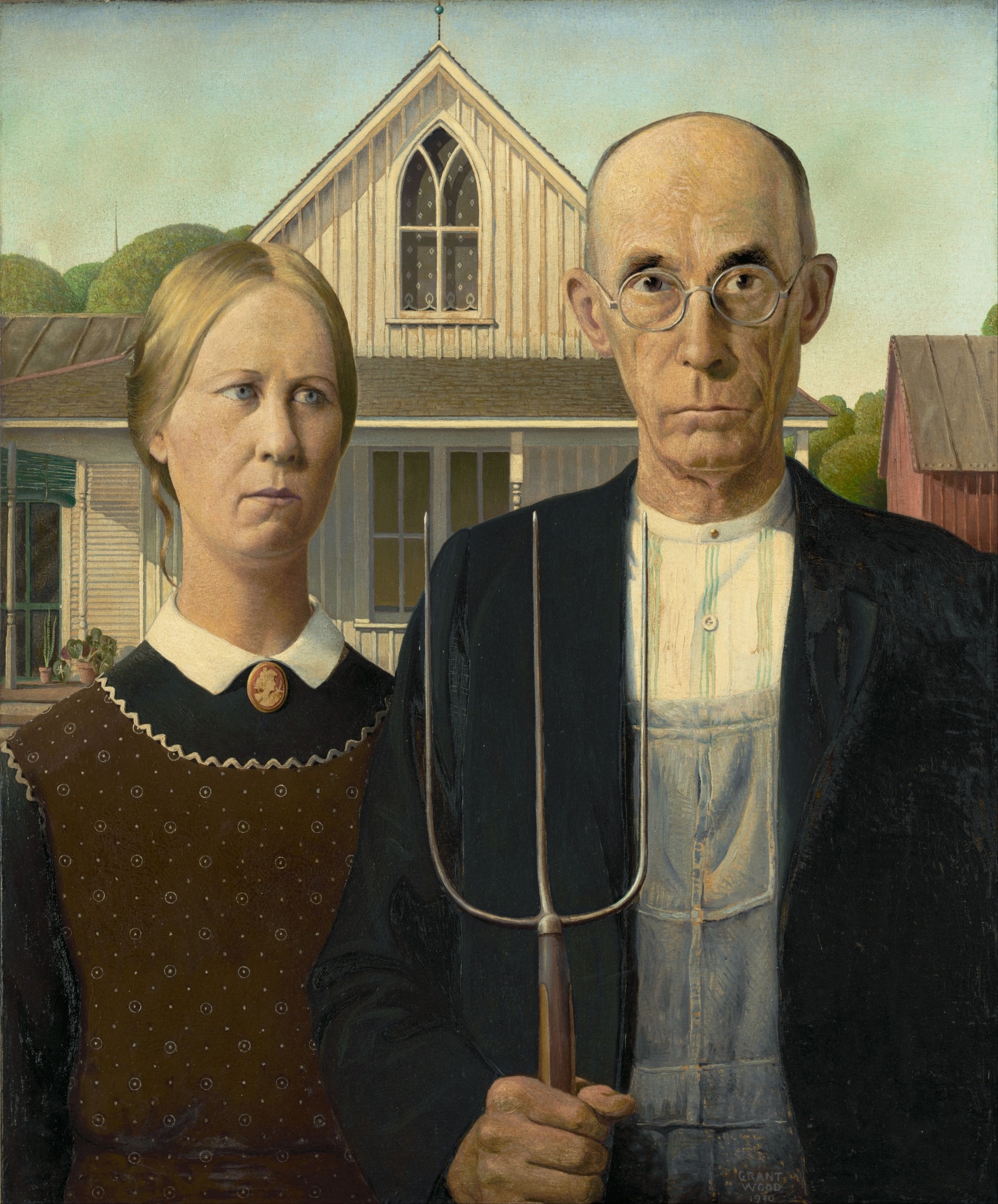
Click on any numbered symbol to learn more about its meaning
Meaning & Symbolism
Explore Deeper with AI
Ask questions about American Gothic
Popular questions:
Powered by AI • Get instant insights about this artwork
Interpretations
Formal Genealogy: From Flemish Precision to New Objectivity
Source: Encyclopaedia Britannica; National Gallery of Art
Reception History: A Cultural Barometer
Source: Steven Biel, American Gothic: A Life of America’s Most Famous Painting
Gendered Optics and Domestic Discipline
Source: Art Institute of Chicago; Smarthistory; Smithsonian Magazine
Medium Matters: Beaverboard, Economy, and Effect
Source: Art Institute of Chicago
Regionalism’s Paradox: Local Matter, Modern Form
Source: Smarthistory; Encyclopaedia Britannica; National Gallery of Art
Identity Under Constraint: Persona and Repression
Source: Whitney Museum of American Art (2018 retrospective, Barbara Haskell)
Explore Specific Elements
Dive deeper into individual scenes and details within American Gothic.
The Pitchfork
The pitchfork in Grant Wood’s American Gothic is more than a farm tool: it is the painting’s compositional spine and its moral emblem. Gripped like a badge of office, the three-tined implement declares labor, order, and a guarded self-possession—all at the center of how the work shaped, and was read by, 1930s America.
The Gothic Window
The pointed-arch attic window is the spark that lit American Gothic: Grant Wood chose the Eldon, Iowa cottage for this Gothic detail and built his entire conceit—the people, the title, the mood—around it. A church-born form grafted onto a humble farmhouse, the window anchors the painting’s geometry while charging it with mingled piety and irony.
The Cameo Brooch
Pinned at the woman’s throat in American Gothic, the small oval cameo brooch is both a family heirloom and a narrative key. Identified by the Figge Art Museum as a Persephone cameo worn by Wood’s sister for the sitting, the jewel anchors the painting’s blend of Midwestern reality, classical memory, and immaculate design.