The Gothic Window in American Gothic
A closer look at this element in Grant Wood's 1930 masterpiece
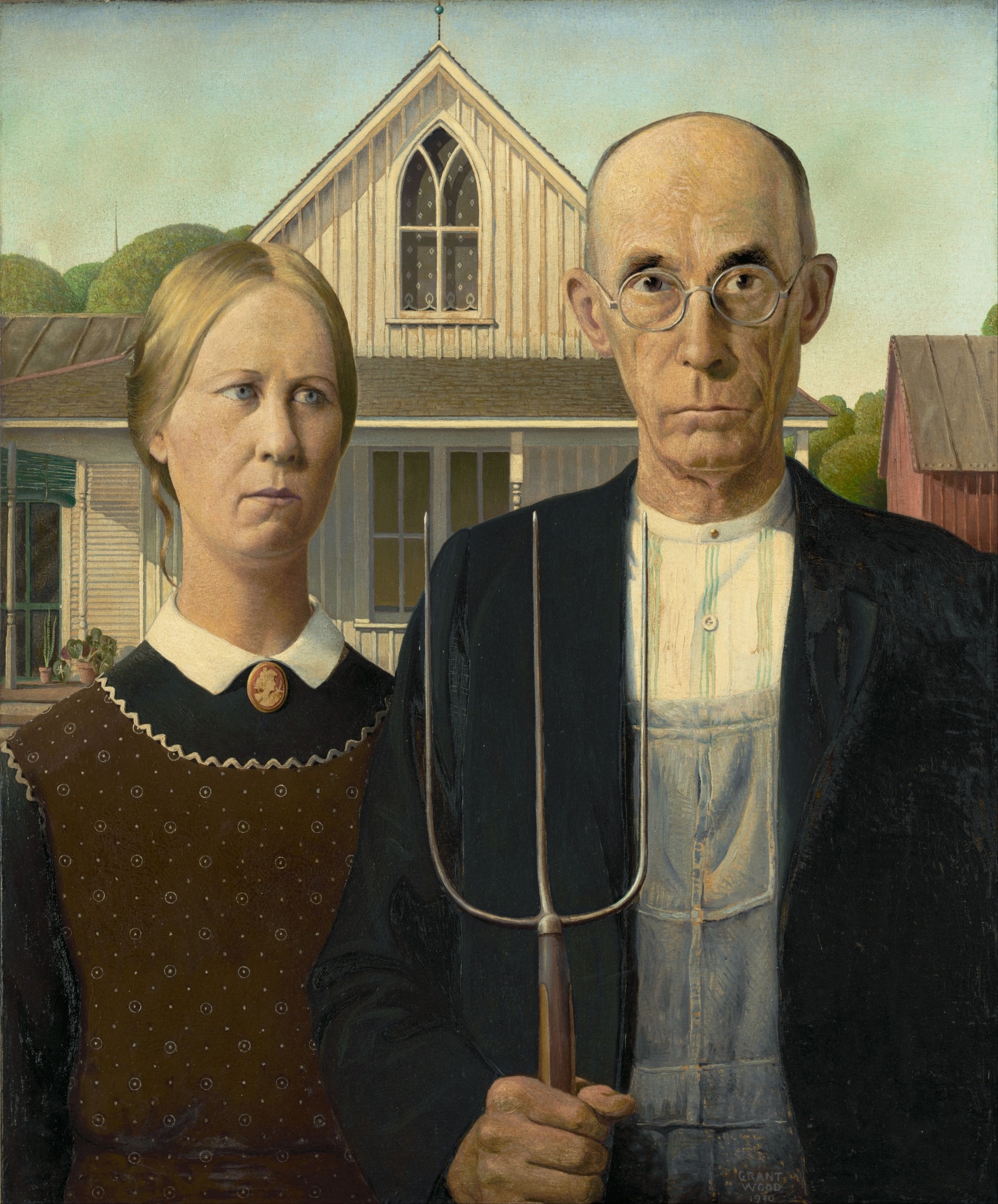
The pointed-arch attic window is the spark that lit American Gothic: Grant Wood chose the Eldon, Iowa cottage for this Gothic detail and built his entire conceit—the people, the title, the mood—around it. A church-born form grafted onto a humble farmhouse, the window anchors the painting’s geometry while charging it with mingled piety and irony.
Historical Context
In August 1930, Grant Wood passed through Eldon, Iowa, noticed a modest wood-frame cottage with a pointed-arch attic window, sketched it on the spot, and then invented the severe pair he “fancied should live in that house.” He titled the finished canvas American Gothic, explicitly keying the work to the Carpenter Gothic motif he had seized upon in the gable window 1. The Art Institute of Chicago—home to the painting—recounts this genesis and Wood’s own phrase “American Gothic people,” underscoring how the window generated both subject and title 1.
Britannica places the house and its “churchlike upper window” at the center of the painting’s conception, explaining how a 19th‑century, rural American translation of medieval Gothic—thin boards standing in for stone—became the immediate visual and titular anchor of the scene 2. In short, the window is not a background extra but the period cue that allowed Wood to fuse a contemporary Midwestern setting with a historical style ripe for commentary 12.
Symbolic Meaning
The Gothic lancet—born of ecclesiastical architecture—imports a church inflection into a private farmhouse. Critics have long read that pointed arch as a sign of moral gravity, restraint, and surveillance in the domestic sphere; its presence feels simultaneously devout and out of place. Jonathan Jones highlights how, shorn of context, the “pointed medieval-style window” could pass for a chapel aperture, an incongruity that charges the house with secrecy and ambiguity 6.
Because Carpenter Gothic often applied medieval motifs superficially to American homes, the window can also register as aspiration edged with irony: a small dwelling borrowing cathedral style. Wood himself, according to early accounts, saw such grafting as “borrowed pretentiousness,” and the title American Gothic turns that architectural joke into a national emblem 4. Britannica situates the window within the painting’s web of stern verticals—gable, siding, pitchfork—which many read as a distilled Protestant ethos, while others see a sly commentary on that very austerity 23. The Whitney’s framing of Wood as moving between reassurance and anxiety clarifies why this compact motif bears double weight: it suggests piety and order even as it unsettles, embodying the painting’s poised tension between reverence and critique 5.
Artistic Technique
After close study of Northern Renaissance painting, Wood adopted a cool, polished precision that governs the window’s rendering: crisp muntins, taut contours, and enamel-smooth paint surfaces that suppress visible brushwork 7. He positions the lancet at the gable’s apex, exactly between the figures’ heads, so its sharp point intensifies the strict vertical cadence established by the siding and the farmer’s pitchfork 2.
Process records show he made a dedicated oil study of the façade and Gothic window, then heightened the ogival profile and roof pitch in the painting to sharpen the motif’s medieval bite 8. The result is not a reportage of a quaint detail but a deliberately clarified sign—precise, planar, and disciplined—through which the entire composition takes its measure.
Connection to the Whole
The Gothic window is the painting’s fulcrum—naming the work, fixing the setting, and cueing the kind of people we face. Wood’s origin story begins with that detail, and the final composition keeps it poised over the pair like a keystone, binding architecture to character 1.
Visually, the lancet crowns the grid of verticals that organizes the picture: it rhymes with the pitchfork tines and shirt stripes, clarifies the gable’s symmetry, and enforces the painting’s frontal, immovable calm 2. Wood’s separate study of the façade underlines the element’s structural role in his process; once intensified on the canvas, the window becomes a compact mediator between old-world form and new-world life, the hinge on which the painting’s gravity and irony turn 8.
Explore the Full Painting
This is just one fascinating element of American Gothic. Discover the complete interpretation, symbolism, and hidden meanings throughout the entire work.
← View full analysis of American GothicSources
- Art Institute of Chicago — “American Gothic: The Top Five FAQs”
- Encyclopaedia Britannica — “American Gothic” (overview; churchlike upper window)
- Encyclopaedia Britannica — “Carpenter Gothic”
- Smithsonian Magazine — Jane Smiley, “In Search of the Real Grant Wood”
- Whitney Museum of American Art — Grant Wood: American Gothic and Other Fables
- The Guardian — Jonathan Jones, “American Gothic, Grant Wood (1930)”
- Art Institute of Chicago — Grant Wood artist page (Northern Renaissance influence; tight handling)
- Smithsonian American Art Museum — Sketch for House in American Gothic (object record)