The Pitchfork in American Gothic
A closer look at this element in Grant Wood's 1930 masterpiece
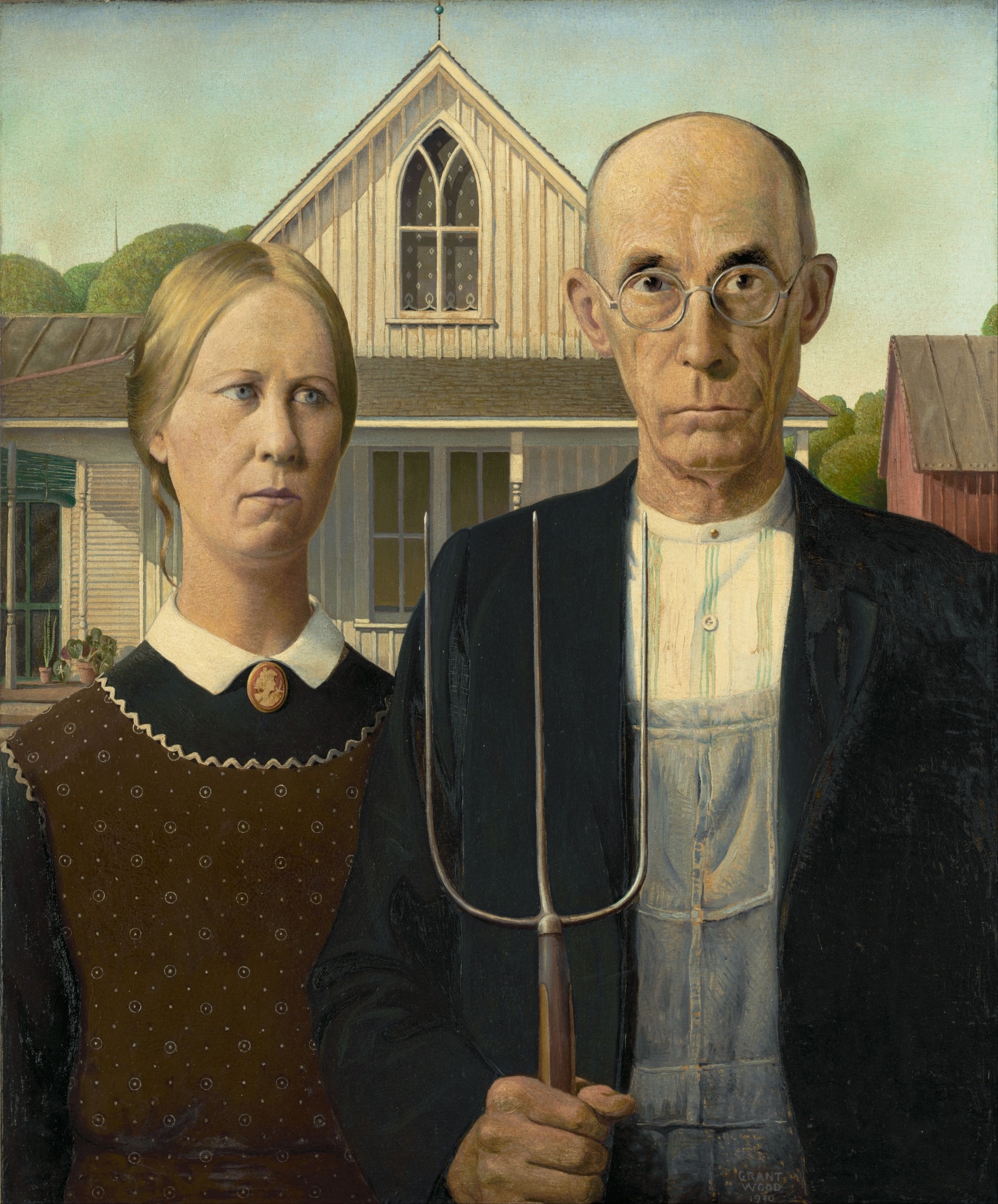
The pitchfork in Grant Wood’s American Gothic is more than a farm tool: it is the painting’s compositional spine and its moral emblem. Gripped like a badge of office, the three-tined implement declares labor, order, and a guarded self-possession—all at the center of how the work shaped, and was read by, 1930s America.
Historical Context
Painted in 1930, at the dawn of the Great Depression, American Gothic offered viewers a steadying image grounded in rural American values. Wood places a farm implement squarely in the sitter’s grasp to anchor the figures within that agrarian world and to project dignity and constancy at a moment of economic anxiety. The Art Institute of Chicago’s curatorial interpretation underscores this affirmative framing, noting how the painting constructs a concise portrait of farm life and responsibility 1.
Wood’s practice aligned with Regionalism (also called American Scene painting), a movement that championed recognizable, local subjects over European avant‑garde abstraction. In that context, a pitchfork serves as a legible sign—instantly communicating the farmer’s role and the ethos of work without recourse to allegory. Educational reference sources further emphasize how the tool signals masculine agricultural labor, making it a natural, era-appropriate attribute for Wood’s archetypal Midwestern figure 2.
Symbolic Meaning
The pitchfork functions first as an emblem of labor and masculine responsibility: it names the sitter as a working agrarian whose authority derives from toil and stewardship of the land 2. Its three tines have also been read as a Trinitarian allusion—folding Protestant ethics into the image of work and discipline, an interpretive thread acknowledged in reference scholarship 5.
Cultural readings from the 1930s to today amplify a second register: defense. Held upright between viewer and household, the pitchfork doubles as a boundary marker, signaling a firm, even wary posture toward outside incursions or modernity’s disruptions 8. At the same time, the tool operates as synecdoche—standing for the entire agrarian system in which the figures, home, and community are embedded 1. The painting’s renowned ambiguity—satire or sincere homage—flows through this object: it can read as humble instrument or as warning. Curatorial writing highlights how its crisp verticals, echoed throughout clothing and architecture, encode a sense of order and rectitude that supports both interpretations, making the pitchfork the work’s most densely charged sign 4.
Artistic Technique
Wood renders the pitchfork with hard-edged precision—contours clean, planes taut, surfaces enamel-smooth—reflecting his dialogue with Northern Renaissance clarity and his mature, meticulously controlled style 3. Compositionally, the implement is a central vertical accent. Its prongs are echoed in the seams of the overalls, the stripes of the shirt, and the lancet window and rooflines behind, welding figure and architecture into a disciplined grid of rhymes 4.
Placed frontally against the torso with minimal foreshortening, the tool reads instantly, its silhouette crisp against pale fabric. In oil on beaverboard, Wood exploits the support’s fine tooth to achieve knife-sharp edges and a high level of finish, maximizing the pitchfork’s legibility and emblematic force within the modest scale of the painting 1.
Connection to the Whole
The pitchfork is the painting’s visual glue. By repeating its three verticals across clothing and the Carpenter Gothic facade, Wood forges a tight lattice that makes the image feel ordered, severe, and iconic at a glance—a rigor noticed by curators and critics alike 47. It anchors the male figure as archetype while stitching him formally to the house and townscape 1.
As a boundary held at the picture plane, the tool also sets the work’s tone: guarded steadiness rather than convivial welcome, a stance that sustains the painting’s tension between satire and homage 8. Read through the lens of Regionalism, the pitchfork projects self-reliance and civic duty—qualities 1930s audiences prized and that helped American Gothic become a shorthand for Midwestern resolve 2.
Explore the Full Painting
This is just one fascinating element of American Gothic. Discover the complete interpretation, symbolism, and hidden meanings throughout the entire work.
← View full analysis of American GothicSources
- Art Institute of Chicago, collection entry — American Gothic
- EBSCO Research Starters — American Gothic (painting)
- Smarthistory — Grant Wood, American Gothic
- Art Institute of Chicago — American Gothic: The Top Five FAQs
- Britannica — American Gothic (painting by Wood)
- Washington Post — Paul Richard, 'American Gothic,' Pitchfork Perfect
- Smarthistory — Social structures in the U.S. (discussion of American Gothic)