How Much Is Forest Floor Worth?
Last updated: April 3, 2026
Quick Facts
- Insurance Value
- $6.6M (Indicative replacement value (appraisal estimate))
- Methodology
- comparable analysis
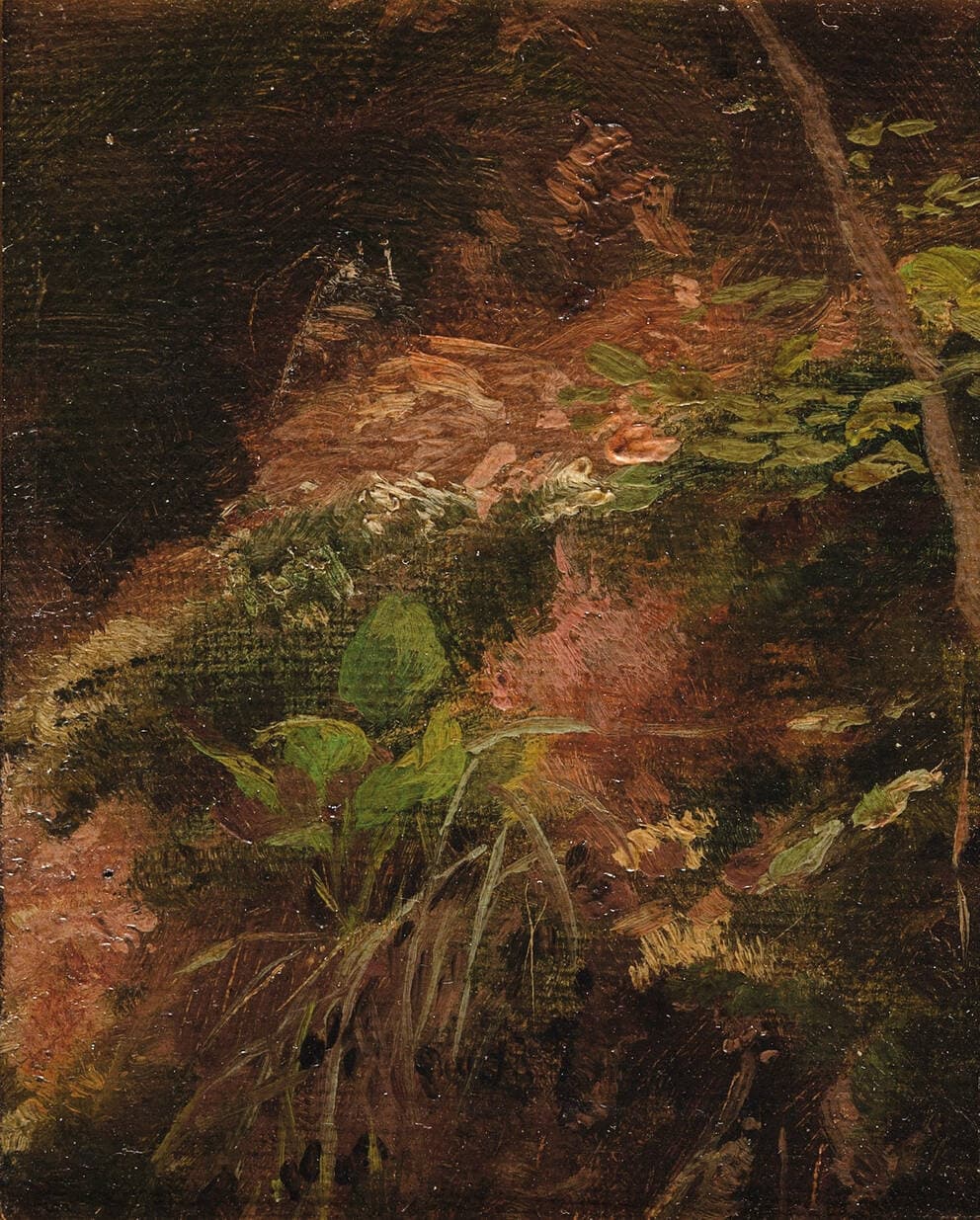
Forest Floor (Waldboden), 1881/82, is a tiny oil sketch by Gustav Klimt (10 × 8 cm), owned by the Klimt-Foundation and on permanent loan to the Leopold Museum. Based on same-artist benchmarks and substantial discounts for period, scale, and finish, we estimate fair market value at $3.5–6 million under normal conditions.
Valuation Analysis
Conclusion: Forest Floor (Waldboden), 1881/82, oil on canvas, 10 × 8 cm, Klimt-Foundation (permanent loan to the Leopold Museum), is a genuine but very small and early study by Gustav Klimt. Using same-artist landscape and portrait results to anchor demand, and applying significant discounts for the work’s pre-Secession date, miniature scale, and sketch-like character, we estimate fair market value at $3.5–6 million [1].
Comparable framework: The top end of Klimt’s market has reset decisively. A late portrait achieved about $108.4 million in 2023, while the 2025 Sotheby’s sale established a new record north of $236 million and delivered exceptional landscape prices (circa $86 million and $70.8 million) [2][4]. In 2022, the prime-period Birch Forest realized $104.6 million, confirming deep global appetite for mature, finished Klimt landscapes [3]. These works form the ceiling for demand and demonstrate the scarcity premium for Klimt oils.
Adjustments for this specific work: Forest Floor is an academic-era oil sketch from 1881/82, executed nearly two decades before Klimt’s mature iconography. Its minute size (10 × 8 cm) and study-like execution place it far from the Golden Phase portraits and large-format Attersee or forest scenes that command peak prices. The Leopold Museum describes the piece in terms consistent with an oil study rather than a fully resolved exhibition canvas, positioning it as a minor but authentic early work within the oeuvre [1].
Provenance and liquidity context: The credit line indicates ownership by the Klimt-Foundation with permanent loan to the Leopold Museum, Vienna. Institutional custody plus potential Austrian export considerations typically narrow the immediate buyer pool and support a conservative stance on liquidity and achievable pricing. The segment’s heightened sensitivity to provenance clarity (illustrated by the widely reported 2024 Vienna sale that later unraveled in 2025) further argues for caution in underwriting an early, off-period work, even with strong institutional provenance [1][5].
Method and positioning: We anchored the estimate to recent same-artist masterpieces, then applied substantial, explicit discounts for period (pre-1890), scale (tiny), and finish (study versus exhibition picture). That yields a value band in the low single-digit millions, with upside capped by the work’s format and artistic significance relative to Klimt’s canonical production. The range would tighten with a current condition report, fuller literature and exhibition history, and confirmation of export eligibility. For insurance, a modest uplift above market is typical; absent object-level condition data, market value remains the best proxy.
Key Valuation Factors
Art Historical Significance
High ImpactWithin Klimt’s oeuvre, the most valuable works are late portraits and prime-period landscapes that crystallize the artist’s Secessionist and Golden Phase vocabulary. Forest Floor predates this period and functions as a small oil study rather than a fully realized exhibition painting. Its significance is therefore primarily documentary: it illuminates Klimt’s early training and sensibility but does not embody the mature stylistic innovations that drive record prices. This status meaningfully constrains value, despite the powerful brand of Klimt’s name and the scarcity of his oils. In market terms, the historical importance of this work is real but limited, and the discount versus mature-period icons is substantial.
Scale, Medium, and Finish
High ImpactAt just 10 × 8 cm, Forest Floor is exceptionally small. Scale is a critical value driver in Klimt’s market: large, square-format landscapes and commanding portraits achieve the strongest prices, while tiny studies trade at a steep size and finish discount. Although this work is an oil on canvas—a positive relative to works on paper—the sketch-like, concise execution and diminutive format sharply reduce wall power, exhibition potential, and broad collector appeal. These characteristics justify a major downward adjustment from the headline benchmarks for mature, fully resolved Klimt paintings, positioning the work firmly in a lower valuation tier within the artist’s oil corpus.
Provenance, Custody, and Legal/Export Context
Medium ImpactThe painting is credited to the Klimt-Foundation and on permanent loan to the Leopold Museum, which signals strong institutional provenance and care—both positive for authenticity and confidence. However, institutional custody typically implies limited availability and potential export or deaccession hurdles if a sale were pursued. For Austrian-held Klimts, export licensing and heightened provenance diligence can narrow the buyer pool and add transactional friction, which can compress achievable pricing at the margin. These considerations do not impugn value but temper liquidity assumptions, reinforcing the rationale for a conservative, market-based band when compared with privately held, export-cleared masterpieces.
Market Benchmarks and Demand for Klimt
High ImpactRecent auction records demonstrate extraordinary depth for Klimt’s prime works, with a new all-time artist record set in 2025 and multiple landscapes achieving $50–100 million in 2022–2025. These results confirm robust, global demand and a scarcity premium for oils. Yet the same data also delineate the tiers within Klimt’s market: off-period, small-scale, or study-like works transact at a fraction of masterpiece levels. Forest Floor sits squarely in that latter tier. Our estimate leverages those same-artist benchmarks to calibrate a realistic position for this painting, ensuring the valuation reflects both the strength of the Klimt brand and the constraints inherent to this object’s period and format.
Sale History
Forest Floor has never been sold at public auction.
Gustav Klimt's Market
Gustav Klimt is a blue-chip, globally sought-after Modern master. His market has strengthened notably in recent seasons, capped by a 2025 Sotheby’s record above $236 million for a late portrait, alongside exceptional landscape prices at roughly $86 million and $70.8 million. In 2023, Lady with a Fan achieved about $108.4 million in London, and in 2022 Birch Forest realized $104.6 million in New York, affirming intense demand for mature-period oils. The buyer base is international, with strong participation from the U.S., Europe, and Asia. Pricing is highly stratified by period, subject, scale, and finish, with masterpieces commanding step-change premiums relative to early or study-format works.
Comparable Sales
Birch Forest (Buchenwald/Birch Forest)
Gustav Klimt
Same artist; close subject affinity (forest floor/understory and tree trunks); a prime, finished landscape benchmark used to anchor the category even though size/date/finish are far above the subject work.
$104.6M
2022, Christie's New York
~$115.0M adjusted
Blumenwiese (Flowering Meadow)
Gustav Klimt
Same artist; nature/ground-plane motif akin to a close-up of vegetation; a prime Golden-Phase landscape establishing an upper benchmark for Klimt’s landscape demand.
$86.0M
2025, Sotheby's New York
Waldabhang bei Unterach am Attersee (Forest Slope in Unterach on the Attersee)
Gustav Klimt
Same artist; directly forest-themed landscape; relevant as a subject benchmark despite being much larger, later, and more fully resolved than the tiny 1881/82 oil sketch.
$70.8M
2025, Sotheby's New York
Insel im Attersee (Island in the Attersee)
Gustav Klimt
Same artist; major mature-period landscape benchmark indicating depth of demand for Klimt oils; used to calibrate a substantial discount for Forest Floor’s very early date and minute scale.
$53.2M
2023, Sotheby's New York
~$57.5M adjusted
Lady with a Fan (Dame mit Fächer)
Gustav Klimt
Same artist; not a landscape, but a marquee recent auction benchmark demonstrating the strength of Klimt’s market in 2023–25; included to frame the top-end premium over minor early works.
$108.4M
2023, Sotheby's London
~$117.1M adjusted
Current Market Trends
The high end of the Modern and Impressionist segment rebounded strongly through 2025, with trophy consignments and single-owner sales catalyzing deep bidding for canonical names. Klimt directly benefited from this momentum, resetting his auction record and validating a new tier for prime landscapes. Even so, the market remains discriminating: works outside an artist’s peak period, or those with small scale and study-like execution, trade at pronounced discounts. Heightened diligence on provenance and export eligibility, particularly for Austria 1900 material, continues to shape liquidity and deal risk. Against this backdrop, Forest Floor’s valuation positions it as a credible, lower-tier Klimt oil within a robust overall market.
Sources
- Leopold Museum Online Collection: Forest Floor (Waldboden), 1881/82
- Sotheby’s: The New York Sales, Nov 2025 results (record Klimt portrait; strong landscapes)
- The Art Newspaper: Paul Allen sale results (Klimt Birch Forest at $104.6m)
- Forbes: Lady with a Fan sets European auction record (2023)
- AP News: 2024 Vienna Klimt sale later reported as canceled (context on diligence)