How Much Is Litzlbergkeller Worth?
Last updated: April 3, 2026
Quick Facts
- Last Sale
- $14.7M (1997, Sotheby's New York)
- Methodology
- comparable analysis
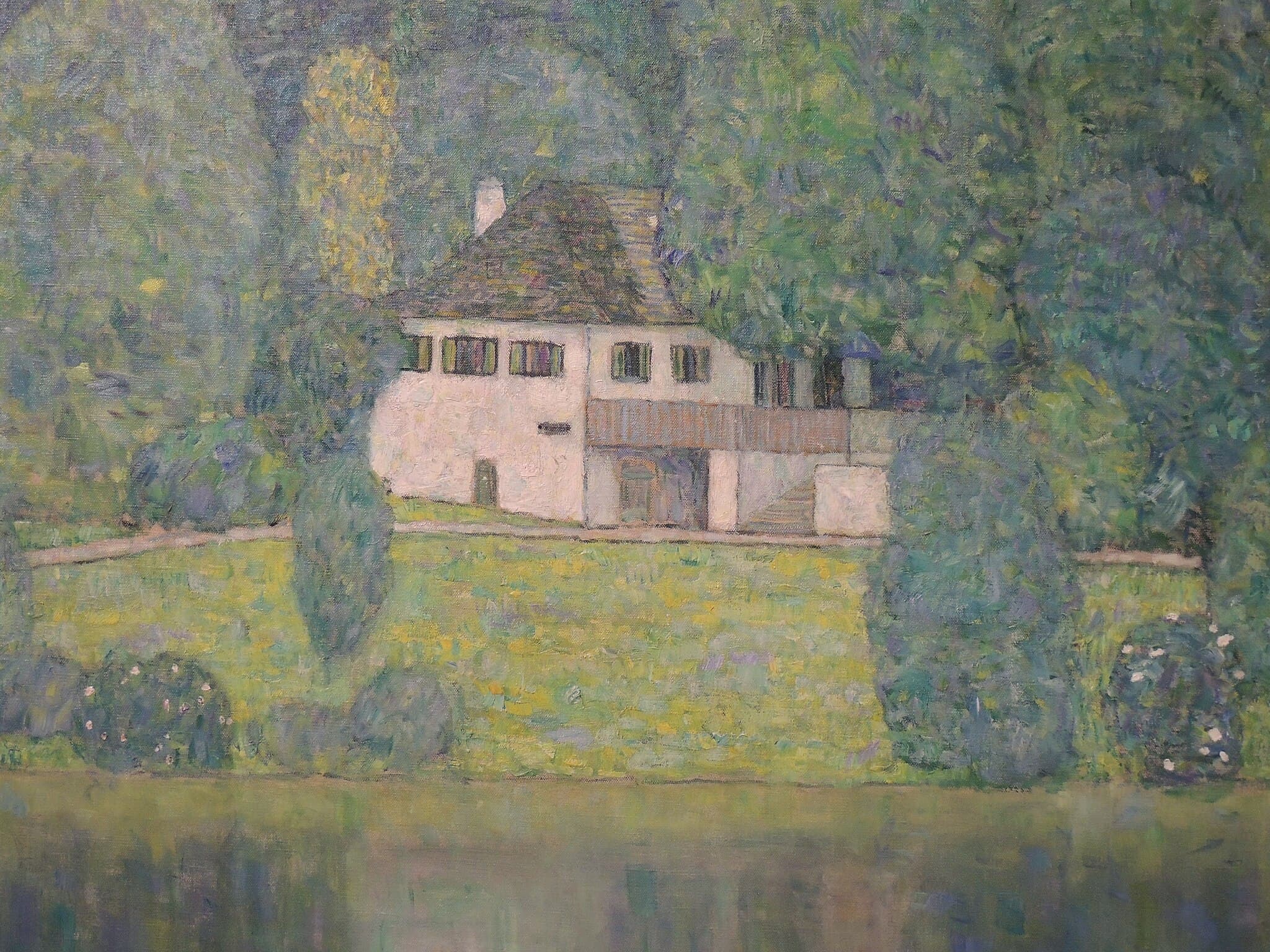
Litzlbergkeller (1915–16, oil on canvas, 110 × 110 cm) is a prime late Attersee landscape by Gustav Klimt, a category with deep global demand and recent marquee results. Anchored by closely related square-format comparables from 2011–2025, and factoring the work’s scale, period, and strong provenance/visibility, we estimate current market value at $65–90 million, assuming top-tier condition.
Valuation Analysis
Work identification and context. Litzlbergkeller (also published as Litzlberger Keller am Attersee) is a mature, square-format landscape painted in 1915–16 at 110 × 110 cm. It depicts the famed Litzlberger Keller on Lake Attersee and sits within Klimt’s coveted late Attersee series; the work has been shown in Vienna and is currently listed by the Leopold Museum, Vienna, as on display and in private ownership [2]. The painting’s last confirmed public sale occurred at Sotheby’s New York on May 13, 1997 (Estate of Serge Sabarsky), where The Washington Post reported a price realized of $14.7 million [1].
How this estimate was derived. We anchor the valuation to directly comparable square-format Klimt landscapes of similar period and scale. The closest like-for-like is Litzlberg am Attersee, sold for $40.4 million at Sotheby’s New York on November 2, 2011 [3]. Since then, pricing for prime Klimt landscapes has re-rated materially: Insel im Attersee achieved $53.2 million in 2023 [5]; in November 2025, Sotheby’s sold Forest Slope in Unterach on the Attersee (1916) for $68.3 million and Blooming Meadow for $86 million, both square-format landmarks underscoring depth of demand for this category [6]. At the upper bound of Klimt’s non-portrait landscape market, Birch Forest realized $104.6 million in 2022, establishing the ceiling for top-tier landscapes [4]. Against this suite of comps, Litzlbergkeller’s prime date, iconic subject within the Attersee cycle, and identical 110 × 110 cm format support an estimated current value of $65–90 million, presuming excellent condition and presentation in a marquee evening sale.
Key factors and market positioning. The painting occupies a strong position within Klimt’s oeuvre: late-period Attersee works are rare, highly refined, and among the most liquid non-portrait Klimts. The square format—a hallmark of Klimt’s landscapes—aligns with the most aggressively pursued examples at auction. Provenance and visibility are additive: a 1997 blue-chip sale from the Sabarsky estate, subsequent private ownership, and prominent exhibition presence at the Leopold Museum enhance buyer confidence and marketability [1][2].
Demand dynamics. Klimt’s market has been catalyzed by multiple nine-figure records in 2022–2025, culminating in a new artist auction record in November 2025, and strong competition for landscapes of the Attersee type [4][6]. Cross-border bidding—particularly from Asia—has been a consistent driver at the top end, and late, square-format landscapes have shown reliable liquidity.
Assumptions and sensitivities. This range assumes: (i) first-rate condition with no significant structural or aesthetic impairments; (ii) full, published provenance and literature; and (iii) placement in a high-profile evening sale (preferably as a top lot or within a single-owner context). Should condition or exhibition history fall short, value would trend toward the lower band; conversely, a best-in-class presentation with third‑party or house guarantee and strong pre-sale marketing could test or exceed the upper $80s.
Key Valuation Factors
Art Historical Significance
High ImpactLitzlbergkeller belongs to Klimt’s late Attersee cycle, the most coveted subset of his landscape oeuvre. The square-format, mosaic-like brushwork and chromatic density epitomize the refined pictorial language Klimt developed in the 1910s. Iconographically, the focus on the Litzlberger Keller situates the canvas at the heart of the artist’s Attersee summers and his engagement with modern leisure and nature. This period’s landscapes are widely exhibited and published, forming a key pillar of Klimt scholarship and market demand. Within the hierarchy of Klimt’s works, late Attersee landscapes are second only to the top portraits in market prestige, but they remain the strongest non-portrait category for depth of bidding and repeatable liquidity.
Rarity and Scale
High ImpactThe 110 × 110 cm square format is both emblematic and scarce, aligning Litzlbergkeller with the most aggressively pursued Klimt landscapes at auction. Comparable late Attersee works of identical scale and maturity rarely appear, and when they do, they have commanded headline prices. Scarcity is compounded by institutional retention and long-term private loans, which reduce available supply in any given season. The combination of prime date (1915–16), square format, and a canonical subject makes direct substitutes limited, supporting price resilience even in mixed macro conditions. Works at smaller formats or from peripheral periods have not achieved the same price density or international competition as the 110 cm square canvases.
Provenance and Exhibition History
Medium ImpactA blue-chip 1997 sale from the Estate of Serge Sabarsky at Sotheby’s New York provides a strong, market-tested provenance line. Since then, the painting has resided in a private collection and has been prominently displayed and catalogued by the Leopold Museum in Vienna, enhancing scholarly and public visibility. Published dimensions and curatorial notes further support due diligence confidence. While restitution-related provenance can affect some Austrian modernist works, this painting’s published trail and high-profile exhibition footprint are net positives. Absence of a recent condition report is the main unknown; assuming no adverse findings, the provenance and institutional exposure argue for broad bidder confidence at the upper end of the estimate.
Market Comparables and Liquidity
High ImpactDirectly comparable square-format landscapes frame the pricing: Litzlberg am Attersee achieved $40.4m in 2011; Insel im Attersee realized $53.2m in 2023; and in 2025, Forest Slope in Unterach on the Attersee and Blooming Meadow made $68.3m and $86m respectively—demonstrating renewed strength for prime Klimt landscapes. Birch Forest’s $104.6m result in 2022 sets the ceiling for the category. These data points, spanning 2011–2025, show a clear re-rating of late, square-format Klimt landscapes. Liquidity is deep across geographies, with consistent top-end engagement from U.S., European, and Asian buyers. In a marquee evening sale with robust marketing, Litzlbergkeller should attract competitive bidding within the stated range.
Sale History
Sotheby's New York
Estate of Serge Sabarsky; price realized reported by The Washington Post; catalogued as "Litzlberger Tavern on Lake Attersee."
Gustav Klimt's Market
Gustav Klimt is a top-tier, globally collected blue-chip artist with multiple nine-figure auction results. After Birch Forest sold for $104.6m in 2022, Lady with a Fan achieved about $108m in 2023, and a new artist auction record was set in November 2025 with a Klimt portrait at $236.4m—repositioning the ceiling for the artist’s market. Landscapes form a vital and highly liquid category, especially the square-format Attersee works, which have recently realized $53.2m to $86m in New York evening sales. Demand is diversified and deep, with strong participation from the U.S., Europe, and Asia. Fresh-to-market, institutionally exhibited works with clear provenance remain the most competitive and financeable.
Comparable Sales
Litzlberg am Attersee
Gustav Klimt
Closest like-for-like: a square-format Attersee lake view from 1914–15 at the same 110×110 cm scale and late style; subject, format and period align directly with Litzlbergkeller.
$40.4M
2011, Sotheby's New York
~$56.6M adjusted
Forest Slope in Unterach on the Attersee
Gustav Klimt
Late Attersee-period landscape from 1916 with the same square-format and mature technique; provides a very recent price anchor in the exact time bracket.
$68.3M
2025, Sotheby's New York
Blooming Meadow
Gustav Klimt
Prime square-format Klimt landscape (c. 1908) whose mosaic-like brushwork defines demand for his non-portrait works; similar scale and market tier though not an Attersee view.
$86.0M
2025, Sotheby's New York
Insel im Attersee
Gustav Klimt
Square-format Attersee lake subject (1901–02); earlier than Litzlbergkeller but core to Klimt’s landscape canon and highly sought-after; strong recent result.
$53.2M
2023, Sotheby's New York
~$55.1M adjusted
Birch Forest
Gustav Klimt
Seminal square-format early landscape (1903) and a marquee benchmark for Klimt landscapes; not an Attersee scene but establishes the top end of pricing for non-portrait Klimts.
$104.6M
2022, Christie's New York
~$113.0M adjusted
Current Market Trends
The top end of the 20th‑century market remains robust for museum‑caliber material, even as broader day‑sale segments are selective. Klimt’s category has benefited from headline records since 2022 and renewed attention to his landscape corpus, with square-format Attersee works commanding mid‑to‑high eight figures. Single‑owner contexts and marquee evening placements amplify outcomes, while Asian bidding continues to be a decisive force at the pinnacle. Provenance diligence remains critical given heightened scrutiny around restitution-era works; when documentation is clear and condition is strong, price discovery has skewed to the high side of expectations.
Sources
- The Washington Post – At the Auctions (May 14, 1997)
- Leopold Museum – Litzlbergkeller (Online Collection)
- Sotheby’s – Impressionist & Modern Art Evening Sale, 2 Nov 2011, Lot 7 (Litzlberg am Attersee)
- Bloomberg – Paul G. Allen Auction Results: Klimt Painting Sets $105 Million Record
- Forbes – Sotheby’s Sells Insel im Attersee for $53.2 Million (May 16, 2023)
- Apollo Magazine – Auctions: Lauder, Klimt, Kahlo in November New York