How Much Is Orchard in the Evening Worth?
Last updated: April 1, 2026
Quick Facts
- Methodology
- comparable analysis
Estimated fair-market value: $30–50 million. The work’s early date (1898), modest vertical format (69 × 55.6 cm), and symbolist dusk palette place it below Klimt’s later, highly decorative square-format landscapes, yet its Secession-era provenance and museum-level placement support robust demand.
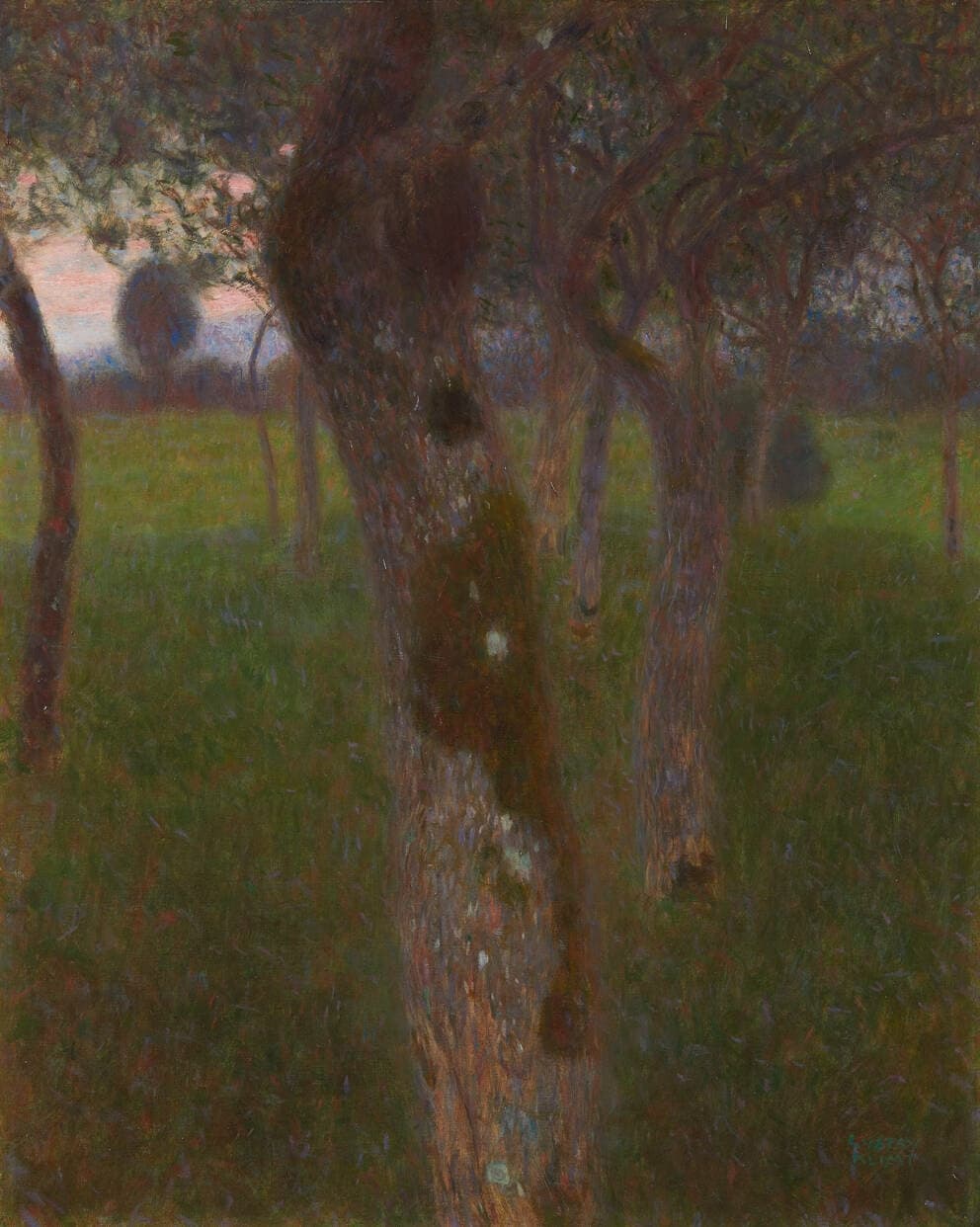
Orchard in the Evening
Gustav Klimt, 1898 • Oil on canvas
Read full analysis of Orchard in the Evening →Valuation Analysis
Conclusion: Based on directly comparable Klimt landscape sales and the work’s documented exhibition/provenance standing, Gustav Klimt’s Orchard in the Evening (1898, oil on canvas, 69 × 55.6 cm) is best positioned at $30–50 million. The painting was shown at the 7th Vienna Secession in 1900, purchased there by pioneering patron Fritz Waerndorfer, and today appears as a permanent loan from a private Austrian collection to the Leopold Museum, Vienna, with standard catalogue references—collectively strong quality indicators that underpin this range [1].
Comparable sales and market calibration: The recent arc of Klimt’s market establishes a clear hierarchy for landscapes. Later, immersive square-format or richly decorative works have reset the category’s ceiling—Christie’s sold Birch Forest (1903) for $104.6 million in 2022 [3], and Sotheby’s achieved $86.0 million for Blumenwiese and $68.3 million for Waldabhang in November 2025 [4]. High-quality but less monumental landscapes have also performed strongly: Insel im Attersee (c.1901–02) brought $53.2 million at Sotheby’s in 2023, confirming deep demand beneath the very top tier [2]. Meanwhile, the artist’s overall apex advanced dramatically with a $236.4 million portrait in 2025, signaling exceptional trophy-level confidence across Klimt’s market [5].
Positioning of Orchard in the Evening: Painted in 1898 and conceived in a vertical format with a moodier, symbolist twilight palette, Orchard in the Evening sits earlier and smaller than Klimt’s headline square-format, mosaic-like Attersee and garden pictures. That places it below the $86–$105 million cohort, yet comfortably within the established band for desirable non-square landscapes. Its confirmed early Secession exhibition, blue-chip provenance to Waerndorfer, and present museum placement provide strong qualitative support, while the compact scale and transitional aesthetic temper upside relative to the very brightest florals and late immersive forests. Synthesizing these factors against the current price curve yields a fair-market range of $30–50 million, with the mid-to-upper 40s achievable in optimal conditions and venue.
Practical considerations: As a work on permanent loan in Austria, any prospective sale may intersect with Austrian cultural property regulations requiring export permits, a logistical factor that can influence timing and liquidity at the margin [6]. This valuation assumes competent, stable condition commensurate with long-term museum care; material condition variance would move the figure. Taken together—documented provenance and exhibition history [1], clear comp anchors across 2022–2025 [2][3][4], and a robust, recently re-anchored Klimt market led by a $236.4 million portrait record [5]—the $30–50 million range reflects current demand for an early, poetic landscape in strong overall state and with well-prepared market presentation.
Key Valuation Factors
Art Historical Significance
High ImpactOrchard in the Evening dates to 1898, an early and formative moment in Klimt’s evolution as a landscape painter. Exhibited at the 7th Vienna Secession in 1900 and purchased there by major patron Fritz Waerndorfer, it embodies the artist’s transitional, symbolist-inflected approach before the fully developed, square-format Attersee and floral ‘mosaic’ landscapes of the 1900s. The work’s dusk tonality and vertical format offer a distinct mood within Klimt’s landscape corpus, underscoring both historical interest and aesthetic individuality. Documented inclusion in core literature and its current presence as a permanent loan to the Leopold Museum reinforce scholarly and institutional validation, which are key value multipliers for blue-chip names.
Market Comparables and Oeuvre Positioning
High ImpactRecent sales define a clear hierarchy: late, decorative square-format landscapes have pushed the ceiling to $86–$105 million, while strong non-square or earlier works cluster beneath that level. Insel im Attersee (c.1901–02) brought $53.2m in 2023, demonstrating depth for smaller, earlier landscapes. Orchard in the Evening, at 69 × 55.6 cm and with a moodier symbolist palette, naturally prices below the very brightest, immersive squares (e.g., Birch Forest; Blumenwiese) but above tertiary works lacking provenance or exhibition heft. This comparison set underpins a $30–50 million range today, with upside if presented in a prime New York or London evening sale with best-in-class marketing and competitive financial terms.
Provenance, Exhibition & Literature
Medium-high ImpactThe painting’s early sale to Fritz Waerndorfer—among Klimt’s most important supporters—along with its showing at the 7th Vienna Secession (1900) provides a compelling historical narrative. It is cited in standard references (e.g., Weidinger; Natter) and held on permanent loan to the Leopold Museum, signaling curatorial endorsement and steady public visibility. Such documentation reduces due-diligence friction, supports buyer confidence, and can intensify institutional and private competition. While provenance alone does not override size/format hierarchy, the combination of a Secession exhibition history, a storied first owner, and museum placement adds meaningful, bankable value that helps anchor the work in the stronger tranche of Klimt landscapes.
Regulatory and Marketability Considerations
Medium ImpactLocated in Austria and on museum loan, the work would likely require an export permit if sold internationally. Austria’s cultural property regime can introduce timing uncertainty and, in rarer cases, constraints on export or pre-emption risk. Elite buyers and the major auction houses are accustomed to navigating such frameworks, but the added complexity can thin marginal bidders or affect guarantee terms. In valuation, this factor typically trims a portion of the upside relative to an unencumbered New York or London consignment, though it is rarely determinative when quality, provenance, and scholarship are strong—as they are here. The $30–50 million range reflects this balance.
Condition, Scale, and Aesthetic Appeal
Medium ImpactAt 69 × 55.6 cm, the work is materially smaller than Klimt’s most celebrated square-format landscapes. Its vertical orientation and atmospheric dusk palette appeal to connoisseurs of the earlier, symbolist Klimt but trade at a discount to the brightest, densely patterned floral or lake vistas. This estimate assumes sound structural and surface condition consistent with long-term museum stewardship; fully stable varnish, minimal retouching, and attractive surface presentation would support the upper half of the range. Conversely, significant restorations, lining issues, or surface disruptions could compress demand and shift pricing toward the lower 30s. Presentation quality (framing, photography, catalogue text) will also matter at this level.
Sale History
Orchard in the Evening has never been sold at public auction.
Gustav Klimt's Market
Gustav Klimt is among the most valuable and liquid artists in the Modern canon, with multiple nine-figure auction results and sustained global demand. The artist’s auction apex was reset in November 2025 when a full-length portrait achieved $236.4 million, reinforcing depth of trophy-level bidding and anchoring confidence across Klimt categories. Landscapes have likewise advanced: a forest interior realized $104.6 million in 2022, and in late 2025 a floral field made $86.0 million while a wooded slope reached $68.3 million. High-quality, jewel-like square-format landscapes and iconic portraits command the top stratum; earlier or smaller works trade at a measured discount but remain strongly bid when provenance, condition, and presentation align.
Comparable Sales
Blumenwiese (Blooming Meadow)
Gustav Klimt
Same artist; prime landscape with dense floral field motif. Calibrates the high end for Klimt landscapes post-2025; useful as an upper bracket even though it’s a later, iconic square format.
$86.0M
2025, Sotheby's New York
Waldabhang bei Unterach am Attersee (Forest Slope in Unterach on the Attersee)
Gustav Klimt
Same artist; landscape/forest subject with immersive surface. A strong non-portrait Klimt landscape benchmark from late style; helpful to gauge demand for non-square forested motifs.
$68.3M
2025, Sotheby's New York
Insel im Attersee (Island in the Attersee)
Gustav Klimt
Same artist; early 1900s landscape close in period to 1898 and smaller than Klimt’s grand square ‘jewel’ canvases. Useful mid‑tier landscape anchor.
$53.2M
2023, Sotheby's New York
~$55.4M adjusted
Birch Forest
Gustav Klimt
Same artist; major landscape (forest interior) from 1903 with highly decorative, immersive surface. Sets the upper bound for Klimt landscapes, though later and larger than the 1898 orchard.
$104.6M
2022, Christie's New York
~$113.9M adjusted
Bauerngarten (Blumengarten)
Gustav Klimt
Same artist; top-tier garden landscape (1907) and long-standing benchmark for Klimt’s square-format floral works. Brackets the premium for the most decorative landscapes.
$59.3M
2017, Sotheby's London
~$77.0M adjusted
Church in Cassone (Landscape with Cypresses)
Gustav Klimt
Same artist; vertical-format landscape (1913) closer in orientation and mood to the 1898 orchard. Helpful for format/scale anchoring below the very largest square ‘mosaic’ works.
$43.2M
2010, Sotheby's London
~$63.1M adjusted
Current Market Trends
At the high end of the Impressionist & Modern segment, demand rebounded decisively through late 2025, driven by constrained supply, selective but intense competition for blue-chip names, and the use of competitive guarantees. Klimt sits at the center of this strength: headline results have re-anchored pricing for top-tier portraits and landscapes, pulling up the overall curve. Buyers remain discriminating on quality, condition, and aesthetic impact, but museum-caliber works with strong literature and provenance continue to attract global bids, including from Asia and the U.S. In this context, a well-presented, early Klimt landscape can confidently command a $30–50 million outcome today.
Sources
- Leopold Museum Online Collection: Orchard in the Evening
- Sotheby’s: The New York Sales May 2023 Results (includes Insel im Attersee at $53.2m)
- The Art Newspaper: Paul G. Allen Collection totals $1.5bn; Klimt’s Birch Forest at $104.6m
- Sotheby’s: Historic Night—Leonard A. Lauder Collection results (Blumenwiese $86.0m; Waldabhang $68.3m)
- AP News: Klimt portrait sets record at $236.4m
- Bundesdenkmalamt (Austria): Export of Cultural Property
- Forbes: Klimt’s Lady with a Fan sells for $108.4m