How Much Is Sitting Nude Man Turned to the Left Worth?
Last updated: April 3, 2026
Quick Facts
- Methodology
- comparable analysis
We estimate Gustav Klimt’s Sitting Nude Man Turned to the Left (1883) at $4–8 million at auction. The work is an early, small-scale academic male nude—less commercially favored than Klimt’s mature portraits and celebrated landscapes—but it remains an authentic oil on canvas with museum exposure, a scarce category that supports a solid multi‑million valuation.
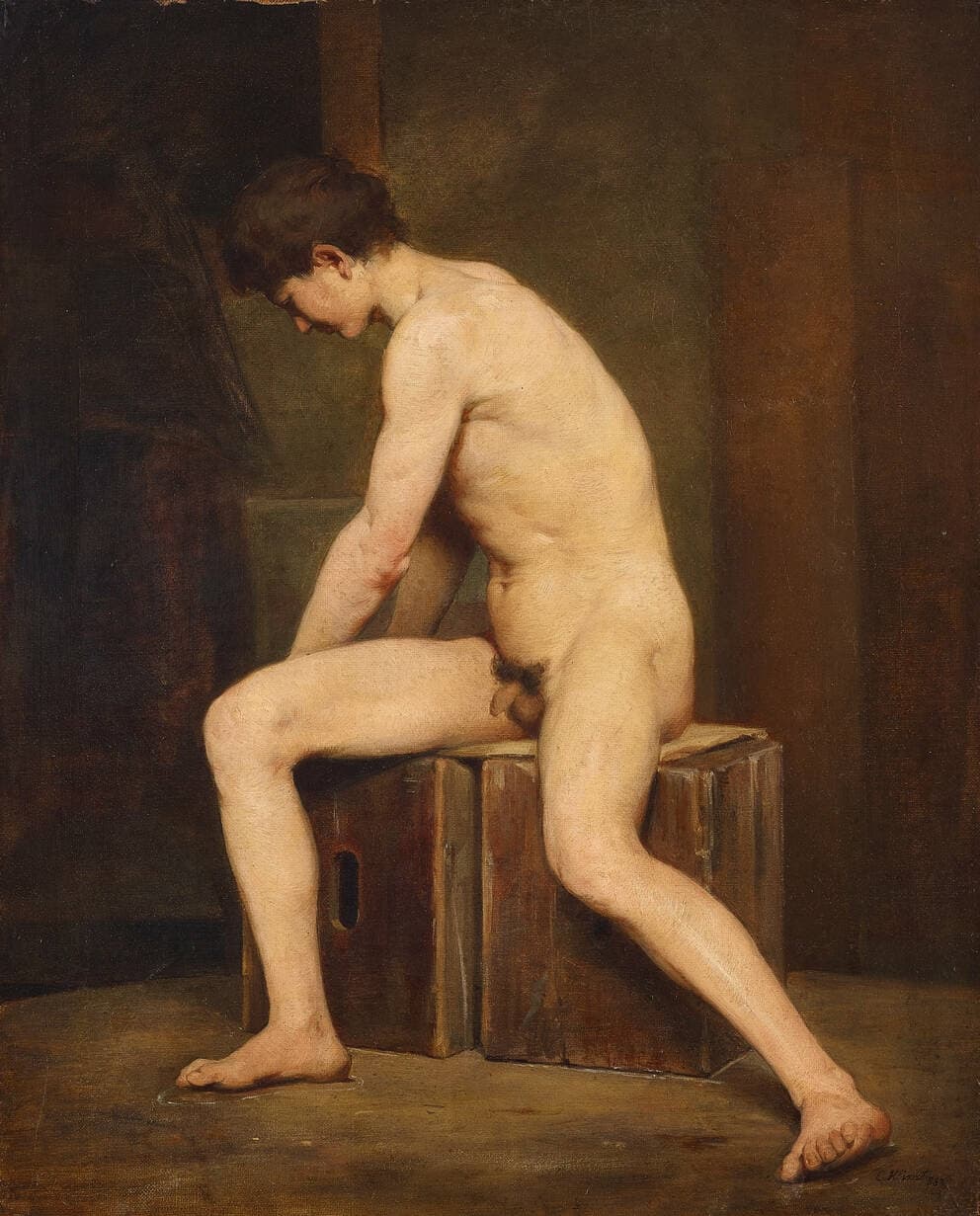
Sitting Nude Man Turned to the Left
Gustav Klimt, 1883 • Oil on canvas
Read full analysis of Sitting Nude Man Turned to the Left →Valuation Analysis
Sitting Nude Man Turned to the Left (1883) is an oil on canvas measuring 46 × 37 cm, firmly placed in Gustav Klimt’s early academic period and currently on permanent loan to the Leopold Museum, Vienna. The work is referenced in key scholarly resources (Weidinger 2007; Natter 2012) and presented publicly, confirming attribution and visibility [1]. Based on same‑artist oil benchmarks and a structured subject/period discount, we estimate auction value at $4–8 million.
Recent results define the ceiling for Klimt oils: Sotheby’s 2025 set a new auction record with Portrait of Elisabeth Lederer at about $236.4m, while mature landscapes also achieved $86.0m and $68.3m that same evening [2][3]. Sotheby’s London sold Lady with a Fan for $108.4m in 2023, and other mature‑period benchmarks include Insel im Attersee at $53.2m (2023) and Birch Forest at $104.6m (2022) [4][5][6]. Against these, the 1883 male nude—small, academic, and non‑iconic—trades at a steep discount to Golden‑Period portraits and prime landscapes, but still in the multi‑million range due to the scarcity of Klimt oils.
Offsetting the period/subject discount are strong positives: it is an authentic oil (far rarer than drawings), museum‑exhibited at the Leopold, and included in leading catalogues raisonnés—all of which underpin credibility and liquidity if offered [1]. Sustained institutional focus on Klimt (e.g., Neue Galerie’s 2024 exhibition) keeps scholarly and collector attention high, supporting broad demand for the artist’s oils across periods [8]. In pristine condition with comprehensive, low‑risk provenance, the painting would position in the middle to upper half of our range.
Market context is constructive: the Modern segment rebounded in 2025, with masterpiece‑level consignments driving competition and confidence at the top end [9]. At the same time, buyers are highly sensitive to provenance—particularly for Austrian Modernism—illustrated by the 2024 im Kinsky Fräulein Lieser episode, which was later reported as unwound amid provenance concerns [7]. Clean title and clear WWII‑era history are therefore pivotal to realizing the stronger outcomes within our range.
We conclude that $4–8 million is the fair auction range in a major evening sale. A well‑brokered private transaction could command a 10–20% premium, reflecting the scarcity of Klimt oils and the work’s museum exposure. Conversely, any condition deficits, export constraints, or provenance ambiguities would bias outcomes toward the lower bound.
Key Valuation Factors
Period and Subject
High ImpactPainted in 1883, this is an academic, small-format male nude—an important document of Klimt’s formation but a category that is structurally discounted versus his Golden‑Period portraits and signature landscapes. Collector demand for early, student‑era male figure studies is narrower, particularly relative to late female portraits, which lead the artist’s market. The subject choice and early date therefore exert a strong downward adjustment compared to the mature, decorative, symbolist works that define Klimt’s brand. This factor is the primary reason the painting sits in the single‑digit millions rather than the tens or hundreds of millions achieved by later portraits and prime landscapes.
Medium and Scarcity (Oil vs. Works on Paper)
High ImpactAs an authentic oil on canvas by Klimt, the work benefits from the significant scarcity premium attached to the artist’s paintings relative to his drawings and prints. Even outside Klimt’s most coveted subjects, oils rarely appear on the market and continue to attract global competition when cleanly documented and in good condition. This scarcity provides a floor to valuation and helps support a robust multi‑million price band despite the early period and academic subject. Relative to works on paper, which are more abundant and price‑sensitive, the oil medium is a key driver elevating the value into our $4–8 million range.
Provenance and Exhibition History
High ImpactThe painting’s presence on permanent loan at the Leopold Museum and its inclusion in standard scholarly references strengthen credibility and marketability. In today’s environment—particularly for Austrian Modernism—buyers place a premium on complete, uncontested provenance across 1900–1950, with heightened scrutiny of WWII‑era chains of ownership. Works that are museum‑exhibited and well‑published with clear title tend to realize the upper half of fair ranges. Conversely, any gaps or sensitivities can lead to price reductions or disrupted transactions. Given these dynamics, documented, low‑risk provenance and sustained institutional exposure are central to achieving a result nearer $7–8 million.
Condition and Scale
Medium ImpactAt approximately 46 × 37 cm, the work is modest in scale, which moderates potential price relative to Klimt’s larger, more imposing canvases. Condition can swing outcomes materially: pristine surface, minimal restoration, and reassuring technical findings (e.g., X‑ray/IRR alignment with period practice) can add momentum and broaden the buyer pool; conversely, structural issues, overpaint, or discoloration can compress bidding. While small size aligns with its function as a study, the market still rewards clean, well‑preserved oils. In our model, outstanding condition supports the mid‑to‑upper band; notable restorations or condition reservations would bias the work toward the lower band.
Art Historical Significance
Medium ImpactThough not a masterpiece of Klimt’s mature style, the painting documents his academic training and early command of figure drawing and modeling. For institutions and connoisseur collectors building comprehensive narratives, such works carry scholarly weight and can anchor the early chapter of Klimt’s development. This significance does not translate into trophy‑level pricing but does support stable demand when coupled with clear attribution, publication, and museum presentation. As part of a coherent collection or in a didactic institutional context, the work’s value is enhanced by its role in mapping Klimt’s trajectory from academic practice to the innovations of the Vienna Secession.
Sale History
Sitting Nude Man Turned to the Left has never been sold at public auction.
Gustav Klimt's Market
Gustav Klimt is a blue‑chip, globally collected artist whose paintings command sustained, record‑setting prices. In 2025, Sotheby’s achieved a new Klimt record with Portrait of Elisabeth Lederer at about $236.4m, while mature landscapes realized $86.0m and $68.3m the same night. In 2023, Lady with a Fan set a then‑record at $108.4m in London, and Birch Forest made $104.6m in 2022. Demand is deepest for Golden‑Period portraits and celebrated landscapes, with robust participation from U.S., European, and Asian collectors. While early or academically oriented subjects trade at substantial discounts, the overall scarcity of Klimt oils ensures strong liquidity and multi‑million outcomes across a range of periods when provenance and condition are sound.
Comparable Sales
Portrait of Elisabeth Lederer (1914–16)
Gustav Klimt
Same artist and medium (oil on canvas); establishes the 2025 apex of demand for Klimt paintings. Not comparable in period/subject/scale, but a key anchor for the ceiling of Klimt’s market.
$236.4M
2025, Sotheby's New York (Leonard A. Lauder Collection)
Blumenwiese (Blooming Meadow) (c. 1908)
Gustav Klimt
Same artist and medium; strong result for a non-portrait category. Useful to gauge depth for Klimt oils beyond the iconic portraits; subject and date still much later than the 1883 work.
$86.0M
2025, Sotheby's New York (Leonard A. Lauder Collection)
Waldabhang bei Unterach am Attersee (Forest Slope in Unterach on the Attersee) (1916)
Gustav Klimt
Same artist and medium; robust late-period landscape benchmark showing sustained demand for Klimt oils outside the Golden-Period portraits. Still later and larger than the 1883 student work.
$68.3M
2025, Sotheby's New York (Leonard A. Lauder Collection)
Dame mit Fächer (Lady with a Fan) (1917–18)
Gustav Klimt
Same artist and medium; late portrait record (then a European auction record). Calibrates the premium for peak-period Klimt versus earlier academic works.
$108.4M
2023, Sotheby's London
~$117.1M adjusted
Insel im Attersee (Island in the Attersee) (1901–02)
Gustav Klimt
Same artist and medium; earlier mature-period landscape (non-iconic portrait category). Helpful for gauging demand for high-quality but non‑trophy Klimt oils.
$53.2M
2023, Sotheby's New York
~$57.5M adjusted
Birch Forest (1903)
Gustav Klimt
Same artist and medium; museum-caliber landscape benchmark that set the stage for subsequent 2023–2025 results. Not comparable in period/subject/scale but a key modern anchor.
$104.6M
2022, Christie's New York (Paul G. Allen Collection)
~$117.2M adjusted
Current Market Trends
The Modern art segment rebounded in 2025, with masterpiece‑grade consignments re‑energizing competition at the top end. Klimt sits at the center of this momentum: late portraits and prime landscapes draw global bidding, while non‑trophy but high‑quality oils benefit from halo effects and scarcity. The market remains polarized—trophy works soar, mid‑tier pieces are selective—yet pricing for well‑documented Klimt oils is resilient. Provenance scrutiny, particularly regarding WWII‑era ownership, is a material factor; clean title and strong exhibition history can unlock premiums, while gaps can dampen demand or delay deals. Overall, conditions favor suitably presented Klimt paintings with clear provenance and excellent condition.
Sources
- Leopold Museum – Sitting Nude Man Turned to the Left (object record)
- The Art Newspaper – Klimt record at Sotheby’s New York (Nov 18, 2025)
- Sotheby’s – Lauder Collection results: Blooming Meadow and Forest Slope
- Sotheby’s – Lady with a Fan sets new European auction record (Jun 27, 2023)
- The Art Newspaper – Sotheby’s Modern Art sales (Insel im Attersee, May 16, 2023)
- The Art Newspaper – Paul G. Allen sale (Birch Forest, Nov 9, 2022)
- The Art Newspaper – Klimt’s Portrait of Fräulein Lieser auction in Vienna (Apr 24, 2024)
- Neue Galerie – Klimt Landscapes (2024 exhibition)
- Art Basel & UBS – Global Art Market Report 2026 (market rebound in 2025)