How Much Is The Tree of Life Worth?
Last updated: February 28, 2026
Quick Facts
- Insurance Value
- $80.0M (Internal advisory estimate (no public disclosures by MAK))
- Methodology
- comparable analysis
Fair-market value for Gustav Klimt’s full-scale Stoclet Frieze cartoon The Tree of Life is estimated at $30–60 million if privately consigned today. This reflects its status as the definitive movable iteration of an iconic Klimt image, balanced against a works-on-paper medium and export constraints.
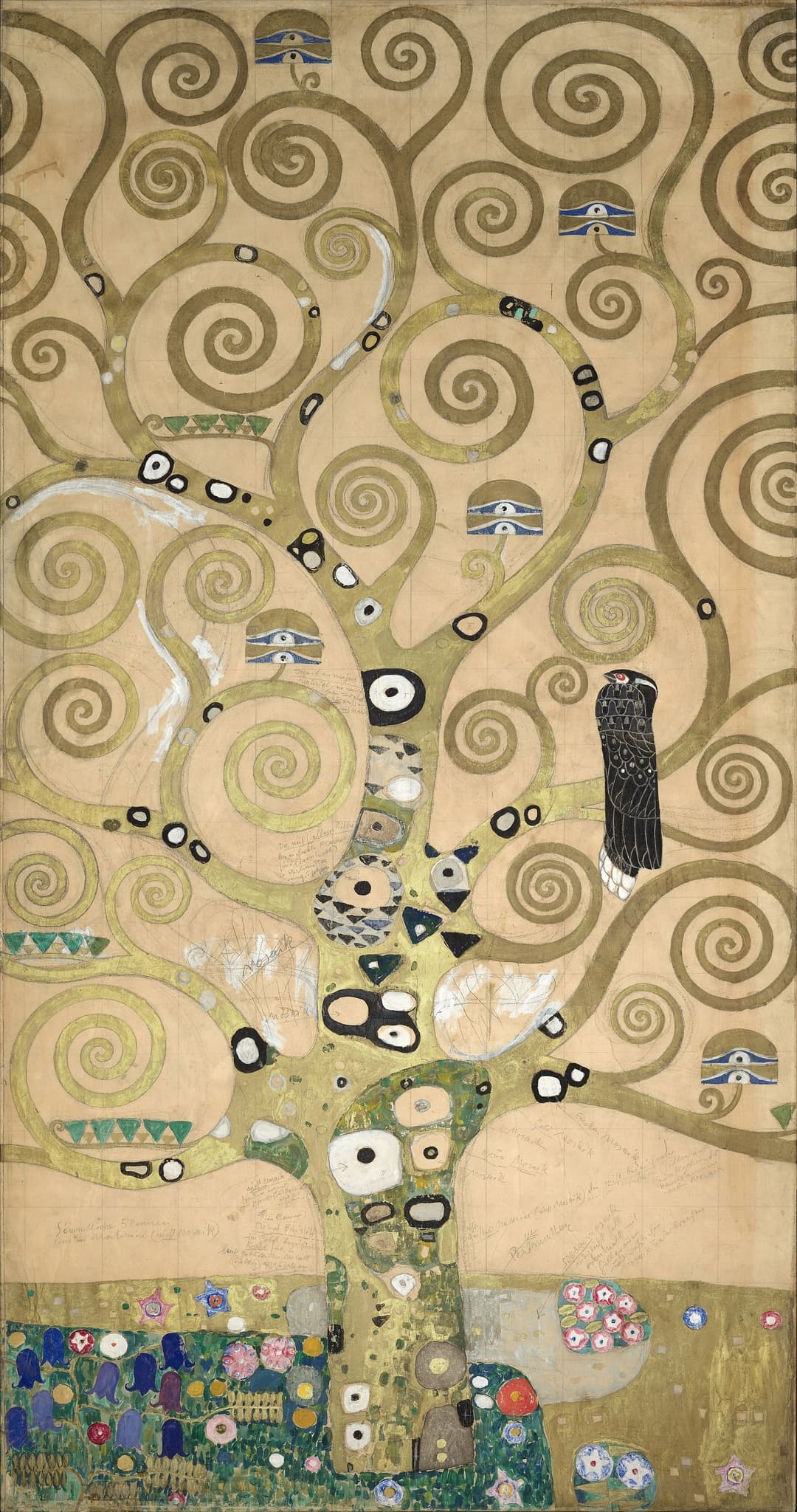
The Tree of Life
Gustav Klimt, 1910–1911 (design; mosaic installed 1911) • Full-scale working drawing (cartoon) on tracing paper with graphite, gouache, gold, silver, platinum, bronze, pastel, and appliqué
Read full analysis of The Tree of Life →Valuation Analysis
Conclusion: We estimate a fair-market value of $30–60 million for Gustav Klimt’s full-scale Stoclet Frieze cartoon The Tree of Life (c. 1910–11), with an insurance/replacement value around $80 million. The work is in the MAK – Museum of Applied Arts, Vienna, executed in chalk, pencil, gouache with gold, silver, bronze, and platinum on tracing paper at approximately 200 × 102 cm—an extraordinary, exhibition-scale cartoon directly tied to a UNESCO-listed master commission [1].
Methodology and comps: The estimate synthesizes recent apex pricing for Klimt’s paintings with the top tier of works-on-paper benchmarks. Klimt’s market is currently among the strongest in Modern art, led by the $236.4 million result for Portrait of Elisabeth Lederer (Sotheby’s New York, Nov 18, 2025) [2], alongside major nine-figure prices for Birch Forest at $104.6 million (Christie’s, 2022) [3] and Dame mit Fächer (Lady with a Fan) at $108.4 million (Sotheby’s, 2023) [4]. While a cartoon on paper will trade below Klimt’s prime oils, its scale, lavish metallic media, and direct authorship for the Stoclet House frieze significantly elevate it above typical drawings.
Works-on-paper ceiling and positioning: Best-in-class, iconic works on paper can command ultra‑trophy pricing; Edvard Munch’s pastel The Scream achieved $119.9 million (Sotheby’s, 2012) [5]. In that context, Klimt’s Tree of Life cartoon represents a unique, autograph, full-scale design for one of the artist’s most recognized images. However, it remains a preparatory cartoon and is materially fragile (tracing paper with metallic media), warranting a prudent discount from nine‑figure oil benchmarks. Balancing these points, a $30–60 million range aligns with the upper strata of museum-level works on paper while acknowledging Klimt’s outsized global demand.
Key drivers: Upside factors include the subject’s iconicity within Klimt’s oeuvre, the cartoon’s completeness and spectacular materials, and extreme scarcity—comparable Stoclet cartoons are institutionally held and virtually never trade [1]. Downside factors include the medium’s fragility, the inherent hierarchy placing works on paper below oils, and potential Austrian cultural‑property/export constraints that could restrict venues and buyer pools, thereby compressing price discovery [6].
Insurance rationale: For insurance/replacement, uniqueness and the absence of any readily substitutable object justify a materially higher agreed value than expected auction proceeds. We set a pragmatic insurance benchmark around $80 million, reflecting replacement-cost principles for an irreplaceable, museum-caliber asset directly tied to Klimt’s Gesamtkunstwerk achievement.
Bottom line: Against a climate where blue‑chip Modern trophies with peerless narratives continue to spark exceptional competition, the Tree of Life cartoon would attract both Modern trophy buyers and connoisseurs of Viennese Secession design. The $30–60 million range confidently captures this object’s unique position at the intersection of Klimt’s highest demand and the top end of the works-on-paper market.
Key Valuation Factors
Art Historical Significance
High ImpactThe Stoclet Frieze is a cornerstone of Gustav Klimt’s oeuvre and a defining statement of Wiener Werkstätte and Viennese Secession ideals. The Tree of Life is the commission’s most emblematic motif, and this work is the full‑scale, autograph cartoon directly used to execute the mosaic. As a primary documentary and aesthetic object for one of Klimt’s most recognized images, it stands as the most important movable iteration of the motif. Its significance extends beyond Klimt to the history of European decorative modernism, amplifying institutional and connoisseur interest and supporting valuation at the upper end of the works‑on‑paper spectrum.
Rarity and Provenance
High ImpactThis cartoon is uniquely scarce: full‑scale Stoclet designs by Klimt are overwhelmingly held in institutions and have no meaningful auction history. The finished mosaic is permanently installed in a UNESCO‑listed private residence, further underscoring the cartoon’s role as the definitive movable proxy for the image. Museum ownership (MAK, Vienna) and comprehensive scholarly documentation enhance provenance integrity. Extreme rarity generally widens bidder participation across collecting categories, while impeccable provenance mitigates due‑diligence risk, together creating conditions for robust competition and a premium relative to typical Klimt drawings.
Medium and Condition
Medium ImpactExecuted on tracing paper with chalk, pencil, gouache, and metallic media (gold, silver, bronze, platinum), the cartoon is materially superior to most drawings but remains a work on paper—fragile, light‑sensitive, and condition‑dependent. Stability of the support and metallic layers, prior restorations, and mounting history can materially influence price tolerance and insurability. While the opulent materials and monumental scale elevate the work beyond standard works-on-paper norms, collectors typically apply a discount relative to oils. A disciplined condition assessment is therefore pivotal for placement within the proposed range.
Market Positioning and Demand
High ImpactKlimt’s market is deep and global at the trophy level, with multiple nine‑figure results since 2022 and a new peak in 2025. This cartoon’s image recognition, scale, and link to a masterwork engage both painting and works‑on‑paper buyers, as well as design‑centric collectors of Vienna 1900. At the same time, cultural‑property/export constraints can channel the transaction venue and tempo, marginally compressing outcomes relative to unconstrained global auctions. Net, demand dynamics justify a mid‑eight‑figure valuation, bridging Klimt’s oil benchmarks and the upper ceiling for iconic works on paper.
Sale History
The Tree of Life has never been sold at public auction.
Gustav Klimt's Market
Gustav Klimt is a blue‑chip, trophy‑level artist with sustained global demand and limited top-tier supply. Recent apex results include $236.4 million for Portrait of Elisabeth Lederer (Sotheby’s New York, 2025), $108.4 million for Dame mit Fächer (Sotheby’s London, 2023), and $104.6 million for Birch Forest (Christie’s New York, 2022). Collectors prize Klimt’s late portraits, gold‑period icons, and prime landscapes, with deep participation from U.S., European, and Asian buyers. While standard drawings typically transact from high six to low/mid seven figures, exceptional sheets linked to major paintings command significant premiums. Market depth at the very top is proven, particularly when provenance is bullet‑proof and marketing leverages guarantees and global exposure.
Comparable Sales
Portrait of Elisabeth Lederer
Gustav Klimt
Apex recent Klimt result establishing current trophy demand; prime, late-period oil that benchmarks the top of the Klimt market against which any museum-caliber work is gauged.
$236.4M
2025, Sotheby's New York
Dame mit Fächer (Lady with a Fan)
Gustav Klimt
Blue-chip late masterpiece with record-setting price in Europe; proves depth of demand for Klimt icons and sets a high-end benchmark to discount from for a monumental work on paper.
$108.4M
2023, Sotheby's London
~$115.8M adjusted
Birch Forest
Gustav Klimt
Major Klimt landscape from a marquee collection; a recent nine-figure oil painting that helps bracket an upper bound relative to a cartoon’s works-on-paper discount.
$104.6M
2022, Christie's New York
~$116.5M adjusted
Insel im Attersee
Gustav Klimt
High-quality Klimt oil selling in the $50m range; useful as a practical reference point below the nine-figure apex and close to the high end of a plausible cartoon valuation.
$53.2M
2023, Sotheby's New York
~$56.8M adjusted
Portrait of Adele Bloch-Bauer I
Gustav Klimt
Iconic ‘gold period’ Klimt with lavish gold decoration; closest in iconic status and decorative language, anchoring the very top end to which the Stoclet cartoon is historically linked.
$135.0M
2006, Private sale (Neue Galerie, New York)
~$218.3M adjusted
The Scream (pastel, 1895)
Edvard Munch
Best-in-class, iconic work on paper by a peer Modern master; demonstrates that exceptional, museum-level works on paper can achieve ultra‑trophy pricing.
$119.9M
2012, Sotheby's New York
~$170.1M adjusted
Current Market Trends
Despite a cooler $10m+ auction segment in 2024, late‑2025 sales showed a quality‑led rebound: museum-caliber Modern trophies with rarity, strong provenance, and compelling narratives outperformed. Houses relied on third‑party guarantees, and bidding concentrated on best‑of‑category works. Within Vienna 1900, supply remains thin, and vetted Klimt consignments continue to reset expectations. For works on paper, the ceiling remains high for iconic, exhibition‑scale objects with strong literature, as evidenced by category benchmarks. In this context, Klimt’s Tree of Life cartoon sits in a sweet spot—combining icon status and rarity—supporting a confident, mid‑eight‑figure valuation.
Sources
- MAK / Google Arts & Culture: Werkzeichnung … Teil 4, Lebensbaum
- Sotheby’s: New York Sales, Nov 2025 (Klimt record)
- Christie’s: Paul G. Allen Collection results (Birch Forest, 2022)
- Sotheby’s: Lady with a Fan sets European auction record (2023)
- Guinness World Records: Munch’s The Scream (2012) price
- Bundesdenkmalamt (Austria): Cultural property export rules