How Much Is Jane Avril Worth?
Last updated: January 29, 2026
Quick Facts
- Methodology
- comparable analysis
Hypothetical open‑market value for Henri de Toulouse‑Lautrec’s Jane Avril (c. 1891–1892, oil on laminate cardboard mounted on panel, 63.2 × 42.2 cm, Clark Art Institute) is $6–10 million today. The estimate is anchored by a closely related April 2025 Paris result for a larger Jane Avril painting on cardboard at ~$5.9 million, adjusted for medium, scale, subject, and top‑tier institutional provenance. Upside beyond $10 million would require exceptional market momentum and competition.
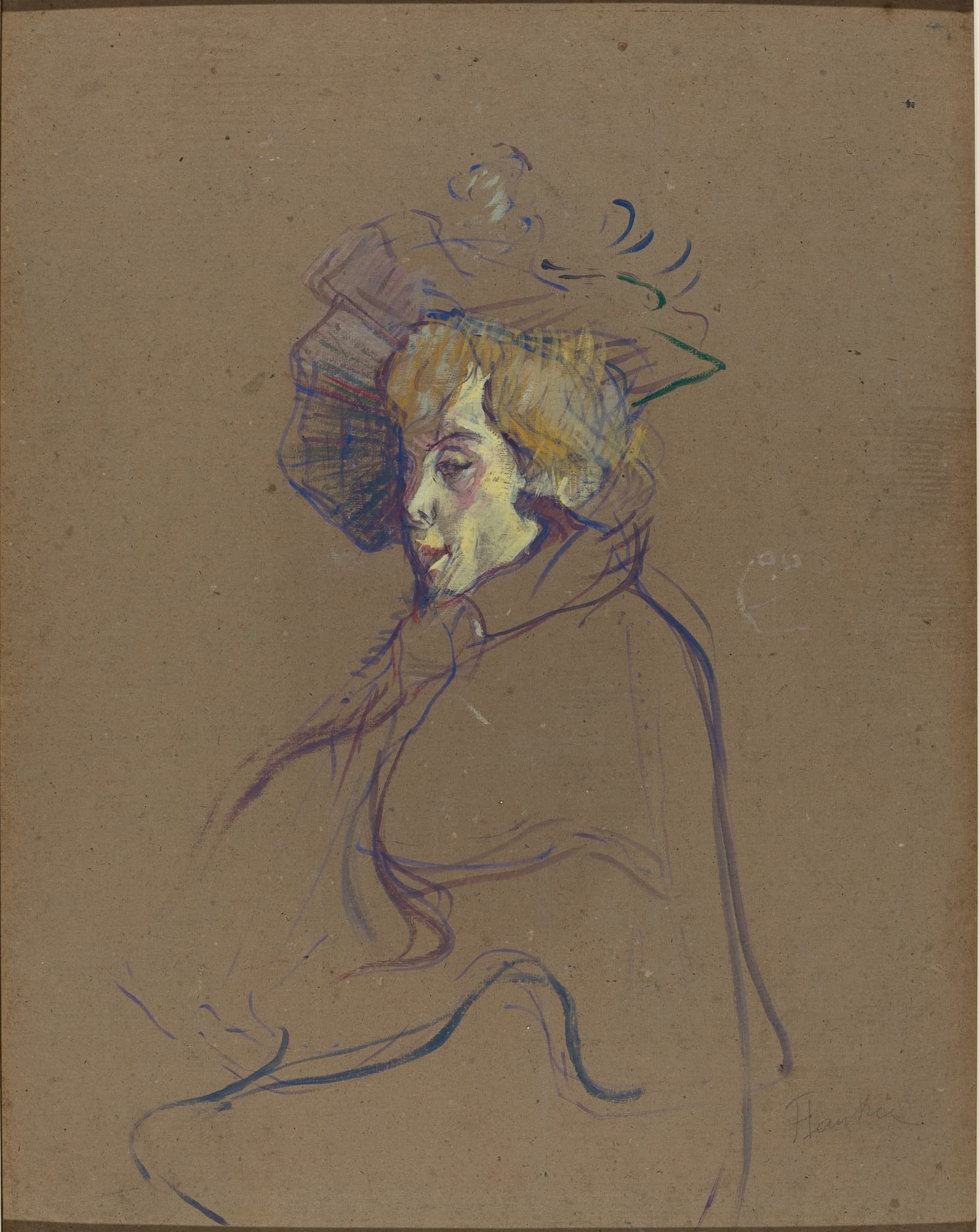
Jane Avril
Henri de Toulouse-Lautrec, c. 1891–1892 • Oil on laminate cardboard, mounted on panel
Read full analysis of Jane Avril →Valuation Analysis
Conclusion: If Henri de Toulouse‑Lautrec’s Jane Avril at the Clark Art Institute were hypothetically offered today in a major evening sale, a fair and defensible estimate is $6–10 million. The work is a prime‑period, early 1890s portrayal of one of the artist’s most iconic muses, executed in oil on laminate cardboard mounted on panel (63.2 × 42.2 cm), with exemplary provenance culminating in long museum ownership [1].
Methodology and anchors: The range is primarily informed by direct, recent comparables. Most notably, Jane Avril au Divan Japonais (1892), a larger cardboard‑supported painting/mixed‑media work by Lautrec, achieved €5,340,000 (price realized, with premium)—about $5.9 million—at Christie’s Paris on April 9, 2025, setting a French record for the artist [2]. A further touchpoint is La femme tatouée (1894), peinture à l’essence on board, which sold for £2,218,000 (~$2.9 million) at Christie’s London on October 9, 2024 [3]. These data points bracket the multi‑million pricing of prime 1890s Lautrec paintings on board/cardboard. At the top of the market, the artist’s record remains La Blanchisseuse (The Laundress), an oil on canvas sold for $22.4 million in 2005—an upper bound applicable to the very largest, canonical canvases [4].
Adjustments for the Clark painting: Relative to the 2025 Jane Avril comp, the Clark work benefits from being in oil (a fully painted treatment) and from A‑level provenance (Frantz Jourdain → Wildenstein → Robert Sterling Clark → museum), factors that can command a premium [1][2]. Counterbalancing are the modest dimensions and cardboard support (even when mounted), as well as a more intimate, bust‑length composition versus the marquee, multi‑figure scenes that drive the artist’s peak prices. On balance, these considerations justify an estimate above the $5.9 million Paris marker yet within a prudent band below the low‑ to mid‑teens usually reserved for larger oils on canvas.
Market positioning: Lautrec’s nightlife imagery remains deeply collected and internationally liquid. The re‑emergence of Paris as a high‑performing venue for early modernism, evidenced by the 2025 French record, is especially supportive for Montmartre subjects [2]. The $6–10 million range situates the Clark Jane Avril in the upper‑mid tier of Lautrec paintings: a highly desirable, museum‑quality oil with iconic subject matter, but not among the artist’s very largest, most famous canvases. In a heated bidding environment with impeccable condition and strong marketing, outperformance into the low‑teens is plausible; conversely, a thin field could compress the result toward the lower half of the range.
Key Valuation Factors
Art Historical Significance
High ImpactJane Avril is one of Toulouse-Lautrec’s most important muses, central to his Montmartre project alongside La Goulue, Yvette Guilbert, and Cha-U-Kao. Works from 1891–1892 capture the artist at the height of his creative engagement with Parisian nightlife, and paintings of Avril are core to museum narratives and scholarship. While the single most famous “Jane Avril” image is the 1893 poster, painted depictions are scarcer and carry meaningful premiums over works on paper. The Clark painting’s date and subject place it squarely within the artist’s most coveted thematic period, making it highly resonant with collectors seeking canonical Belle Époque imagery that bridges fine art and the spectacle of the cabaret.
Medium and Support
Medium ImpactThe work is executed in oil on laminate cardboard, mounted on panel—desirable as a painted work relative to drawings or lithographs, yet generally valued below the artist’s larger oils on canvas. Lautrec’s board/cardboard paintings from the 1890s are prized for their immediacy and painterly character and have achieved multi-million results at auction. That said, collectors typically apply a discount versus canvas for perceived durability and prestige. If condition is excellent (stable support, minimal restorations), the support becomes less of a deterrent. In this case, the oil medium offsets some of the board/cardboard effect, supporting an upper‑mid valuation tier consistent with recent results for comparable supports.
Scale and Composition
Medium ImpactAt 63.2 × 42.2 cm, the painting is of modest, intimate scale, and the composition is a bust‑length portrait rather than a multi‑figure interior. In Lautrec’s market, scale correlates with price, and his most valuable works tend to be larger, fully developed canvases (e.g., At the Moulin Rouge). Still, small and medium-format oils from the early 1890s can be highly sought after when the sitter is iconic and the execution strong. The subject’s recognizability (Jane Avril) partly compensates for the size, but the composition’s intimacy naturally caps the ceiling below major, exhibition-defining canvases—hence a range in the high single digits to low eight figures, not the mid‑teens and above.
Provenance and Institutional Standing
High ImpactThe ownership line—from Frantz Jourdain in Paris to Wildenstein (New York), then to Robert Sterling Clark, and finally the Clark Art Institute—confers exceptional credibility. Long-term museum custody is a powerful market signal: it underwrites authenticity, literature/exhibition exposure, and desirability. Works with this caliber of provenance often command premiums, and they can attract institutional interest when deaccessioned. While museum ownership removes any near‑term sale likelihood, a hypothetical offering with this pedigree would benefit from global marketing and competitive bidding. The only caveat is that some buyers prioritize large canvases; nonetheless, the provenance quality squarely supports upper‑mid tier pricing for the artist’s painted works.
Sale History
Jane Avril has never been sold at public auction.
Henri de Toulouse-Lautrec's Market
Henri de Toulouse-Lautrec is a blue-chip, internationally liquid name, with deep demand for prime 1890s Montmartre subjects. While the artist’s market is anchored by posters and lithographs at accessible levels, true scarcity lies in his paintings, which command multi-million prices when the subject, period, and quality align. The current world auction record is $22.4 million for La Blanchisseuse (2005), a large oil on canvas. Recent results show robust appetite for painted works on board/cardboard: in April 2025, a larger Jane Avril painting on cardboard reached ~$5.9 million in Paris, the highest price for the artist in France. Collectors prize iconic sitters (Jane Avril, La Goulue, Yvette Guilbert) and early 1890s cabaret scenes, favoring strong provenance and condition.
Comparable Sales
Jane Avril au Divan Japonais
Henri de Toulouse-Lautrec
Best direct comp: same artist, c.1892, mixed media/paint on cardboard support, iconic Jane Avril subject, larger but close in scale; sold in a major evening sale.
$5.9M
2025, Christie's Paris
La femme tatouée
Henri de Toulouse-Lautrec
Same artist and decade (1894); peinture à l’essence on board (very close technique/support to oil on cardboard), comparable dimensions; bordello theme within Lautrec’s signature Montmartre subject matter.
$2.9M
2024, Christie's London
~$3.0M adjusted
Princeteau dans son atelier
Henri de Toulouse-Lautrec
Oil painting by the same artist; provides a recent benchmark for painted works, though earlier (1881) and not a prime Montmartre/cabaret subject.
$763K
2023, Bonhams New York
~$810K adjusted
Portrait de femme, Décoration du salon de la maison de la rue d’Amboise
Henri de Toulouse-Lautrec
Same artist and year (1892), painted medium on paper laid to canvas; much smaller value but helps bracket the low end of 1890s painted works outside marquee subjects.
$106K
2025, Christie's Paris
La Blanchisseuse (The Laundress)
Henri de Toulouse-Lautrec
Artist’s auction record; oil on canvas of monumental quality. Not recent or directly comparable in support/subject, but it provides an upper bound for Lautrec’s market for top-tier paintings.
$22.4M
2005, Christie's New York
~$37.0M adjusted
Current Market Trends
The broader Impressionist and Post‑Impressionist segment experienced a pullback in 2023–2024 as trophy supply thinned and buyers became more selective, but late‑2025 brought renewed momentum for museum‑caliber works. Paris has reasserted itself as a strong venue for early modernist consignments, a tailwind for French subject matter, including Lautrec. In this selectively strong environment, canonical imagery with top provenance outperforms, while smaller or less definitive works trade with disciplined pricing. Within Lautrec’s market, posters remain highly liquid at four‑ to five‑figure levels, but painted works—especially oil/board examples with iconic cabaret subjects—draw focused competition and can set national records. Guarantees and careful sale placement (Paris or New York evening sales) are increasingly decisive.