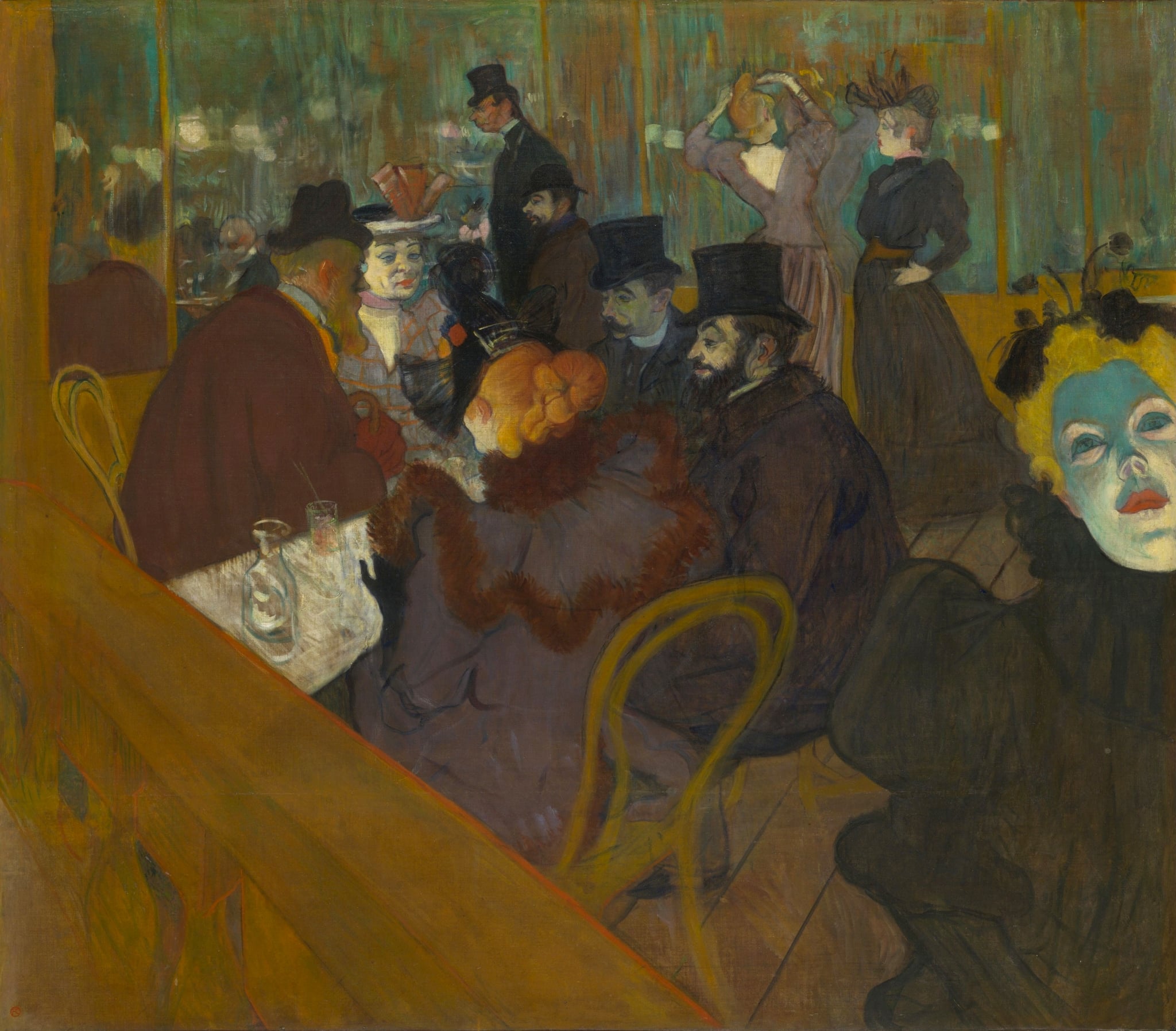
Lautrec’s portrait turns a fleeting glance into an identity machine. The figure is almost conjured from emptiness: violet and blue lines draft a sweeping cloak; a handful of green and indigo strokes flick upward to suggest the plumes of a hat; the ground remains raw, its brown grain unvarnished, so that the image reads as apparition rather than anatomical presence. This calculated economy performs two acts at once. First, it
imports the graphic clarity of the advertising poster—flat areas, sinuous contour, daring negative space—into an oil portrait, a vocabulary that Lautrec perfected across his public commissions for the entertainment world
45. Second, it
withholds finished modeling, insisting that the subject is a silhouette assembled in the viewer’s eye, just as a star’s persona is assembled from glimpses at the door and flashes on the stage. The Clark’s curators note that Lautrec’s offstage images of Avril retain “unnatural” color keyed to stage makeup and harsh lighting; here the
lemon–lilac–carmine face is not naturalism but theatrical carryover, a statement that performance bleeds into private life
1.
The portrait’s psychology is embedded in its design. The eyelids droop; the mouth pulls taut; the head turns slightly away even as the hat proclaims presence. This tension between
envelopment and advertisement—
cloak as carapace, feathers as flare—encodes a modern push-pull:
self-protection in public space against the imperative to be seen 12. Lautrec’s line privileges motion over anatomy; the torso is a ribboning arabesque, as if the dancer’s famous kicks had been translated into stillness, their energy stored in contour rather than limb
3. The effect is a
paradoxical stasis-in-movement that unites his private portraits with the kinetic grammar of his posters, where cropping, vertical thrusts, and musical analogues (like the double bass in the 1893 Jane Avril) turn bodies into rhythm made visible
4. By echoing that poster logic here—without the billposter’s text—Lautrec asserts that modern identity is a designed surface, and that intimacy, for celebrities, is itself a kind of staging
24.
The meaning of Jane Avril, then, is not biographical illustration but a proposition about how images make persons. The portrait’s brown void sets a threshold space—neither street nor stage, a liminal field where a woman becomes the role she must play. Lautrec keeps the marks quick and decisive, the palette high-keyed and dissonant, to show that persona is an effect of lighting and line as much as of flesh. This is why Jane Avril is important: it demonstrates how Post‑Impressionist painting could absorb the lessons of the
poster and the café‑concert to picture a new social fact—
celebrity as collaboration between performer, artist, and audience 26. In a handful of strokes, he renders both the lure and the cost of visibility, making the fin‑de‑siècle present as a nervy dialogue between elegance and exhaustion, spectacle and self. The dancer becomes an icon not by revelation of essence but by the disciplined orchestration of silhouette, color, and space—and by the viewer’s recognition that to look is already to complete the act of performance
134.