The Mandolin and Jug in The Sleeping Gypsy
A closer look at this element in Henri Rousseau's 1897 masterpiece
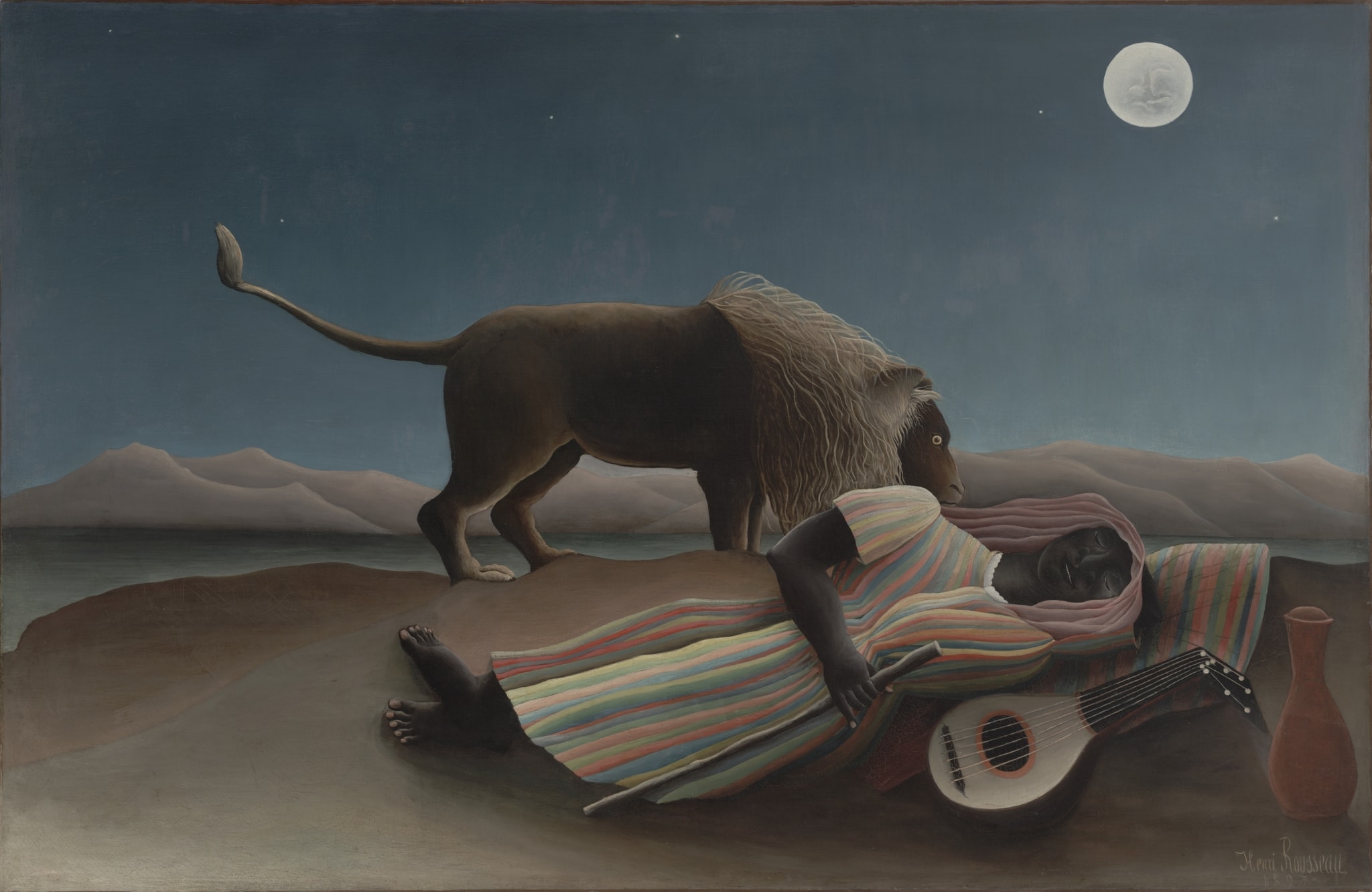
In The Sleeping Gypsy, the compact still-life of a mandolin and an earthen water jug anchors Rousseau’s moonlit fantasy in human reality. Named by the artist as the traveler’s instrument and drinking vessel, they declare her vocation and survival kit while quietly intensifying the painting’s balance of serenity and threat.
Historical Context
Henri Rousseau painted The Sleeping Gypsy in 1897 and described its central figure as a wandering mandolin player resting in a completely arid desert. In the same letter, he specified that the nearby jar is a vase with drinking water. The two objects therefore belong to the sleeper’s daily life: the mandolin identifies her profession; the jug provisions her journey across a parched landscape 2.
The canonical version in the Museum of Modern Art places the instrument and jug together beside the reclining figure, forming a small still-life that reads instantly and legibly. Their placement was part of Rousseau’s carefully staged composition, preserved in MoMA’s widely reproduced canvas and collection record, where the objects sit at the picture’s foreground edge like a calling card of identity and circumstance 1.
Symbolic Meaning
The mandolin operates as an emblem of artistic identity. MoMA’s curatorial text states plainly that, as a musician, the sleeper is an artist; the instrument signals art’s presence inside the nocturnal scene and frames the figure not as a vagrant but as a practitioner of craft and performance 2.
The jug, explicitly defined by Rousseau as potable water for a desert journey, symbolizes sustenance and bodily need. Set beside the delicate instrument, it humanizes the scene and heightens the figure’s vulnerability. Britannica underscores how the landscape is otherwise bare except for the woman’s jug and mandolin, making this pair the painting’s only man-made forms and a fulcrum for the work’s famed tension between peace and danger 4.
Rousseau’s pairing also taps a broader nineteenth‑century iconography: the “gypsy musician” holding or accompanied by a mandolin was a familiar artistic type, exemplified by Corot. In this lineage, the mandolin declares itinerancy and self-sufficiency, while Rousseau’s own wording confirms the instrument is a mandolin—not a lute—pinning the image to a specific, recognizable vocation 52.
Artistic Technique
Rousseau renders the mandolin and jug with precise contours and crystalline color, a formally exacting treatment MoMA highlights across the canvas. Their edges are crisp, surfaces polished, and highlights evenly distributed under the cool lunar light, so the pair reads as a poised still-life within the larger tableau 2.
Despite Rousseau’s reputation for naïve style, the instrument is carefully modeled: subtle light effects play across the soundboard, strings, and bowl, and soft chiaroscuro rounds the jug’s neck and shoulder. Such finish reflects his slow, layered method and jewel-like palette noted by Britannica, producing objects that feel tangible and serene against the simplified ground 63.
Connection to the Whole
Placed near the sleeper’s head and pillow, the mandolin and jug act as a narrative hinge: they tell us who she is (a traveling musician) and how she survives the desert night (with water). Their compact geometry—oval of the mandolin, vertical of the jug—anchors the foreground and stabilizes the scene’s right edge 12.
Formally and thematically, this human still-life counters the lion’s silent approach and the vast, moonlit emptiness. As Britannica observes, the painting thrives on a poised balance of serenity and latent peril; the instrument and vessel voice culture and care within wilderness, making the calm feel deliberate rather than accidental 4.
Explore the Full Painting
This is just one fascinating element of The Sleeping Gypsy. Discover the complete interpretation, symbolism, and hidden meanings throughout the entire work.
← View full analysis of The Sleeping GypsySources
- Museum of Modern Art — Collection record: Henri Rousseau, The Sleeping Gypsy (1897)
- Museum of Modern Art — MoMA Highlights (curatorial text quoting Rousseau’s letter)
- Encyclopaedia Britannica — The Sleeping Gypsy (overview; technique and Rousseau and music)
- Encyclopaedia Britannica — Henri Rousseau: Later paintings and recognition
- National Gallery of Art — Corot, Gypsy Woman with Mandolin (iconographic context)
- Finestre sull’Arte — Henri Rousseau the Customsman: life and works of the naïve artist