The Sniffing Lion in The Sleeping Gypsy
A closer look at this element in Henri Rousseau's 1897 masterpiece
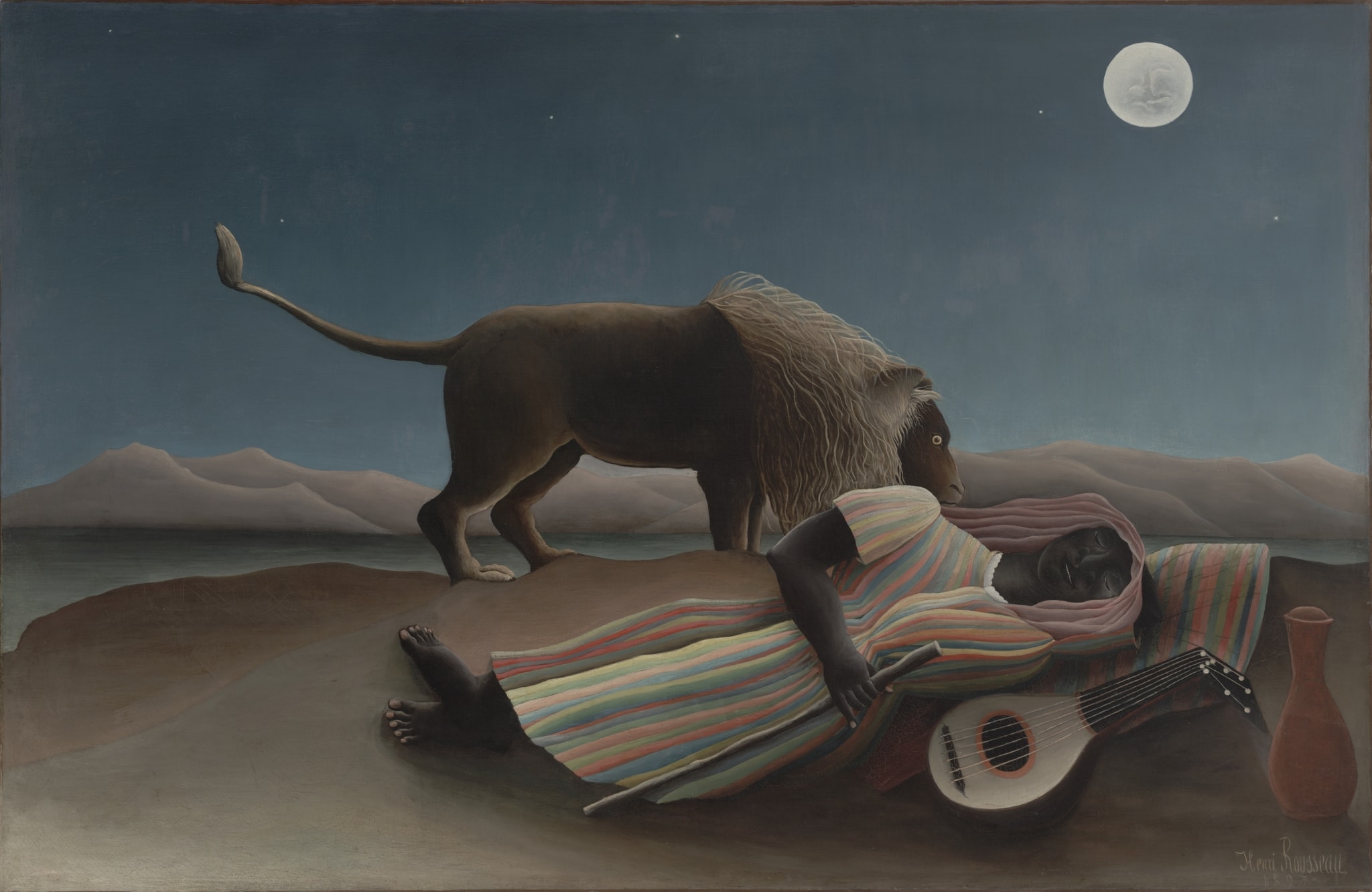
Rousseau’s lion leans in to sniff, not strike—an uncanny pause that turns a predator into the quiet fulcrum of The Sleeping Gypsy. Drawn from Paris’s ‘exotic’ image-bank yet rendered with dreamlike calm, the animal concentrates the painting’s suspense and serenity.
Historical Context
Painted in 1897, The Sleeping Gypsy emerged from a Paris enthralled by zoo menageries, taxidermy halls, and public sculpture that fed popular appetite for far‑off fauna. Rousseau, who never visited the deserts he imagined, studied animals at the Jardin des Plantes and in museum displays, then translated those sources into his own lexicon of simplified forms and lucid color 1. The artist even clarified the scene’s action in a letter: a lion “chances to pass by, picks up her scent yet does not devour her,” fixing the creature’s role as a cautious onlooker rather than an attacker 1.
Scholars have traced the lion’s pose—lowered head, alert tail—to a Paris model likely familiar to Rousseau: Alfred Jacquemart’s bronze Lion and Corpse at the Jardin des Plantes fountain. The resemblance suggests how a metropolitan sculpture became raw material for a nocturnal fantasy, repurposing a sensational motif into poised stillness 2. This blend of urban source material and dreamlike staging placed Rousseau squarely within fin‑de‑siècle currents that prized the exotic while anticipating modernist reinventions of subject and style 12.
Symbolic Meaning
The lion’s nonviolent approach produces a taut balance between threat and peace, the painting’s governing mood. MoMA describes the sleeper as vulnerable while the animal appears “calmed and entranced,” a reversal that converts the expected predator into a suspended possibility rather than an event 1. Rousseau’s own wording—that the lion smells her but does not devour—directs viewers to read the beast as a testing presence, not an executioner 1.
Across the twentieth century, interpretations expanded this poise into a theory of dreams. In 1926 Jean Cocteau proposed that the lion—and even the landscape—might be dream projection, an idea that aligned the picture with Symbolist concerns and foreshadowed Surrealism’s mapping of the unconscious 4. Pedagogical scholarship has pushed the reading further, recasting the animal as a guardian whose watch signals harmony between human and beast rather than imminent violence 6. General surveys note the lion’s fixed gaze and sniffing muzzle—details that keep the image on a knife‑edge of ambiguity, equally available to fear and reassurance 5. This multivalence powers the work’s “peculiarly psychic” charge: the lion is at once omen, sentinel, and embodiment of the sleeper’s interior world 1465.
Artistic Technique
Rousseau renders the lion with precise contours and crystalline color, modeling form through delicate shifts of moonlit tone rather than naturalistic anatomy. Light feathers across the mane and flanks, giving presence without muscular fuss, in keeping with the painting’s exacting yet Naïve finish 1. He flattens volumes and simplifies features—the single wide eye, taut tail, and planar body—distilling the animal into emblematic clarity 23.
Compositionally, the lion’s diagonal body locks against the horizontal desert and river, while the mane’s rhythms echo the sleeper’s striped robe, binding potential disruption into ordered pattern. Such stylization reflects Rousseau’s consistent practice of translating zoo and taxidermy sources into patterned, readable forms that privilege design over verisimilitude 32.
Connection to the Whole
The “sniffing” pause is the canvas’s engine: by hovering at the threshold of action, the lion concentrates the work’s polarity between serene sleep and latent danger. MoMA characterizes the animal as entranced before a dangerously vulnerable figure—an equilibrium that keeps the scene suspended, timeless, and intensely legible 1.
The lion also anchors the dream–reality hinge. Cocteau’s reading of the beast as a projection helps explain why the painting became a touchstone for modern explorations of the unconscious 4. Historically sourced from Parisian sculpture and menagerie culture, the predator arrives as a sign of the exotic; Rousseau neutralizes it through simplification and order, folding menace into harmony and turning spectacle into mystery 81.
Explore the Full Painting
This is just one fascinating element of The Sleeping Gypsy. Discover the complete interpretation, symbolism, and hidden meanings throughout the entire work.
← View full analysis of The Sleeping GypsySources
- MoMA Highlights (Rousseau, The Sleeping Gypsy): artist’s description and formal analysis
- Artnet News, “Untangling the Myths Behind Henri Rousseau’s Eccentric Masterpiece”
- National Gallery (London), Surprised! essay on Rousseau’s animal sources and method
- MoMA catalogue essay tracing Cocteau’s 1926 dream‑projection interpretation
- Encyclopaedia Britannica, entries on The Sleeping Gypsy and Rousseau’s later work
- Annenberg Learner, Art Through Time: Dreams & Visions (lion as protector)
- MoMA Collection record for The Sleeping Gypsy
- Los Angeles Times, exhibition coverage linking Rousseau’s lion to Jacquemart’s bronze