How Much Is The Sleeping Gypsy Worth?
Last updated: February 7, 2026
Quick Facts
- Last Sale
- $17K (1926, Hôtel Drouot, Paris)
- Methodology
- comparable analysis
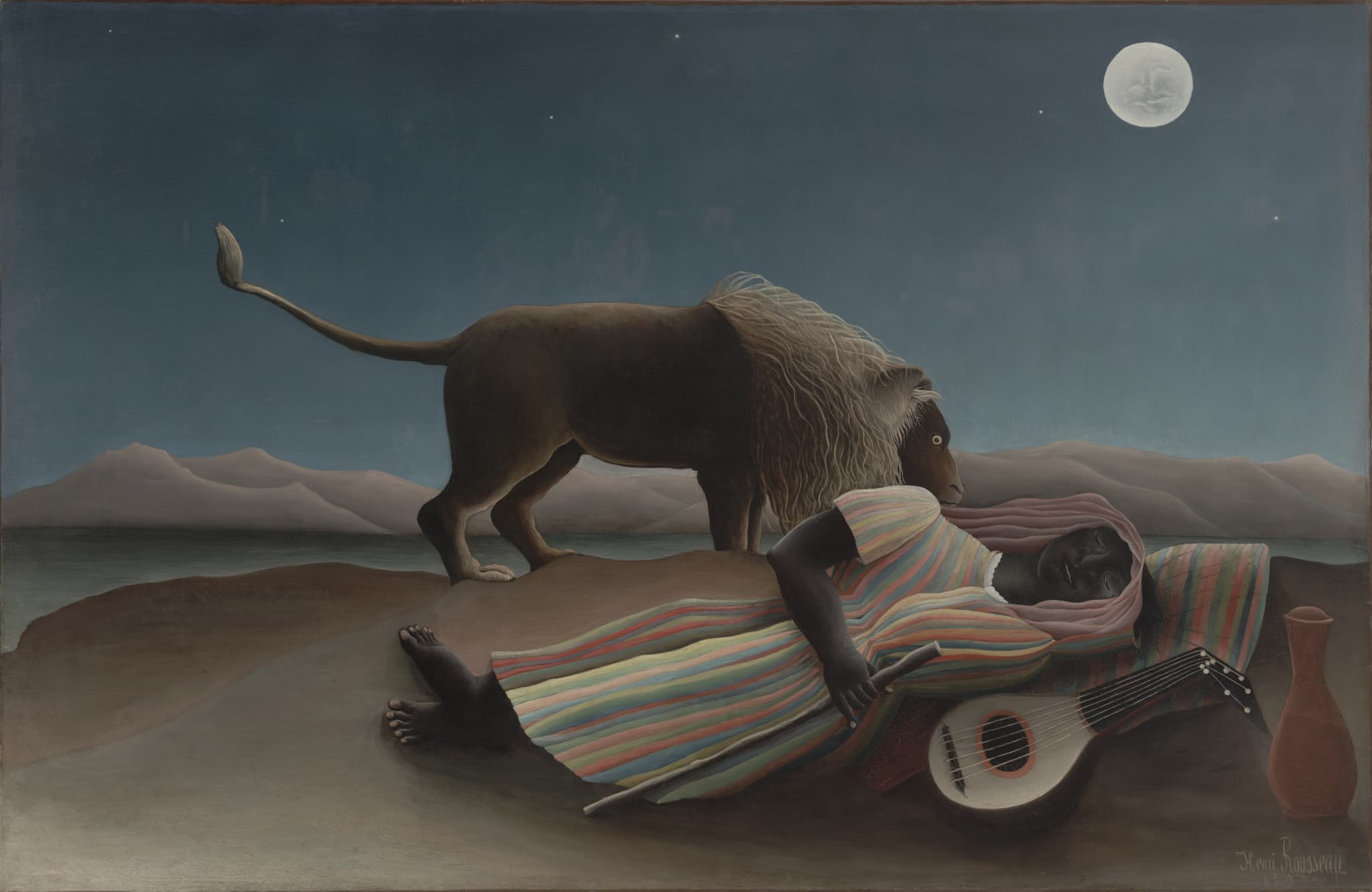
Henri Rousseau’s The Sleeping Gypsy is a canonical museum masterpiece whose hypothetical open‑market value is estimated at $120–180 million. The range is supported by Rousseau’s reset market level after the $43.5m sale of Les Flamants and nine‑figure benchmarks for culturally iconic late‑19th/early‑20th‑century works.
Valuation Analysis
Estimate: $120–180 million (hypothetical open‑market value). The Sleeping Gypsy (1897) is one of Rousseau’s two or three defining images and a centerpiece of the Museum of Modern Art’s collection, with universal recognition that far exceeds the artist’s typical market bandwidth [1]. Its cultural stature, rarity at the absolute top tier, and ironclad institutional provenance together justify a nine‑figure valuation if the work were ever to be privately offered.
Comparable analysis and anchoring data. Rousseau’s public market was decisively reset in May 2023 when Les Flamants achieved $43.5 million at Christie’s—an order‑of‑magnitude leap over his prior record and clear evidence of deep demand for a major late jungle canvas [2]. Cross‑artist trophy benchmarks of similar era and cultural weight regularly transact in the nine figures: Monet’s Meules at $110.7 million (2019) [3], Munch’s The Scream (pastel) at $119.9 million (2012) [4], and Klimt’s Portrait of Elisabeth Lederer at $236.4 million (2025) [5]. Given The Sleeping Gypsy’s singular iconicity within Rousseau’s oeuvre—arguably more recognizable than Les Flamants—positioning it at roughly 3×–4× Rousseau’s record and in line with these peer trophies is warranted.
Market dynamics and scarcity. Fewer than a few hundred Rousseau oils are known and the vast majority of A‑caliber examples reside in institutions, creating chronic supply scarcity. While late‑2024 bidding showed heightened selectivity—e.g., a jungle‑category work guided at $10–20 million went unsold [8]—this tightening has concentrated demand around unassailable, museum‑grade masterpieces. The Sleeping Gypsy sits at the very apex of that pyramid. In a well‑structured private sale with multiple global bidders, competitive tension could reasonably push the result toward or above the top of the indicated range.
Provenance, institutional status, and condition. The painting’s distinguished ownership history—from the John Quinn estate sale at Hôtel Drouot in 1926 (520,000 FF; buyer Henri Bing) to Olga Guggenheim’s 1939 gift to MoMA—adds confidence and prestige [7][1]. Its status as a MoMA icon typically confers a “museum‑masterpiece premium,” even as standard U.S. deaccession norms make an actual sale extraordinarily unlikely; those same norms underscore how irreplaceable the work is within the canon [6]. Any formal appraisal would be conditioned on a current conservation report, but the work’s extensive publication and exhibition record supports its preeminence.
Positioning and catalysts. The estimate reflects The Sleeping Gypsy’s unmatched brand recognition and foundational importance to early Modernism and proto‑Surrealism. Near‑term scholarship and exhibitions (Barnes Foundation/Orangerie, 2025–26) are expanding Rousseau’s audience and reinforcing critical esteem—positive demand drivers for the artist’s pinnacle works [9]. Balancing a somewhat narrower active collector base than Monet or Klimt with the extreme rarity and iconicity here, a $120–180 million bracket is the most defensible synthesis of current evidence and trophy‑market behavior.
Key Valuation Factors
Art Historical Significance
High ImpactThe Sleeping Gypsy is a cornerstone of early Modernism and a signature image of Rousseau’s career, frequently reproduced in survey texts and widely cited for its dreamlike poetics and proto‑Surrealist sensibility. Beyond its formal qualities—monumental stillness, nocturne palette, and emblematic lion—it encapsulates Rousseau’s unique synthesis of naiveté and sophistication that influenced generations of avant‑garde artists. Within Rousseau’s body of work, only The Dream and a handful of late jungle canvases rival its importance. This art‑historical centrality is a key driver of nine‑figure trophy pricing, ensuring intense competition among top collectors and institutions should it ever be available.
Iconicity and Cultural Recognition
High ImpactFew images from the fin‑de‑siècle era are as instantly recognizable as The Sleeping Gypsy. Its presence in MoMA’s collection has amplified its global visibility for decades, elevating it beyond specialist circles into popular culture. Such brand‑level recognition is a defining feature of works that clear $100 million—comparable to widely known images by Monet, Munch, and Klimt. For collectors seeking a museum‑defining statement piece, this level of cultural penetration translates directly into willingness to pay an exceptional premium for the single best example available, particularly when long‑term scarcity is effectively absolute.
Rarity and Market Supply
High ImpactPrime Rousseau oils are exceptionally scarce in private hands; most A‑tier works are sequestered in major museums. The public auction record of $43.5m for Les Flamants (2023) shows that when a major late canvas surfaces, demand is deep despite limited historical price precedents. At the same time, 2024’s bought‑in jungle‑category picture at a $10–20m pitch underscores buyers’ strict quality discrimination. The Sleeping Gypsy stands at the absolute pinnacle of quality and fame within the oeuvre, implying a step‑change above existing records. This extreme rarity supports both the nine‑figure level and the upper‑range outcome in a competitive setting.
Provenance and Institutional Status
High ImpactThe work’s passage through the storied John Quinn collection and its 1939 gift to MoMA from Olga Guggenheim provide impeccable provenance. Museum stewardship confers additional confidence around authenticity, care, and documentation—attributes valued at the very top of the market. While U.S. museum deaccession standards make an actual sale highly unlikely, that same status adds an intangible ‘museum‑masterpiece’ premium to any hypothetical pricing. Should deaccession policies permit a tightly managed private transaction, the combination of provenance quality and institutional imprimatur would be a powerful catalyst for premium bidding.
Market Context and Timing
Medium ImpactThe broader Modern segment saw value contraction in 2023–24 with pronounced caution at $10m+ price points, yet the very top of the market reasserted itself in 2025 with record‑level results for irreplaceable icons. Rousseau’s 2023 record confirmed a higher baseline for the artist’s best work, while subsequent selectivity penalized lesser examples. In this climate, a universally iconic, fully documented masterpiece like The Sleeping Gypsy aligns with what is still clearing at the apex: culturally resonant, trophy‑grade works with airtight narratives. Timing a sale to periods of peak trophy liquidity could draw strong international competition and stretch toward the top of the range.
Sale History
Hôtel Drouot, Paris
John Quinn estate sale; hammered 520,000 French francs; buyer Henri Bing. USD shown at approximate 1926 FX for context.
Henri Rousseau's Market
Henri Rousseau (1844–1910) is a foundational figure of Modern art whose market is defined by extreme scarcity at the top end. His public auction record leapt to $43.5 million with Les Flamants at Christie’s in May 2023, resetting expectations for major late jungle canvases. The collecting base is narrower than Monet or Klimt, but deep for the best examples, with robust institutional holdings reducing available supply. Late‑2024 caution led to the buy‑in of a smaller jungle‑category work guided at $10–20 million, highlighting stringent quality discrimination. Overall demand concentrates around fully published, museum‑caliber oils with ironclad provenance—precisely the tier where The Sleeping Gypsy resides.
Comparable Sales
Les Flamants
Henri Rousseau
Same artist; late, large-scale jungle subject (1910). Closest market anchor for an A+ Rousseau oil and directly evidences current demand for top-tier Rousseau paintings.
$43.5M
2023, Christie's New York
~$45.7M adjusted
The Scream (Pastel, 1895)
Edvard Munch
Category benchmark for a universally iconic, late‑19th‑century image with deep cultural resonance. Demonstrates nine‑figure pricing for masterpieces with global name recognition.
$119.9M
2012, Sotheby's New York
~$164.3M adjusted
Meules (Haystacks)
Claude Monet
Blue‑chip, period‑defining icon from the 1890s. Shows depth of global demand for emblematic late‑19th‑century images—useful for calibrating trophy pricing for The Sleeping Gypsy.
$110.7M
2019, Sotheby's New York
~$137.3M adjusted
Dame mit Fächer (Lady with a Fan)
Gustav Klimt
Top‑tier late work by a foundational Modern master. Confirms >$100m pricing for museum‑quality, globally recognized icons of roughly the same era.
$108.4M
2023, Sotheby's London
~$113.8M adjusted
Portrait of Elisabeth Lederer
Gustav Klimt
Record‑setting Modern trophy (2025). Establishes the contemporary ceiling for irreplaceable museum‑caliber masterpieces from the c. 1900–1915 period.
$236.4M
2025, Sotheby's New York
Current Market Trends
After a strong post‑pandemic run, Modern category values cooled in 2023–24 amid tighter liquidity and fewer trophy consignments, with buyers increasingly selective above $10 million. Despite this, the apex of the market remains resilient: when truly irreplaceable icons appear, competition is intense and price ceilings are tested, as seen with record results in 2025. This bifurcation favors unimpeachable masterpieces with global name recognition and flawless documentation. Rousseau’s top tier sits squarely in that lane, while mid‑tier works face more scrutiny. Against this backdrop, The Sleeping Gypsy aligns with what still commands premium pricing: an unassailable, museum‑grade, culturally iconic work.
Sources
- MoMA Collection: Henri Rousseau, The Sleeping Gypsy
- The Art Newspaper: Christie’s New York $506m spring sale nets records, incl. Rousseau
- Sotheby’s: Monet’s Meules sells for $110.7 million (artist record)
- ABC News: Edvard Munch’s The Scream sells for $120 million
- The Guardian: Klimt portrait sells for $236.4m, a modern-art auction record
- American Alliance of Museums: Deaccessioning & Disposal of Collections
- Haskell, Dissertation (UT Austin): 1926 Quinn estate sale reference
- Financial Times: Late‑2024 New York evening sales—selectivity and bought‑ins
- Barnes Foundation: Henri Rousseau—A Painter’s Secrets (2025–26)