How Much Is The Arnolfini Portrait Worth?
Last updated: February 5, 2026
Quick Facts
- Methodology
- comparable analysis
Our synthesized hypothetical valuation for Jan van Eyck’s The Arnolfini Portrait is $300–600 million. The estimate is anchored by top-tier Old Master comparables, the work’s singular art-historical status, and van Eyck’s extreme scarcity, with clear upside if multiple trophy-seeking buyers competed.
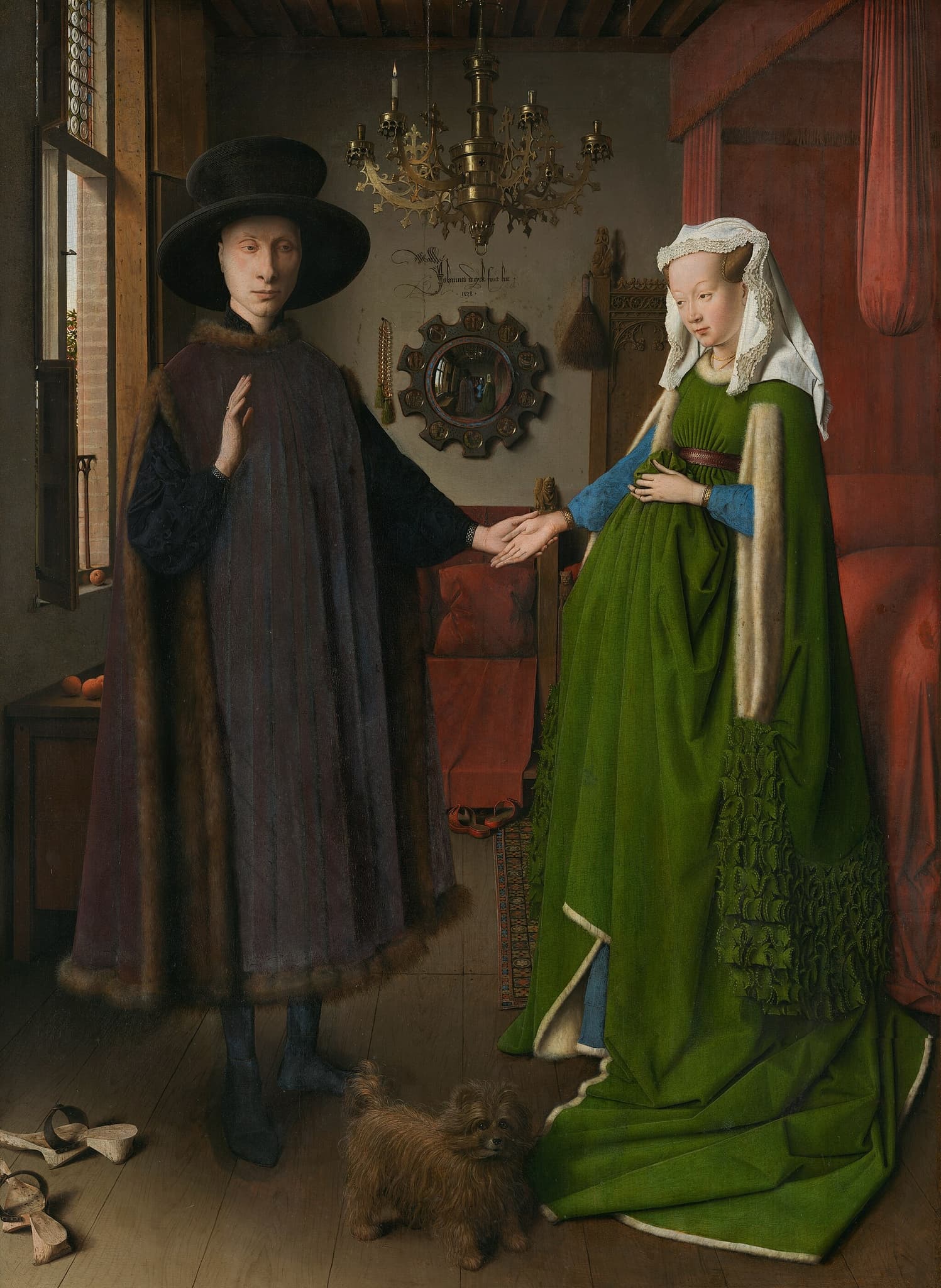
The Arnolfini Portrait
Jan van Eyck, 1434 • Oil on oak panel
Read full analysis of The Arnolfini Portrait →Valuation Analysis
Conclusion: Jan van Eyck’s The Arnolfini Portrait (1434), a cornerstone of Western art held by the National Gallery, London, would command $300–600 million in a hypothetical sale. This range reflects its unrivaled art-historical stature, van Eyck’s near-total market illiquidity, and the pricing environment set by recent trophy-caliber sales in adjacent categories [1][2].
Comparable anchor points: The upper end of the Old Masters market demonstrates capacity for record pricing when an icon with global name recognition appears. Leonardo da Vinci’s Salvator Mundi achieved $450.3 million at Christie’s (2017), establishing a modern ceiling for a canonical Renaissance picture [3]. Botticelli’s 2021 portrait reached $92.2 million, the strongest modern auction benchmark for a 15th-century portrait [4]. The joint institutional acquisition of Rembrandt’s pendant portraits for about €160 million (~$174m in 2016) evidences nine-figure institutional firepower for national-treasure portraits [5]. Set against these, Arnolfini’s fame, authorship, and rarity place it materially above Botticelli and credibly in the $300m+ arena, with realistic potential to exceed the Leonardo watermark in a multi-bidder scenario. Recent category records (e.g., Titian’s $22.2m in 2024) confirm continued depth at the top end even in selective markets [8].
Rarity and primacy: Autograph van Eyck paintings are among the scarcest in Old Masters; the small surviving corpus is almost entirely in museums. Arnolfini is arguably the most celebrated single-panel van Eyck after the Ghent Altarpiece and a touchstone for early oil technique and Northern portraiture. This combination of absolute scarcity and canonical status merits a substantial “national treasure” premium, justifying a band far above standard Old Master benchmarks [1].
Provenance and institutional context: The painting has been in the National Gallery since 1842, acquired from Maj.-Gen. James Hay; it has no modern auction history [2]. UK national collections are typically covered by the Government Indemnity Scheme rather than commercial insurance, with confidential valuations agreed for loans [6]. While a sale is theoretical under current governance, any market exercise would attract donor-backed museums, ultra–high-net-worth collectors, and sovereign entities, intensifying competition.
Market conditions and execution: Old Masters are a smaller auction sector with thinner liquidity, but masterpiece-level supply is exceptionally scarce and sparks intense bidding when available. Post-2024, the market remains selective but shows resilience and renewed participation for headline works [7][8]. Under auction or private treaty with two or more motivated principals, Arnolfini would clear $300m decisively; with three or more, pricing could test or surpass $600m. Our range balances that upside against category selectivity and acknowledges the work’s unmatched status within Northern Renaissance portraiture.
Key Valuation Factors
Art Historical Significance
High ImpactThe Arnolfini Portrait is a defining image of the early Northern Renaissance and among the most famous portraits in Western art. Its technical sophistication (oil glazes, optical precision) and densely layered symbolism make it a keystone for scholarship and a perennial public draw. Within van Eyck’s oeuvre, it sits at the very top, rivaled only by the Ghent Altarpiece in cultural prominence. This level of significance triggers a ‘canon icon’ premium observed in record-setting trophies, positioning the work well above most Old Master benchmarks and aligning it with the small set of universally recognized masterworks that transcend category constraints.
Extreme Scarcity of Autograph Works
High ImpactAutograph paintings by Jan van Eyck are extraordinarily scarce and overwhelmingly museum-held. There is no meaningful modern auction record for a fully accepted van Eyck panel. This near-zero supply drives value by forcing buyers to compete intensely when hypothetically presented with a one-of-one opportunity to acquire a canonical van Eyck. Scarcity premiums in Old Masters are amplified for artists with foundational art-historical importance; as a result, Arnolfini’s market position sits far above peers whose works surface occasionally. The scarcity factor underpins both the $300m floor and the potential to surpass past Old Master records if multiple committed buyers emerge.
Market Comparables and Trophy Demand
High ImpactRecent results demonstrate robust trophy demand at the very top: Leonardo’s Salvator Mundi at $450.3m established a modern ceiling; Botticelli’s $92.2m portrait defined a high-water mark for 15th‑century portraiture; and Rembrandt’s pendant portraits achieved a widely reported €160m via private treaty. These benchmarks, alongside recent Old Master records (e.g., Titian in 2024), show deep, global capital for singular works. Relative to these comps, Arnolfini’s fame and authorship justify a higher valuation band. In a competitive auction or negotiated private sale with multiple principals, pricing would plausibly extend into the $300–600m range.
Provenance, Legal Status, and National‑Treasure Premium
High ImpactHeld by the National Gallery since 1842, Arnolfini benefits from impeccable, long-term museum provenance and centuries of scholarship. UK national collections typically use the Government Indemnity Scheme for loans with confidential agreed values. While deaccession is highly constrained, the hypothetical nature of any sale does not diminish price—if anything, it elevates it via a ‘national treasure’ premium and donor/sovereign involvement. In practice, such objects transact only under exceptional circumstances, often at prices reflecting cultural patrimony as much as private market dynamics—supporting the top end of our range.
Sale History
Private treaty to the National Gallery, London
Original consideration was 600 guineas (£630 GBP) from Maj.-Gen. James Hay; USD shown is a 2025 CPI/FX illustration for context, not an 1842 transaction equivalent.
Jan van Eyck's Market
Jan van Eyck sits in the absolute top tier of Old Masters by art-historical importance, yet his market is effectively untested: virtually all of the roughly two dozen autograph paintings are in museums, and no confirmed autograph panel has sold at public auction in the modern era. Consequently, there is no meaningful auction ‘record’ for van Eyck. Pricing for a hypothetical sale must be extrapolated from adjacent benchmarks—Botticelli’s $92.2m portrait, the Rembrandt pair at ~€160m, and Leonardo’s $450.3m record—plus a scarcity and canon-icon premium. If an indisputably autograph van Eyck of major significance were offered, demand from museums (via donors), UHNW collectors, and sovereign-backed entities would be immediate and intense.
Comparable Sales
Salvator Mundi
Leonardo da Vinci
Rarest-tier Old Master trophy with global name recognition; demonstrates the upper bound of demand for canon-defining Renaissance works with extreme scarcity.
$450.3M
2017, Christie's New York
~$572.9M adjusted
Portrait of a Young Man Holding a Roundel
Sandro Botticelli
Top-tier Renaissance portrait benchmark; closest modern-market auction comp for a 15th-century master portrait with broad name recognition.
$92.2M
2021, Sotheby's New York
~$107.9M adjusted
Portraits of Maerten Soolmans and Oopjen Coppit
Rembrandt van Rijn
Museum-caliber Old Master portrait pair acquired privately at a widely reported nine-figure price; evidences institutional capacity to pay for national-treasure portraits.
$174.0M
2016, Private treaty (joint acquisition by Louvre & Rijksmuseum)
~$226.2M adjusted
Massacre of the Innocents
Peter Paul Rubens
Northern Baroque masterpiece and historic Old Master auction landmark; useful for calibrating high-end Old Masters appetite pre-2017.
$76.7M
2002, Sotheby's London
~$134.2M adjusted
Rest on the Flight into Egypt
Titian
Recent (2024) early Italian Renaissance record; shows current demand and price ceiling for rediscovered/masterpiece-level Old Masters in today’s market.
$22.2M
2024, Christie's London
~$22.8M adjusted
Portrait of Elisabeth Lederer
Gustav Klimt
Not an Old Master but a top-of-market trophy result that demonstrates current depth for globally iconic portraits; useful for upper-bound trophy-chasing context.
$236.4M
2025, Sotheby's New York
Current Market Trends
Old Masters remain the smallest auction segment and saw a contraction in 2024 amid a dearth of trophy lots, but standout works continued to achieve strong results. In 2024–2025, the category showed selective resilience: record prices for best-in-class works (e.g., Titian) and deep participation for masterpieces contrasted with a thinner mid-to-high market. The broader art market’s appetite for icons—evidenced by results from Leonardo and, outside the category, Klimt—indicates persistent capital for singular, globally recognized works. Against this backdrop, a canonical Northern Renaissance masterpiece like Arnolfini would command exceptional competition and pricing power.
Sources
- National Gallery, London — The Arnolfini Portrait (collection entry)
- National Gallery Scholarly Catalogue (Campbell, 1998) — ownership and 1842 acquisition details
- Christie’s — Leonardo da Vinci, Salvator Mundi sells for $450.3m (press release, 2017)
- Sotheby’s — Botticelli portrait sells for $92.2m (press release, 2021)
- The Art Newspaper — France and the Netherlands finalise €160m Rembrandt treaty (2016)
- UK Government — Government Indemnity Scheme (policy guidance)
- UBS/Art Basel — The Art Market 2025: Auctions (Old Masters sector trends)
- Christie’s — Old Masters Part I (London, July 2024): Titian record