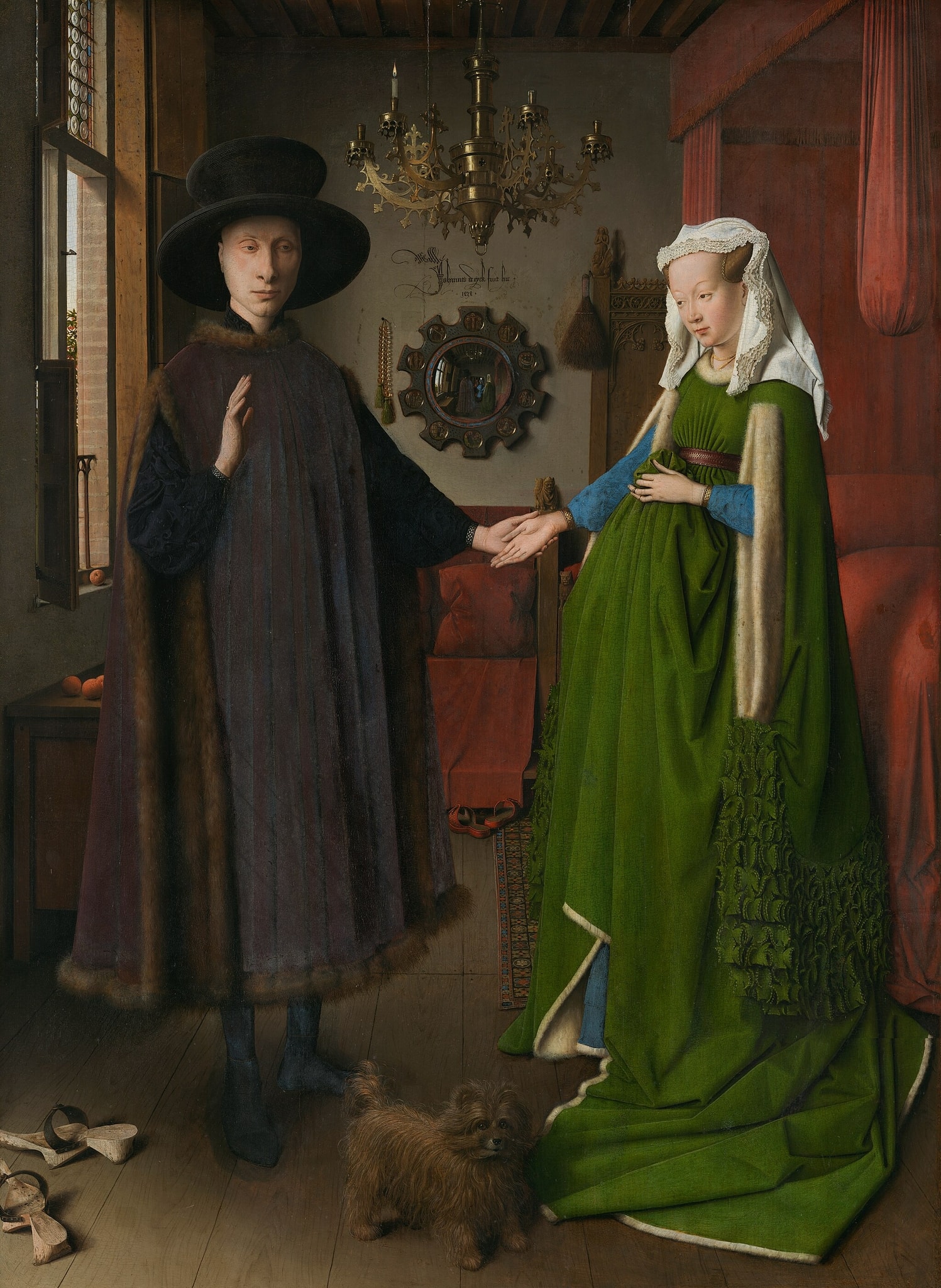
The Arnolfini Portrait

by Jan van Eyck

In The Arnolfini Portrait, Jan van Eyck stages a poised encounter between a richly dressed couple whose joined hands, a single burning candle, and a convex mirror transform a domestic interior into a scene of status and sanctity. The painting asserts the artist’s own presence—"Johannes de eyck fuit hic 1434"—as if to validate the moment while showcasing oil painting’s power to make belief tangible through light, texture, and reflection [1][2].
💰

Market Value

$300–600 million

How much is The Arnolfini Portrait worth?

Fast Facts

Year
1434
Medium
Oil on oak panel
Dimensions
82.2 × 60 cm
Location
The National Gallery, London
The Arnolfini Portrait by Jan van Eyck (1434) featuring Convex mirror with reflected figures and Passion roundels, Single burning candle, Joined hands and raised hand, Small Dog

Click on any numbered symbol to learn more about its meaning

Meaning & Symbolism

Van Eyck orchestrates the room so that the couple’s clasped right hands and the man’s raised left hand read as a deliberate act of self-presentation, not a notarized marriage. The painter amplifies this claim by writing himself into the wall—“was here”—and by placing two figures in the convex mirror who stand where a viewer would enter, turning the picture into a scene that acknowledges witnesses and the artist alike 12. Around that mirror, tiny Passion roundels inscribe salvation history into the domestic sphere, suggesting that conjugal life is lived under the arc of Christ’s suffering and redemption. Yet technical analysis shows many “symbolic” items—the dog at their feet, pattens by the floor, the chandelier’s candle, oranges on the sill, and even the St Margaret carving near the bed—were added late, weakening the idea of a pre-scripted legal or liturgical ceremony and underscoring van Eyck’s painterly freedom to intensify meaning as he worked 2. In this light, the single flame burning by day functions less as a coded contract clause and more as a potent sign of divine oversight within an image crafted to persuade us of the couple’s virtue and gravity 12. Status and piety are woven together through materials and fashion. The woman’s voluminous green gown—gathered, not pregnant—advertises expense and, in period associations, hope or fecundity; the man’s fur-lined tabard and broad hat project sober prosperity 1. Oranges and a fine carpet bespeak long-distance trade and wealth in Bruges, a mercantile hub where Giovanni di Nicolao Arnolfini, likely the sitter, was active 12. The amber-like rosary by the bed and the St Margaret carving (a childbirth patron) fold devotion into display, while the cast-off pattens at the floor’s edge nod to the threshold between outside traffic and an interior construed as morally charged space—an idea once overstated as “holy ground,” now treated with caution 12. The small dog, traditionally linked to fidelity, sits precisely where their hands meet, a visual hinge between affection and contract 1. The room itself is a reception chamber, not a modern bedroom; the grand bed served as a prestige furnishing for greeting guests, which clarifies the scene as a curated performance of household identity rather than a nuptial rite 12. Why The Arnolfini Portrait is important is that it redefines portraiture as an arena where social reality and sacred implication are fused through optical mastery. Van Eyck’s oil technique pulls daylight across glass, fur, brass, and velvet with such fidelity that the picture appears to certify truths about the couple simply by making them visible. That illusion of documentary certainty—bolstered by the mirror’s inclusive reflection and the performative signature—made the panel a touchstone for later debates: marriage certificate (Panofsky), betrothal (Hall), social performance (Harbison), or memorial image, a minority view 465. The National Gallery’s current position, grounded in technical study, steers away from a literal ritual reading, emphasizing instead a sophisticated double portrait in which objects carry layered, not fixed, meanings 2. In sum, van Eyck secures the couple’s honor and the painter’s authorship in the same stroke: a domestic covenant staged for the eye, authenticated by presence, and made enduring by paint 12.

Explore Deeper with AI

Ask questions about The Arnolfini Portrait

Popular questions:

Powered by AI • Get instant insights about this artwork

💬 Ask questions about this artwork!

Interpretations

Formal Analysis

Van Eyck binds optical bravura to authorial self-inscription. The convex mirror expands the picture’s field to include putative witnesses, while the artist’s note—“fuit hic”—asserts presence as a pictorial event. The room’s plausibility masks engineered anomalies (mirror scale, chandelier clearance), reminding us that naturalism is a constructed rhetoric. Technical study shows iterative revisions and late additions, evidencing a working method that layered meanings as paint accrued. The result is a calculated mimesis that performs truth rather than merely recording it: textures persuade (fur, brass, glass), reflections authenticate, and script seals the contract of looking. Van Eyck’s oil technique—glazes over a carefully prepared underdrawing—serves not just description but argument: that seeing, here, equals believing 123.

Source: National Gallery; Lorne Campbell (NG Catalogue); The Met Heilbrunn Timeline

Social-Economic Context

This image stages a merchant household’s credit-worthiness in objects: imported oranges, a Levantine-style carpet, and regulated furs tie the sitters to Bruges’s international trade circuits. The “bedroom” is in fact a reception chamber—status furniture arranged for callers—so display is social currency. The small dog and meticulous floors read as good order, while sober dress codes temper luxury with probity. Rather than a notarial scene, the portrait acts like a balance sheet in images, translating liquidity and reputation into visible tokens. In Harbison’s terms, such things carry multivalent meanings inside lived courtly-urban culture; they are not rigid symbols but social behaviors made legible through paint 126.

Source: National Gallery; Lorne Campbell (NG Catalogue); Craig Harbison, Renaissance Quarterly

Devotional-Domestic Theology

Passion roundels encircling the mirror and the amber-like rosary introduce lay devotion into a mercantile interior. The single burning candle—often analogized to a sanctuary light—suggests vigilant divine oversight more than contractual oath. Yet technical evidence complicates programmatic symbolism: St Margaret’s carving and other “pious” props were added late, arguing for accretive intensification rather than a pre-scripted iconographic scheme. Read this as Burgundian household piety—habitual prayer embedded in daily space—rather than a sacramental moment. The painting’s power lies in how it domesticates salvation history without collapsing into allegory: the sacred hovers, supervises, and dignifies conduct in an urbane room that remains thoroughly lived-in 12.

Source: National Gallery; Lorne Campbell (NG Catalogue)

Ritual & Legal Culture (Comparative Reading)

Panofsky’s classic claim that the panel is a witnessed marriage contract made the signature quasi-notarial and objects juridical; Hall softened this to a betrothal (sponsalia) suited to a domestic venue. Current NG scholarship resists both: underdrawing revisions, absence of clergy, and late-added “symbols” argue against a fixed ritual program. The gestures read as self-presentation within civic custom, where reputation worked through visible comportment and things. Thus the picture borrows the gravitas of legal witnessing—mirror “attendees,” emphatic script—without performing law. It’s a savvy conflation of public and private, ceremony and sociability: a portrait that feels official because it orchestrates signs of officialdom 245.

Source: Lorne Campbell (NG Catalogue); Erwin Panofsky; Edwin Hall

Memorial Hypothesis (Debated)

Some scholars (e.g., Koster) read the snuffed candle and selective emphases as cues that the woman may be deceased, making the panel a memorial double portrait. This reading marshals asymmetric lighting, Passion imagery, and the bed’s prominence to suggest absence marked by presence. The National Gallery, however, finds insufficient evidence: many supposed signals are late additions or common devotional props, and the work’s social address argues for a living reception space. Even if not a memorial, the image tolerates a memento mori inflection: the lone flame by day, crystalline surfaces, and mirror miniatures calibrate a world where visibility is fragile and honor is what endures. The painting’s ambiguity keeps mortality latent within domestic dignity 27.

Source: Margaret L. Koster; Lorne Campbell (NG Catalogue)

Related Themes

About Jan van Eyck

Jan van Eyck, court painter to Philip the Good in Bruges, pioneered a luminous oil technique that enabled unprecedented naturalism and intricate symbolic layering. Active by the 1420s and dead by 1441, he helped define Northern Renaissance painting through works that fuse devotional themes with acute observation [3][7].
View all works by Jan van Eyck