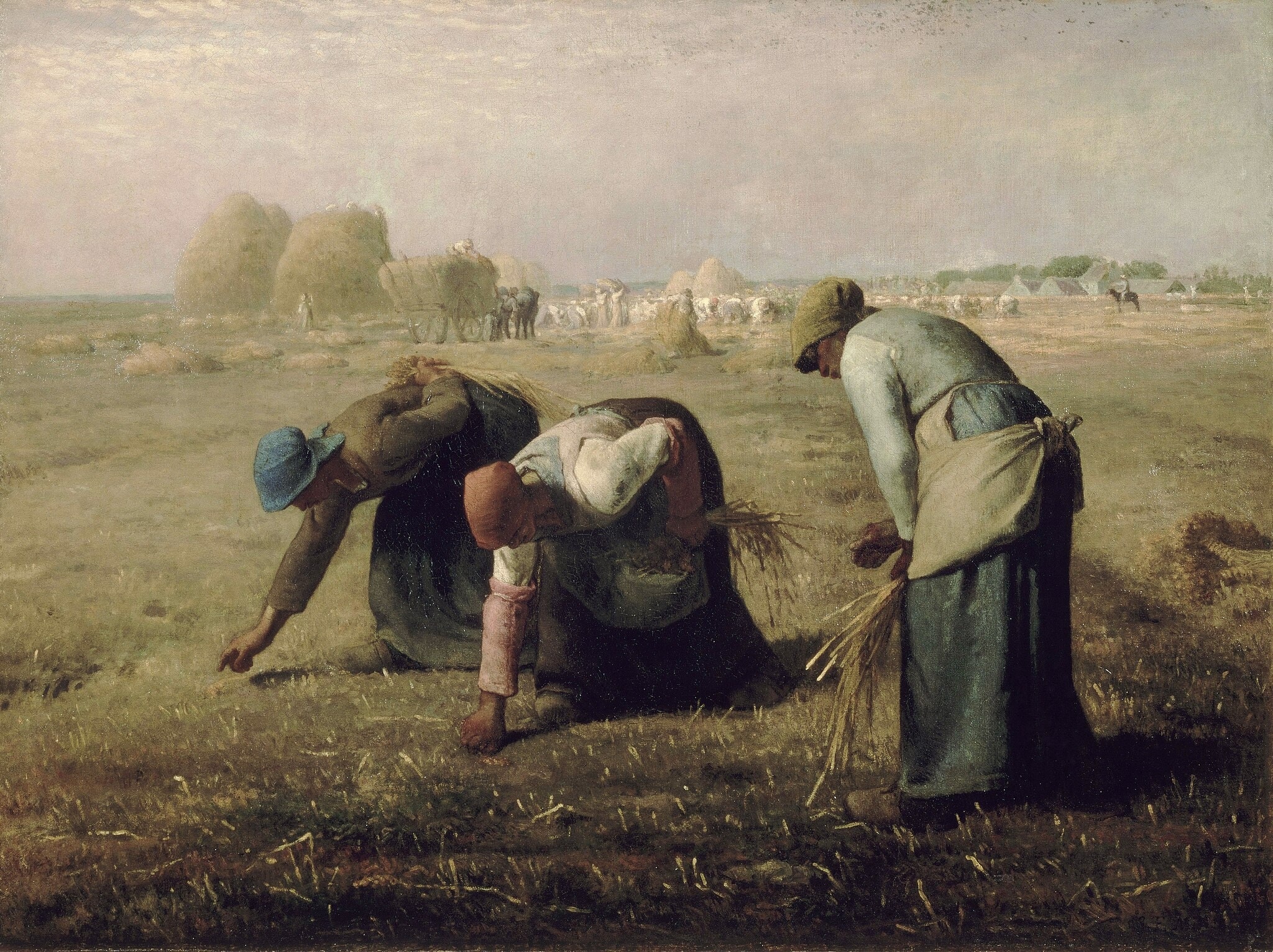
The Gleaners
Three peasant women bend in a solemn rhythm, gleaning leftover stalks under a dry, late-afternoon light. In the far distance, tiny carts, haystacks, and an overseer on horseback signal abundance and authority, while the foreground figures loom with monumental gravity, asserting the dignity of labor amid inequality [1][2].
Fast Facts
- Year
- 1857
- Medium
- Oil on canvas
- Dimensions
- 83.5 x 110 cm
- Location
- Musée d’Orsay, Paris
Click on any numbered symbol to learn more about its meaning
Meaning & Symbolism
Millet composes a triad of bodies—left, center, right—that choreographs the gleaning cycle: reaching, grasping, gathering. The women’s faces are shadowed, their hands close to the soil, and their torsos hinge at the waist, creating a low, horizontal cadence that reads as ritual rather than anecdote. The abrupt change of scale between these near-life-size figures and the miniaturized background—haystacks, loaded wagons, a cluster of workers—turns the landscape into a ledger of inequality. The wealth of the harvest sits far away in a powdered, golden haze, while the foreground is weighted and tactile, lit by slanting light that carves the women’s sleeves, aprons, and kerchiefs into sculptural volumes 1. A small rider at the right middle distance functions as a steward, emblem of property and surveillance. His presence codifies gleaning as permitted yet policed charity, echoing biblical mandates that landowners leave the edges of fields for the poor (Leviticus 19; Deuteronomy 24; Ruth) 15. Within this visual economy, the women are both subject to rules and morally centered by the composition.
The painting’s quiet radicalism lies in its fusion of Realist observation with classicizing monumentality. Millet borrows the gravitas of the grand tradition—broad silhouettes, a low horizon, sculptural mass—to elevate a subject typically relegated to genre scenes. Contemporary viewers felt the pressure of that elevation: critics at the 1857 Salon saw not just gleaners but the specter of social unrest, calling them the “Three Fates of poverty” and hinting at revolutionary anxieties in the wake of 1848 24. Yet the canvas avoids agitprop. Instead, its power comes from controlled formal contrasts: nearness versus distance, weight versus haze, anonymity versus overseen order. The women’s bodies read as durable architecture against a sky worked to a matte calm; their task is repetitive, but the sequence of gestures—bend, pick, lift—suggests time, endurance, and the minimal increments by which survival is achieved 13. The painting thus performs an ethical recalibration: prosperity is plentiful but remote, while the act that secures subsistence is immediate, central, and dignified.
That recalibration explains why The Gleaners is important in art history. It extends Realism’s program of bringing modern life into high art, akin to Courbet, but with a poetic austerity that makes critique inseparable from empathy 23. By monumentalizing women who work at the threshold between plenty and want, Millet provides an image that is at once local—rooted in the custom of gleaning—and universal in its address to labor, scarcity, and social hierarchy. The canvas became a touchstone for later artists who sought an “epic of the everyday,” demonstrating that formal choices—scale, horizon, light—can articulate social meaning without narrative excess. In short, the meaning of The Gleaners is a moral argument made through composition: abundance may define the background of society, but the measure of its justice is found in those who gather what remains 123.
Explore Deeper with AI
Ask questions about The Gleaners
Popular questions:
Powered by AI • Get instant insights about this artwork
💬 Ask questions about this artwork!
Interpretations
Historical Context & Reception
Exhibited at the 1857 Salon, The Gleaners landed in a France still tense after 1848. Critics read the canvas as politically volatile precisely because it monumentalized rural poor at Salon scale. Period commentary dubbed the trio the “Three Fates of poverty,” insinuating revolutionary menace behind their calm industry, and even invoked the specter of 1793 24. Yet the painting withholds agitational narrative; its charge lies in how grand composition meets modest subject. This reception history clarifies how form becomes ideology in the Second Empire: a large canvas of peasants could be seen as subversive even without explicit polemic, because it reassigns pictorial honor from elites to laborers 2.
Source: The Met (Heilbrunn Timeline); Larousse (press summaries)
Iconography & Biblical Ethics
Millet taps a deep iconographic well: the practice of gleaning echoes Leviticus 19 and Deuteronomy 24, and resonates with the Book of Ruth, where leftover harvest sustains the vulnerable 15. In Orsay’s reading, the small mounted steward marks gleaning as permitted but regulated—charity bounded by property 1. This dual coding (mercy and control) complicates the foreground’s dignity: the women’s work embodies a covenantal ethic while remaining contingent on estate oversight. The picture thus stages an ethical paradox: a landscape of plenty that depends on laws of restraint, with surveillance as the hinge between scriptural obligation and modern agrarian capitalism 15.
Source: Musée d’Orsay; ESV Bible (Leviticus 19; Deuteronomy 24; Ruth 2)
Formal Analysis: Scale, Light, and Social Optics
The painting’s critique is formal. Orsay highlights the abrupt change of scale: near‑life‑size figures press against the picture plane while distant carts and haystacks dissolve into powdered haze 1. Slanting late‑day light carves sleeves and aprons into sculptural volumes, granting weight to toil even as background wealth is miniaturized and aestheticized 13. The low horizon and broad silhouettes borrow the grand manner to recast labor as monumentality without rhetoric. This optical structure reassigns value: proximity equals gravity, distance equals abstraction. Inequality is not narrated; it is seen through calibrated contrasts of mass, clarity, and atmospheric recession 13.
Source: Musée d’Orsay; Smarthistory
Gendered Labor: Anonymity and Endurance
Millet’s trio are women whose bodies hinge at the waist, their faces shadowed and identities generalized—emblematic rather than individuated 1. This anonymity, far from erasure, amplifies a gendered logic of rural work: domestic textiles (aprons, kerchiefs) become quasi‑architectural forms, converting care‑adjacent labor into public monument 13. The sequential gestures—bend, grasp, lift—map a feminized choreography of endurance, where visibility accrues not through portrait likeness but through repetition and duration. By monumentalizing women in the field, Millet counters the era’s relegation of female labor to the private sphere, yet he also signals its constrained social legibility through the withheld face 13.
Source: Smarthistory; Musée d’Orsay
Realism’s Grand Manner and Political Charge
Within nineteenth‑century Realism, Millet’s strategy is to fuse empirical observation with classicizing gravitas, a move that made everyday labor carry the weight of history painting 2. Like Courbet’s Stonebreakers (now lost), the scale itself became ideological: to dignify peasants at this size was to rebuke academic hierarchies of subject matter 2. But Millet tempers provocation with poetic austerity—broad masses, matte skies, controlled rhythms—showing how Realism can critique without anecdote. The result is a model for later artists seeking an epic of the everyday, where composition (horizon, silhouette, atmospheric depth) becomes a carrier of social meaning apart from overt narrative 23.
Source: The Met (Heilbrunn Timeline); Smarthistory
Process & Iteration: Studies, Etching, and Refinement
Years before 1857, Millet probed the motif in a vertical composition and an etching (c. 1855–56), now in multiple collections 678. Comparing the print to the painting shows a tightening of the gesture sequence and a lowering of the horizon to magnify the figures’ mass. The etching’s linear economy clarifies how Millet distilled the triadic rhythm and calibrated spacing before committing to oil. This iterative path underscores intention: the monumentalization of gleaners was not spontaneous observation but a considered design problem—how to translate repetitive labor into durable architecture on the picture plane 678. The painting reads, therefore, as the culmination of a sustained compositional experiment.
Source: Cleveland Museum of Art; Hood Museum; Smithsonian American Art Museum
Related Themes
About Jean-Francois Millet
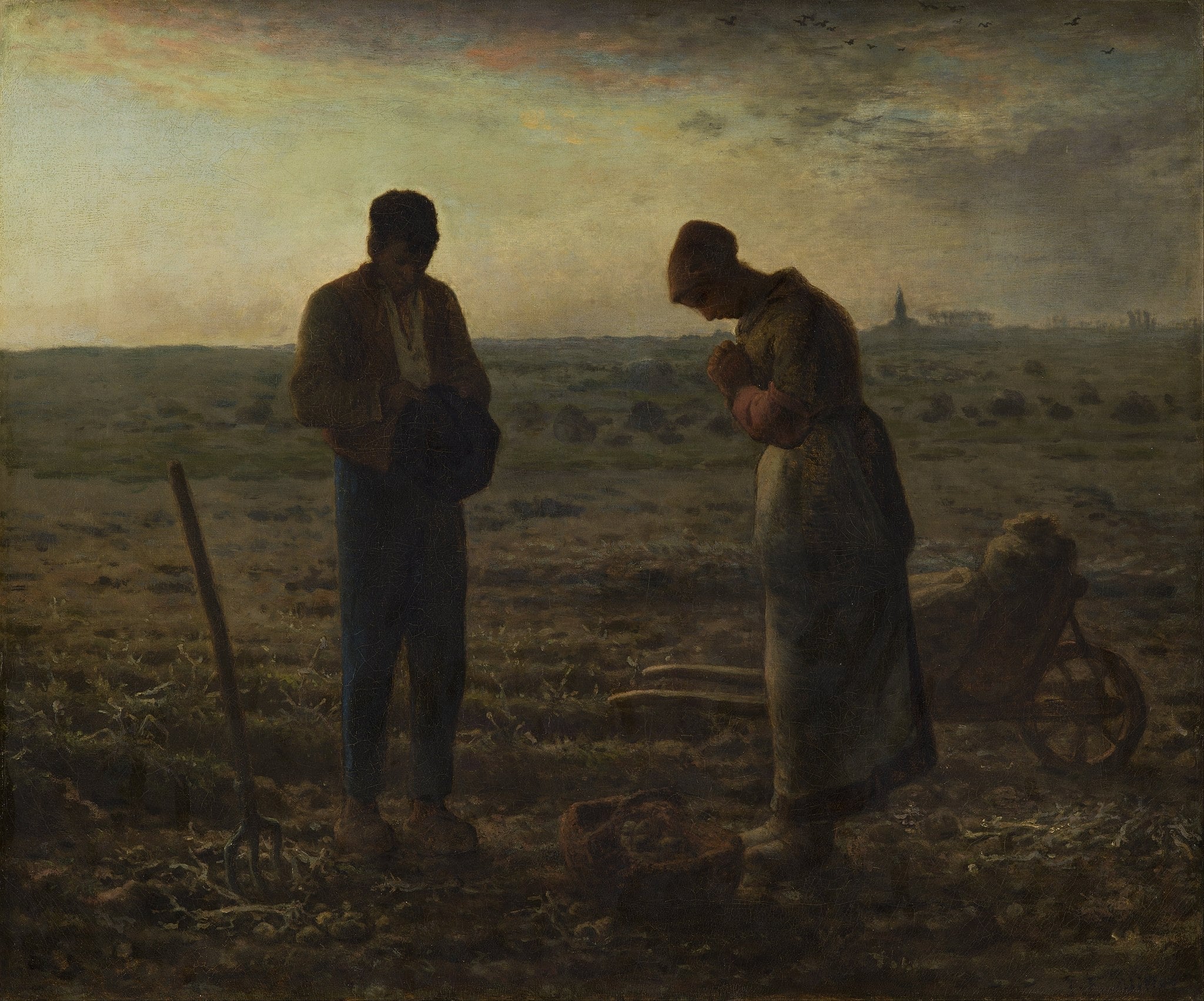
Jean-Francois Millet (1814–1875), a leading Realist associated with the Barbizon school, devoted his career to monumental images of rural labor. After settling in Barbizon in 1849, he pursued peasant subjects—The Sower, The Gleaners, The Angelus—seeking to dignify modern work with classical gravity while resisting overt propaganda [2][6].
View all works by Jean-Francois Millet →