The Distant Harvest in The Gleaners
A closer look at this element in Jean-Francois Millet's 1857 masterpiece
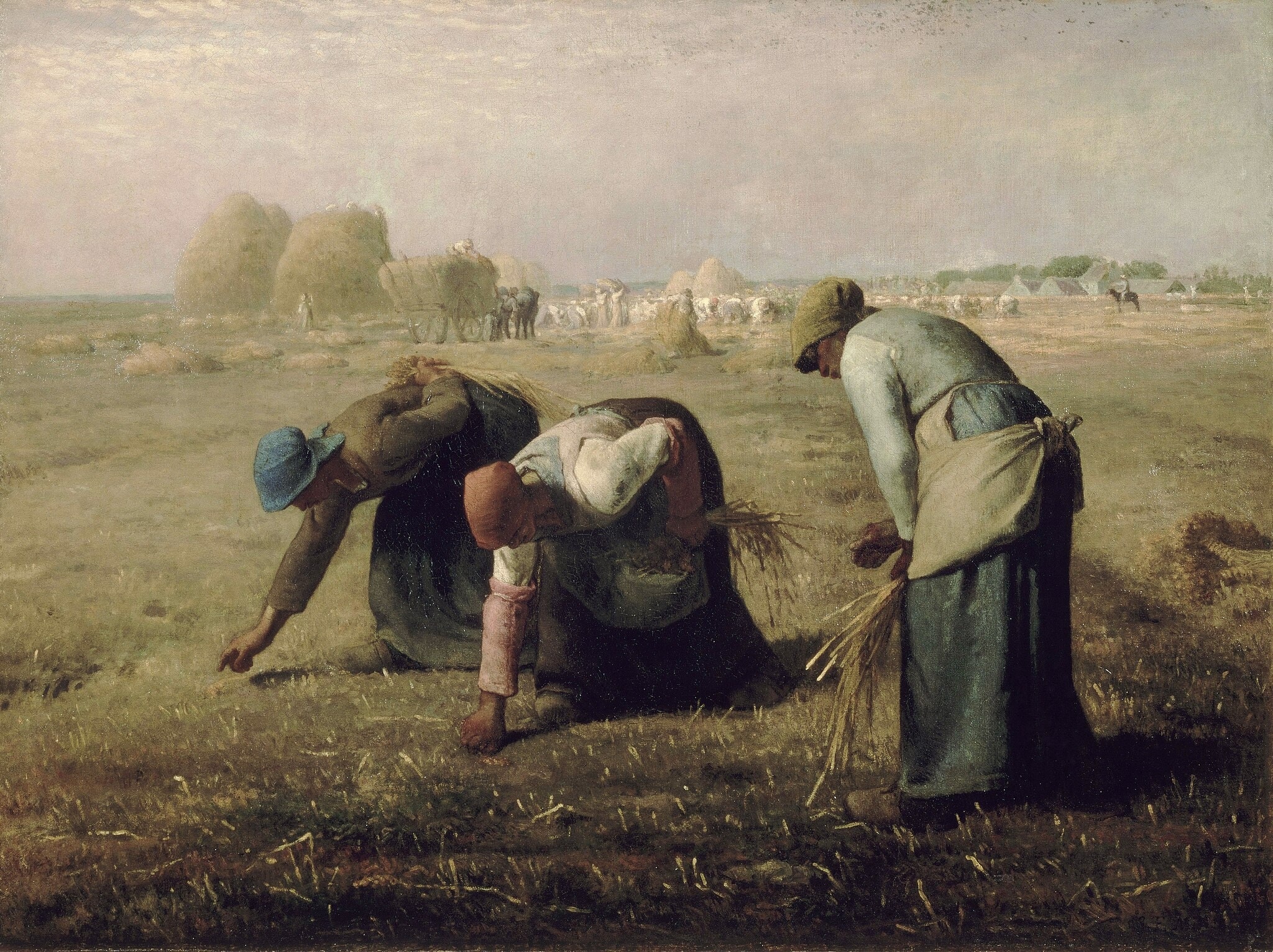
Across the horizon of Millet’s The Gleaners, a sun‑washed field hums with wagons, hayricks, and a mounted steward—the estate’s prosperous harvest unfolding at scale. This bright, organized bustle throws the shadowed gleaners into sharper relief, turning a rural scene into a clear-eyed meditation on labor, authority, and exclusion.
Historical Context
Painted for the Salon of 1857, The Gleaners grew out of Millet’s close study of rural labor around Barbizon. He situates three women gleaning the scraps of the cut grain against the estate’s main harvest, which stretches across the horizon in full swing—sheaves stacked into ricks, a heaped wagon, and a mounted steward supervising the workforce. Musée d’Orsay’s curators describe this background as a deliberately brighter, more abundant zone that “opposes” the gleaners’ rough toil, anchoring the scene in the real practices and hierarchies of Second‑Empire agriculture 1.
Contemporary guidance from the same museum clarifies why the contrast mattered in 1857: gleaning was tolerated charity but strictly policed, and Millet shows the very figure who enforces the rules. Viewers encountered poverty and plenty in the same field, sparking polarized responses—some saw dignity, others feared social agitation. By embedding the bustling harvest and its overseer, Millet made class, control, and charity legible at once, which helps explain the scandalized reception at the Salon 2.
Symbolic Meaning
The distant harvest reads as the landowner’s domain—orderly, productive, and sunlit. It symbolizes wealth and agricultural success, a sphere from which the foreground gleaners are economically excluded. The rider near the horizon embodies surveillance and property rights, converting background incident into a sign of authority. Art historians therefore treat the painting not as a biblical parable but as modern social commentary: the luminous abundance beyond literalizes the resources that remain out of reach for those who stoop to gather leftovers 13.
Millet had already forged this opposition in Harvesters Resting (Ruth and Boaz), where a meager gleaner’s bundle confronts stacked grain—an image of sanctioned charity beside amassed wealth. That logic persists here, sharpened by distance and light: prosperity appears miniature yet pervasive, a golden belt encircling the scene while the gleaners labor under stricter light and shadow. Standard readings summarize the effect succinctly—“grinding poverty in the foreground” against a “rich harvest in the sunlit distance”—a pairing that made inequality legible to Salon audiences and still organizes how the work is read today 65.
Artistic Technique
Millet renders the far scene in a high-key palette—powdery golds and tawny ochres—bathed in late‑day light that dissolves edges into a festive haze. Against this veil, hayricks, a heaped wagon, clustered laborers, and the mounted steward register as bright notes more than detailed forms, signaling abundance by mass and tone rather than description. He stages an abrupt change of scale across a high horizon: the gleaners are monumental and sculpted by raking light, while the harvest is miniaturized and radiant, a band of prosperity held just beyond reach. This calculated shift in value, color temperature, and scale turns background into argument as much as atmosphere 1.
Connection to the Whole
The horizon’s activity supplies the painting’s argumentative spine. By showing evident plenty, organized labor, and a watchful steward at a remove, Millet frames the gleaners’ bent, repetitive motions as work performed under rules and at the margins of prosperity. The background’s brightness is not decorative; it is the counterweight that defines the foreground’s austerity and makes the painting’s social stakes unmistakable 13.
Without the distant harvest, the three figures would read as generic peasant types. With it, their gestures become historically specific acts within a regulated economy of charity and control. Light, scale, and placement bind the zones together, ensuring that wealth and want are seen simultaneously—precisely the conjunction that animated the painting’s contentious Salon debut 2.
Explore the Full Painting
This is just one fascinating element of The Gleaners. Discover the complete interpretation, symbolism, and hidden meanings throughout the entire work.
← View full analysis of The GleanersSources
- Musée d’Orsay, object page: Des glaneuses (1857)
- Musée d’Orsay, educator guide: Le monde rural vu par les artistes (pp. 4–5)
- The Met, Heilbrunn Timeline: Nineteenth-Century French Realism
- The Art Story, Jean‑François Millet: Artworks (The Gleaners entry)
- Wikipedia, The Gleaners
- Museum of Fine Arts, Boston, Harvesters Resting (Ruth and Boaz)