The Three Bent Women in The Gleaners
A closer look at this element in Jean-Francois Millet's 1857 masterpiece
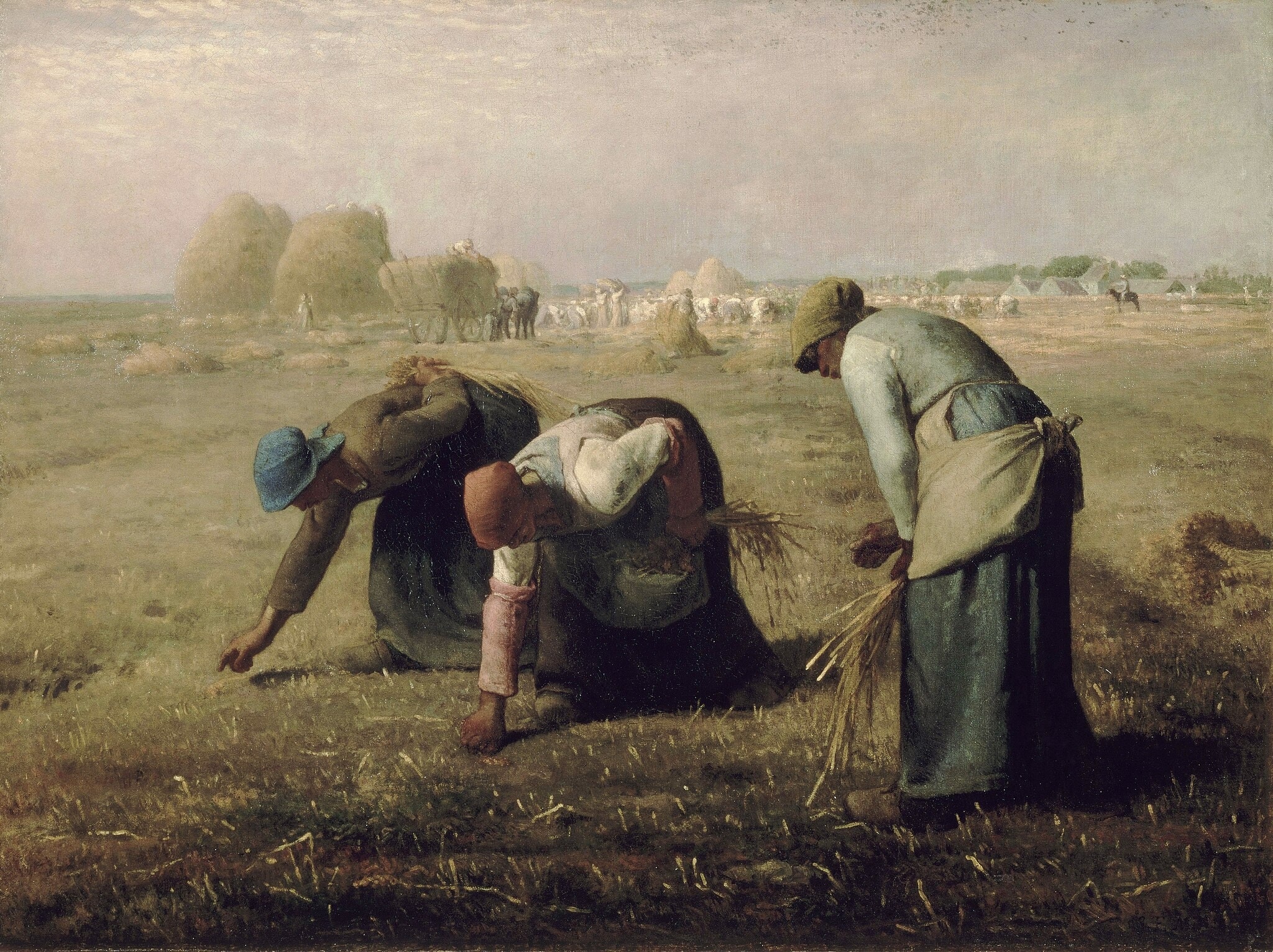
The three bent women in the foreground of Millet’s The Gleaners embody the most precarious rung of rural labor—gleaning, the sanctioned gathering of leftover grain. Monumentalized at close range yet separated from the prosperous harvest behind them, they turn a routine act of survival into a quiet epic of endurance and social critique.
Historical Context
Exhibited at the Paris Salon of 1857, The Gleaners appeared in the tense aftermath of the Revolution of 1848, when public debate over poverty, labor, and social order was acute. Realist painters like Millet were elevating everyday work to the scale of history painting, a move some Salon viewers deemed unsettling. Critics read the canvas as politically edged precisely because it foregrounded the rural poor at heroic scale, even though the artist’s manner remained restrained and traditional 2.
The subject itself—three women gleaning—comes from a long‑standing communal right that allowed the poorest villagers to collect scraps after the harvest. Millet anchors these figures in the immediate foreground, while abundant haystacks, loaded carts, and a mounted steward recede into luminous distance. The steward symbolizes the oversight and rules that governed gleaning, visually underscoring the women’s constrained position within the agrarian hierarchy. Musée d’Orsay characterizes them as certainly poor yet treated with emblematic dignity rather than sentimentality, situating the motif within contemporary practices and the charged reception the painting received at the Salon 1.
Symbolic Meaning
The trio functions less as individualized portraits than as types of peasant womanhood engaged in the lowest‑status agricultural task. Bent backs, lowered heads, and hands close to the ground mark an existence tied to subsistence and repetition. By placing them across the entire foreground, Millet confers scale, weight, and visibility, transforming gleaning into an emblem of endurance and of structural inequality. Musée d’Orsay notes that the women retain dignity without lapse into pity, while the distant haystacks and bustling carts stage a deliberate contrast between scarcity and abundance 1, 5.
Within the politics of Realism, that contrast reads as a quiet social critique. The women’s monumental presence, their rhythmic sequence of stoop–grasp–rise, and their separation from the “main enterprise” of the harvest encode hierarchy directly into the composition. An overseer on horseback appears indifferent, a figure of regulation rather than aid. Contemporary viewers recognized the implications: humble labor had been granted the gravitas traditionally reserved for sacred or heroic history, a reallocation of artistic prestige that many found subversive after 1848. Smarthistory and the Met underline how the figures’ postures and the painting’s sober handling communicate hardship while asserting peasant life as a worthy, modern subject 3, 2.
Artistic Technique
Millet renders the three women with muted earth tones and softened contours, tempering stark subject matter with a low, pearly light. He models the figures with denser paint, giving their backs and arms sculptural heft and a palpable sense of effort. Kept below the horizon, the bodies rhyme as a left‑to‑right cadence—stooping, gathering, beginning to rise—creating a visual grammar for repetitive labor. By enlarging the trio in the foreground and pushing opulent sheaves, haystacks, carts, and a mounted steward into the luminous distance, Millet shapes a formal counterpoint that serves his social theme. The figures’ weight and calm frontality recall classical gravitas, applied here to modern peasant work 3, 2.
Connection to the Whole
The three bent women are the painting’s moral and compositional fulcrum. Their nearness to the earth and cyclical motions anchor the foreground, while the glowing expanse of harvested wealth and the watchful steward in the distance articulate a stratified rural order. Read together, the trio, the overseer, and the haystacks map a clear hierarchy—from gleaners to management to landowners—without resorting to narrative rhetoric. This monumental genre foreground is the Realist statement of the work: anonymous, low‑status labor assumes the visual authority of high art, turning a specific practice into a broader meditation on endurance, value, and social distance in mid‑19th‑century France 1, 3, 2, 4.
Explore the Full Painting
This is just one fascinating element of The Gleaners. Discover the complete interpretation, symbolism, and hidden meanings throughout the entire work.
← View full analysis of The GleanersSources
- Musée d’Orsay – Des glaneuses (The Gleaners), object record
- The Metropolitan Museum of Art – Heilbrunn Timeline: Nineteenth‑Century French Realism
- Smarthistory – Jean‑François Millet, The Gleaners
- Musée d’Orsay – Education guide: Le monde rural vu par les artistes
- Musée du Louvre – Les Glaneuses (graphic study)
- National Gallery of Art – Education packet: Picturing France, 1830–1900