How Much Is View of Delft Worth?
Last updated: February 22, 2026
Quick Facts
- Current Location
- Mauritshuis
- Methodology
- comparable analysis
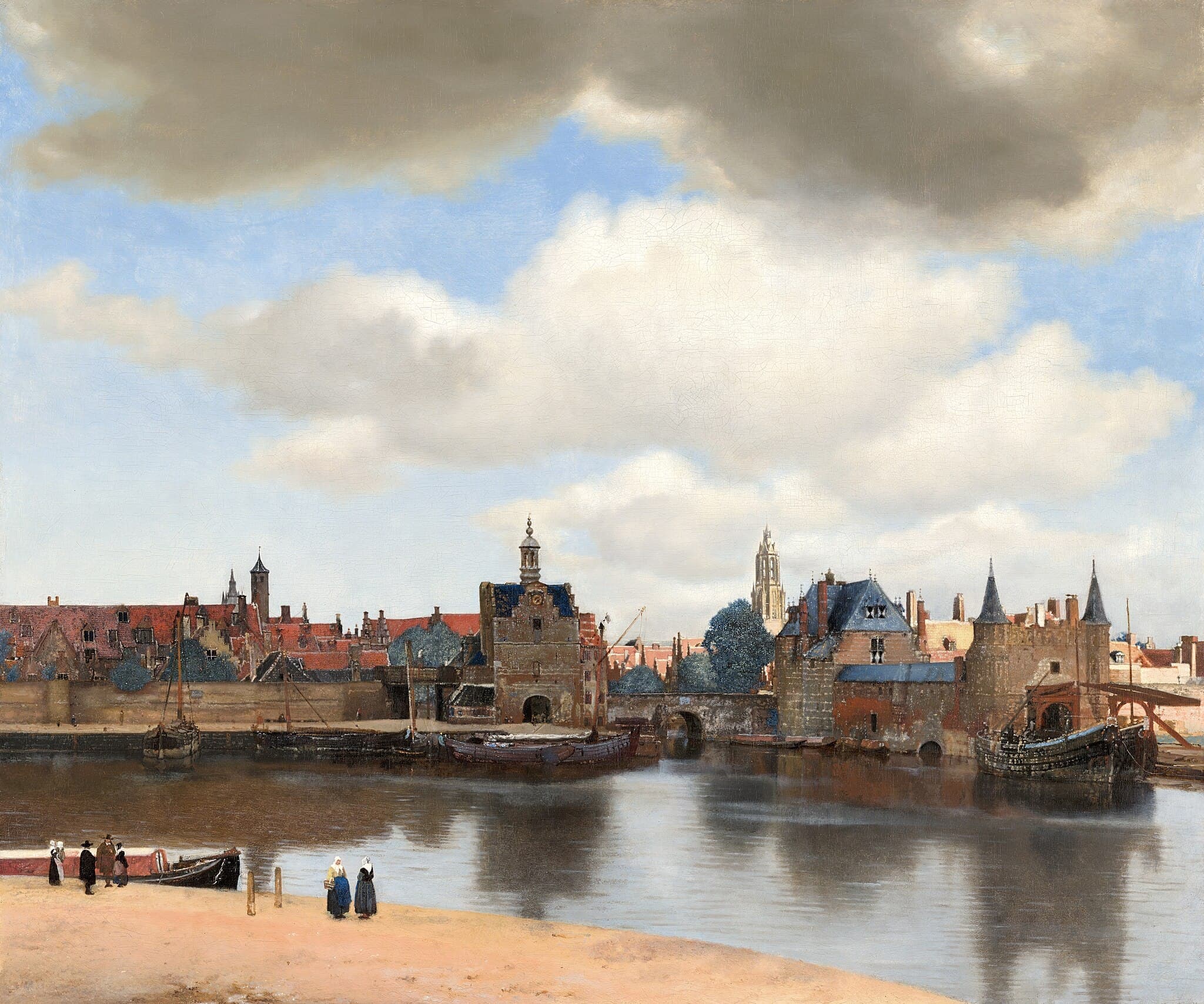
A defensible open‑market value for Vermeer’s View of Delft is $300–600 million. The work is a canonical masterpiece, one of only two Vermeer cityscapes, and is held by the Mauritshuis; although not for sale, its stature and rarity support record‑level pricing if freely traded.
Valuation Analysis
Estimated value: $300–600 million. Vermeer’s View of Delft is a once‑in‑a‑generation masterpiece: one of only two cityscapes in the artist’s tiny oeuvre and among his most celebrated works. It is held by the Mauritshuis, The Hague, as a Dutch state treasure, and is not for sale, but if it were freely marketable it would command the top tier of Old Master pricing.
Evidence and sale history. The painting is widely identified with the “Gezigt op Delft” that led the landmark 1696 Dissius auction at 200 guilders—the highest price for a Vermeer in that sale [1]. It entered the Royal Cabinet of Paintings (Mauritshuis) in 1822 and has remained in that collection since [2]. While these historic prices do not translate meaningfully into modern USD, they establish long‑standing recognition and unimpeachable provenance.
Comparable benchmarks. At the apex of the Old Masters market, Leonardo’s Salvator Mundi realized $450.3m (2017) [3]. The most relevant Dutch Golden Age benchmark is the joint Louvre/Rijksmuseum acquisition of Rembrandt’s pendant portraits at about €160m (~$174m at the time) [4]. More broadly, recent record‑level sales for canonical historical masters—such as Klimt’s Portrait of Elisabeth Lederer at $236.4m (2025) [5]—demonstrate robust, cross‑category demand for museum‑grade trophies. Against these signposts, View of Delft’s combination of rarity, art‑historical centrality, and brand recognition warrants positioning in the $300–600m zone.
Artist market context. Modern auction records understate Vermeer’s true demand because virtually no undisputed masterpieces trade. The only broadly accepted Vermeer to sell publicly in recent decades—Young Woman Seated at a Virginals—achieved £16.246m in 2004 [6]. An attributed work, Saint Praxedis, brought £6.24m in 2014 amid attribution debate [7]. Meanwhile, global visibility for Vermeer remains exceptional (e.g., the Rijksmuseum’s 2023 blockbuster) [8], reinforcing buyer appetite at the very top end.
Conclusion and positioning. Triangulating the sparse Vermeer market with apex Old Master and cross‑category trophy results, View of Delft justifies a $300–600m estimate. Its unimpeachable provenance, museum stewardship, subject rarity, and cultural resonance support values at or above the Salvator Mundi record in a fully competitive setting. Practical constraints (national‑treasure status, export barriers) preclude an actual sale, but on a clean, open‑market basis this painting sits squarely in record territory.
Key Valuation Factors
Art Historical Significance
High ImpactView of Delft is universally regarded as one of Vermeer’s supreme achievements and a cornerstone of Dutch Golden Age painting. It is one of only two cityscapes in the artist’s oeuvre and occupies a rare position in the canon: celebrated by scholars and the public alike for its luminous atmosphere, observational acuity, and technical refinement. Its consistent presence in major surveys and literature, and its iconic status within Vermeer’s small body of work, ensure deep, cross‑category demand. For museums and top private collectors, this is not just a masterwork by a blue‑chip name; it is a definitive statement of the genre and period—precisely the type of cultural asset that catalyzes record‑level bidding.
Rarity and Supply Constraints
High ImpactOnly about 34–36 autograph Vermeers are accepted today, and the overwhelming majority are in museums, rendering real market supply essentially nil. Among those, cityscapes total just two, with View of Delft the more panoramic and widely reproduced. This extreme scarcity creates an outsized rarity premium in any hypothetical sale. Because top‑tier Vermeers are virtually unobtainable, pent‑up demand concentrates on the few canonical examples. In a trophy‑driven auction or private treaty environment, scarcity of this magnitude typically compresses bidder caution and elevates price ceilings, especially among buyers who prize singularity and cultural capital over financial comparables.
Provenance, State, and Museum Stewardship
High ImpactThe painting boasts exemplary provenance from the 17th century forward, including its leading price in the 1696 Dissius sale and continuous museum stewardship at the Mauritshuis since 1822. Such a chain minimizes transactional risk and underwrites buyer confidence. Condition is believed to be very good, supported by its careful conservation history as a national treasure. Works with ironclad provenance and strong physical state command significant premiums at the ultra‑trophy level because they reduce uncertainty, simplify due diligence, and meet institutional standards—key for any buyer seeking an asset destined for prominent display and long‑term cultural significance.
Market Benchmarks and Trophy Dynamics
High ImpactAt the pinnacle of the market, record outcomes for canonical Old Masters and historical blue‑chips demonstrate deep, globally diversified demand. Leonardo’s Salvator Mundi at $450.3m anchored a new ceiling for category‑defining works; Rembrandt’s pendant portraits privately transacted at roughly $174m to two national museums; and other trophy‑caliber paintings have achieved mid‑ to high‑nine‑figure prices in recent seasons. Against this backdrop, a museum‑grade Vermeer of unique subject and fame would command a similar response from both private collectors and sovereign or institutional buyers, justifying a $300–600m valuation range in an open, competitive process.
Sale History
Amsterdam, Dissius auction
Sold as 'Gezigt op Delft' for 200 guilders; highest Vermeer price in the sale.
Amsterdam, S. J. Stinstra sale
Sold for 2,900 guilders; purchased for the Royal Cabinet of Paintings (Mauritshuis).
Johannes Vermeer's Market
Johannes Vermeer’s market is defined by extreme scarcity and museum dominance. With roughly three dozen accepted works, almost all in public collections, liquidity is minimal and modern auction records understate latent demand. The only widely accepted Vermeer to sell publicly in recent decades—Young Woman Seated at a Virginals—made £16.246m in 2004, while an attributed work, Saint Praxedis, brought £6.24m in 2014 amid debate. Given Vermeer’s towering art‑historical status and pop‑culture resonance, an undisputed, museum‑quality masterpiece would attract cross‑category trophy bidders and institutions, setting new Old Masters benchmarks. Consequently, valuations for his best paintings must be extrapolated from apex Old Master and blue‑chip trophy comparables rather than artist‑specific auction history.
Comparable Sales
Young Woman Seated at the Virginals
Johannes Vermeer
Same artist; only widely accepted Vermeer to sell publicly in modern times. Though a small interior and not a cityscape, it anchors Vermeer’s market value and scarcity.
$30.1M
2004, Sotheby's London
~$50.9M adjusted
Salvator Mundi
Leonardo da Vinci
Apex Old Master trophy sale demonstrating cross‑category, record‑setting demand for canon‑defining works—key for framing upper bound of a Vermeer masterpiece.
$450.3M
2017, Christie's New York
~$590.0M adjusted
Portraits of Marten Soolmans and Oopjen Coppit
Rembrandt van Rijn
Top‑tier Dutch Golden Age benchmark; joint museum acquisition of an unquestioned masterpiece pair—relevant for positioning a national‑treasure‑level Dutch work.
$174.0M
2016, Private treaty (Louvre & Rijksmuseum)
~$232.0M adjusted
Portrait of a Young Man Holding a Roundel
Sandro Botticelli
Major Old Master auction benchmark in recent years; signals depth of demand for iconic historical names at nine‑figure levels.
$92.2M
2021, Sotheby's New York
~$109.0M adjusted
Lady with a Fan
Gustav Klimt
Recent European auction record; demonstrates current trophy pricing for canonical historical works and cross‑category competition among top collectors.
$108.4M
2023, Sotheby's London
~$113.6M adjusted
Portrait of Elisabeth Lederer
Gustav Klimt
Second‑highest auction price on record; a fresh proof of nine‑figure appetite for museum‑grade historical masterpieces—useful ceiling reference for ultra‑trophies.
$236.4M
2025, Sotheby's New York
Current Market Trends
The Old Masters market is highly selective and supply‑driven, with strong outcomes clustered around fresh, museum‑grade trophies. While the category is smaller by value than modern and contemporary, cross‑category collectors increasingly seek historically validated names, and institutions remain active buyers. Recent years have reaffirmed that culturally iconic, best‑in‑class works can achieve mid‑ to high‑nine‑figure prices, supported by a diversified global buyer base and the normalization of guarantees. In this environment, truly singular masterpieces—especially with ironclad provenance and broad recognition—can transcend category norms and contend with all‑time records, even amid broader market cyclicality.
Sources
- The Frick Collection — Vermeer Provenance (Dissius sale, 1696)
- Mauritshuis — View of Delft (collection entry)
- BBC News — Leonardo da Vinci's Salvator Mundi sells for $450m
- DW — France and the Netherlands buy two Rembrandts together
- The Washington Post — Klimt portrait sells for $236.4 million at Sotheby’s
- The Art Newspaper — £16.2m Vermeer led patchy sales (archive)
- Los Angeles Times — Painting attributed to Vermeer sells for $10.7 million
- Rijksmuseum — Vermeer exhibition most successful in its history