The Farm Cart in the Stream in The Hay Wain
A closer look at this element in John Constable's 1821 masterpiece
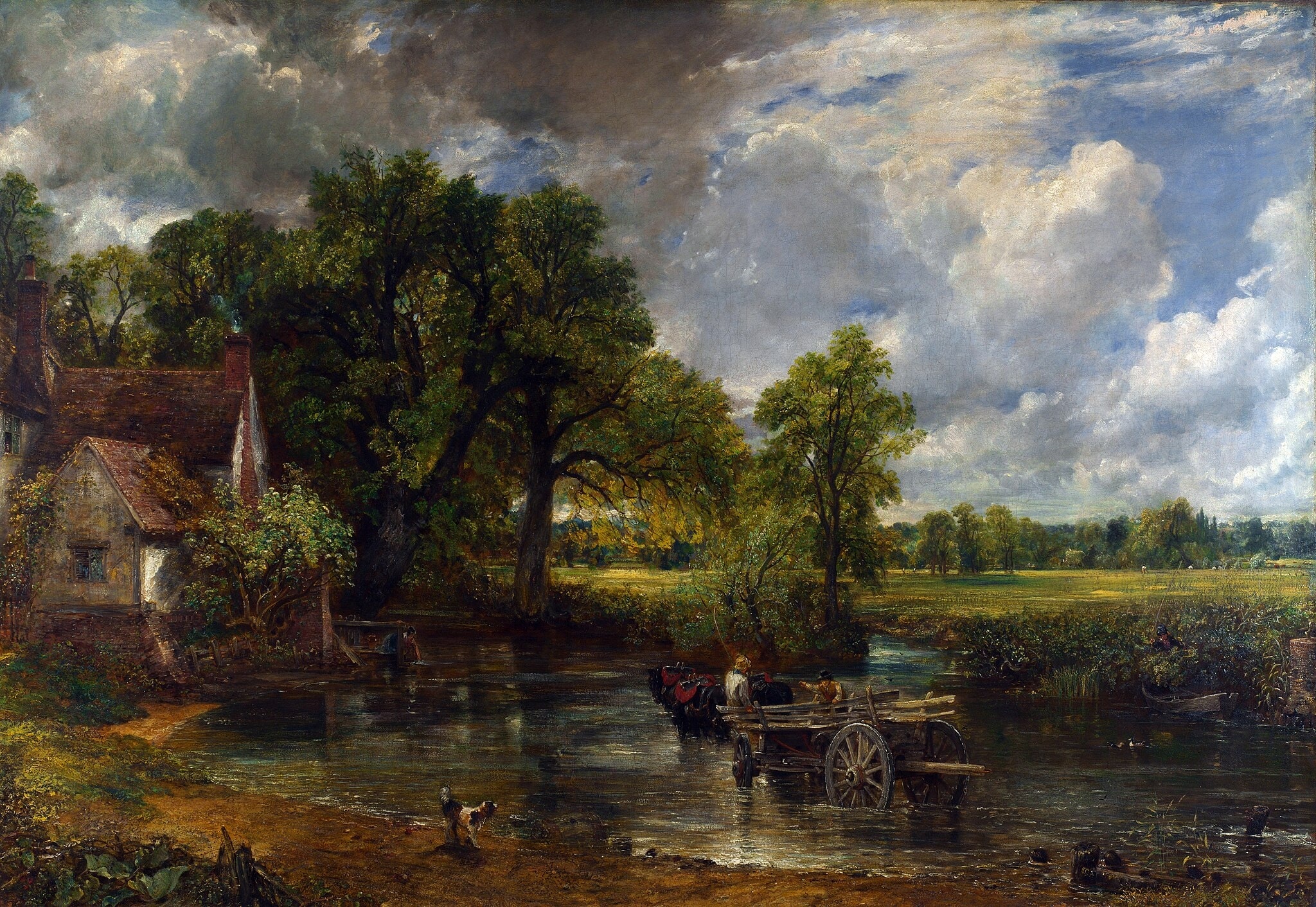
At the very heart of Constable’s The Hay Wain sits the farm cart—an empty, low‑sided wain—halted mid‑ford in the millpond of the River Stour. More than a picturesque accent, its watery passage folds practical rural routine into a grand landscape, bridging Dutch precedents and Constable’s modern claim that ordinary labor could carry epic weight.
Historical Context
Constable painted The Hay Wain in 1821, transforming a familiar scene from his native Stour Valley into a large exhibition canvas. The central cart is the wain itself, drawn by three horses across the shallow ford beside Flatford Mill, a property long connected to Constable’s family. The motif comes from lived knowledge of the place and from sustained preparatory work—field studies, a dedicated oil sketch of the wagon, and a full‑scale trial composition—refined in the London studio for the Royal Academy show. 1
Placing the cart in the water was not mere poetry. Contemporary technical understanding held that running wooden wheels through a pond swelled the timber and tightened the iron tyres, a routine that coincided with the most direct route to the hayfield. By choosing this unsensational incident, Constable aligned his English view with admired Flemish and Dutch ford scenes while asserting the dignity of everyday labor on a grand canvas—the scale later dubbed the six‑footer. 2
Symbolic Meaning
The wain in the stream functions as a georgic emblem: cyclical, seasonal work carried on with steady competence. It turns a maintenance chore—soaking the wheels—into the painting’s moral center, a sign of order, habit, and continuity within a landscape threatened, in the cultural imagination of the 1820s, by industrial dislocation. Smarthistory situates this ideal within a contemporaneous longing among urban viewers for a stable countryside, a pastoral "Eden" seemingly untouched by factories and unrest. 5
At the same time, Constable’s cart converses with northern prototypes—17th‑century Flemish and Dutch ford scenes—while declaring an English identity through specific topography and light. Egerton notes how the wagon’s atypically low sides resemble timber carts and how its placement in water echoes precedents by van Goyen and Siberechts; such echoes give the humble subject historical gravitas. 2 Yet the image is not innocent of social implication. Barrell’s influential critique reminds us that this vision of ordered contentment risks veiling rural hardship; the wain’s calm progress can be read both as a claim for continuity and as an aesthetic screen over contemporary agrarian distress. The cart thus crystallizes a productive tension between tradition and modernity, solace and strain—meanings that have animated the painting’s reception ever since. 81
Artistic Technique
Constable developed the cart through iterative study: a small oil sketch of the wagon (Yale) and a rapid full‑size oil sketch (V&A) precede the final canvas, where he reworked details and even removed a rider seen in the study. 431 In the exhibition picture he models the wain with broken, tactile strokes and crisp highlights—"Constable’s snow"—that sparkle on spokes, water ripples, and harness. The horses’ red‑fringed housen cut bright, rhythmic accents against a green‑brown key, a favored coloristic device. 21
Compositionally the cart is the fulcrum: its mass counters Willy Lott’s house at left and the small boat at far right, while the front wheel’s slight cant and the two handlers lend quiet, directional movement through the middle ground. 2
Connection to the Whole
The wain organizes the painting’s narrative and space. It stages a crossing between private domesticity (the cottage and garden) and collective labor (the distant haymakers), tying near bank to far meadow and fixing the eye at the work’s original title, "Landscape: Noon." 21 As the dominant motif, it stabilizes the broad sky and wooded masses, letting Constable orchestrate balance across the long horizon: cart and cottage to the left‑center, boat to the right, meadow beyond. 2
More ambitiously, the cart makes a case for modern landscape’s seriousness. By granting a routine task the scale, finish, and affect of grand art, Constable advanced a national, timely ideal of English rural life—observed, unsentimental, and resonant amid industrial change. 561
Explore the Full Painting
This is just one fascinating element of The Hay Wain. Discover the complete interpretation, symbolism, and hidden meanings throughout the entire work.
← View full analysis of The Hay WainSources
- National Gallery (London), collection entry: John Constable, The Hay Wain (NG1207)
- National Gallery (London), scholarly catalogue (Egerton 2000), The Hay Wain
- Victoria and Albert Museum, Conservation Journal 59 (2011): Conservation of Constable’s six‑foot sketches
- Yale Center for British Art, Sketch for The Hay Wain (c. 1820)
- Smarthistory, Constable and the English landscape
- The Metropolitan Museum of Art, Constable’s England (Graham Reynolds, 1983)
- Encyclopaedia Britannica, The Hay Wain
- John Barrell, The Dark Side of the Landscape (Cambridge University Press)