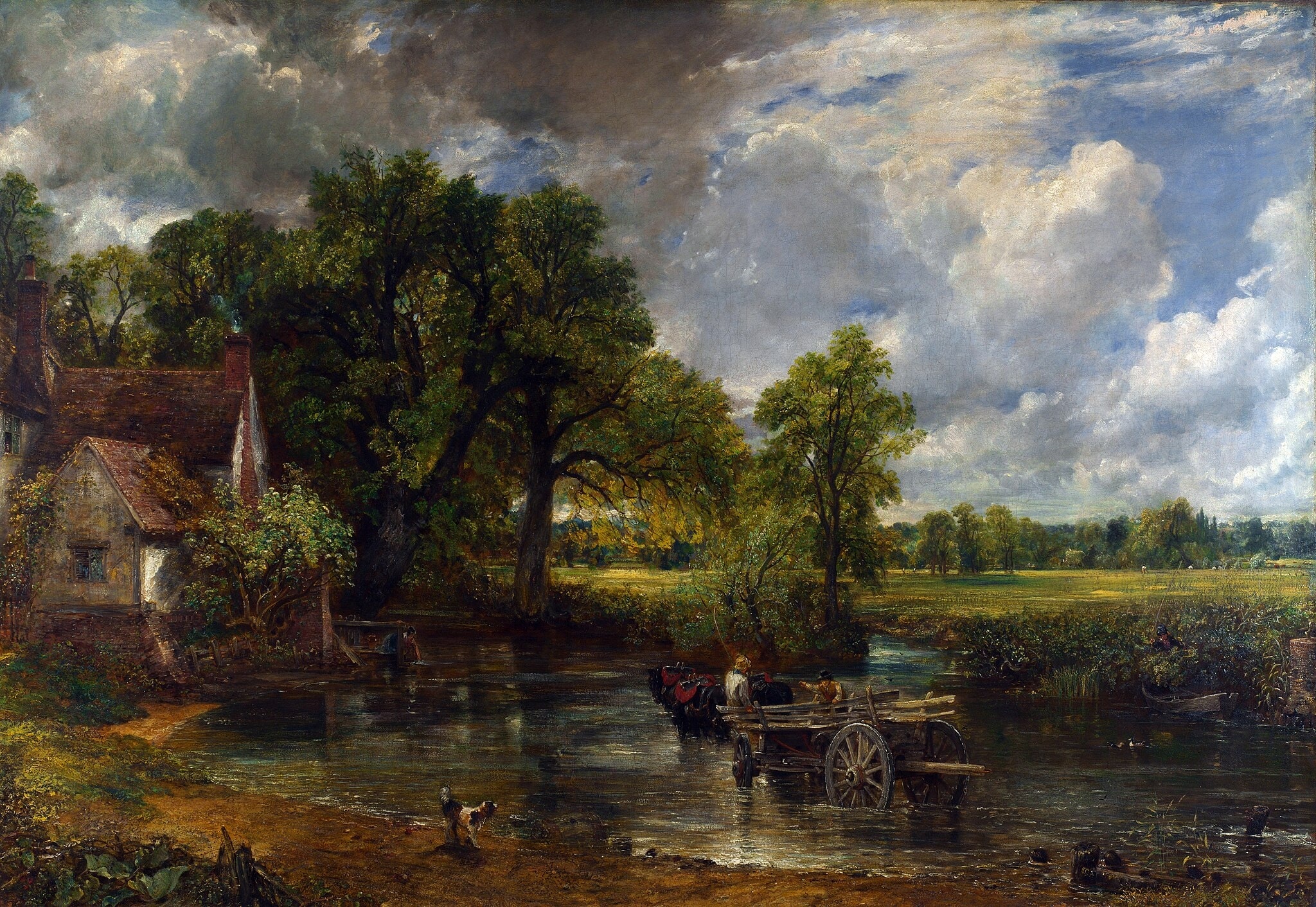
The Hay Wain

by John Constable

Set beside Willy Lott’s cottage on the River Stour, The Hay Wain stages a moment of unhurried rural labor: an empty timber cart, drawn by three horses with red-collared tack, pauses mid‑ford as weather shifts above. Constable fuses empirical observation—rippling reflections, chimney smoke, flickers of white on leaves—with a composed vista of fields opening to sun. The result is a serene yet alert meditation on work, weather, and continuity in the English countryside [1][3].
💰

Market Value

$100-150 million

How much is The Hay Wain worth?

Fast Facts

Year
1821
Medium
Oil on canvas
Dimensions
130.2 × 185.4 cm
Location
National Gallery, London
The Hay Wain by John Constable (1821) featuring Empty timber cart (the ‘wain’), Team of three horses with red tack, River ford and mirrored water, Willy Lott’s cottage with chimney smoke

Click on any numbered symbol to learn more about its meaning

Meaning & Symbolism

Constable builds his argument from particulars. The wagon at center is not piled with hay but stands as a low‑sided timber cart, its wheels half‑submerged, the shafts empty; the team of three dark horses leans into the ford while their red fringes punctuate the green‑brown key of the land. That emptiness signals a pause in transit rather than a climax of harvest, fixing the scene at the tempo of maintenance and return. At the left margin, the cottage—rooted in Constable’s biography—exhales a faint plume of smoke, while a woman stoops at the water step and a dog splashes at the bank. These modest acts tether labor to domesticity, as if the ford were an extension of the yard. Across the right foreground, slick reflections braid sky, cart, and reeds; small dabs of high white—the so‑called “Constable’s snow”—spark the water’s surface and leaf‑tips, registering passing light rather than emblematic sparkle 17. The distant meadow carries tiny haymakers and ricks, but Constable refuses a theatrical focus; the workload is distributed across space, as work is across a day. The sky does the conceptual heavy lifting. Its layered cumulus towers over the low horizon, alternating shadow‑fields with clearings of white and blue; one reads not a generic pastoral dome but a specific set of meteorological conditions, the product of Constable’s “skying” practice and timed notes on wind, cloud, and light 3. That attention to weather is not merely technical. It translates into a philosophy of duration: the ford is a crossing; the clouds are passages; the alternation of shade and sunlight enacts cyclical time. Within this cycle, human effort is dignified but not dramatized. The composition withholds industrial motifs even as England industrializes, offering the Stour Valley as a site where a familiar social order appears natural, stable, and local 15. Critics have read this as both a tender defense of rural continuity and a smoothing of rural hardship; the picture’s quiet is eloquent and ideological at once 56. The cart’s Flemish precedent—ford scenes admired by Constable—adds an art‑historical chord, yet here the quotation is naturalized into Suffolk fact, tightening the bond between European painterly lineage and English place 1. Why The Hay Wain is important is inseparable from its reception. Exhibited at the Royal Academy in 1821 as Landscape: Noon, it won esteem without a buyer; in Paris (1824) it took a gold medal and startled French painters with its truth to light and weather, feeding Romantic and later Barbizon naturalism 12. This cross‑Channel moment helped make Constable a “national painter,” whose Englishness was constructed precisely through his empirical rendering of local nature 4. The picture’s authority rests on that doubleness: exact observation (the wet axle, the boat nosing reeds at right, the wheel’s weight sinking into water) and a composed national imaginary in which countryside, labor, and weather hold their ground amid modernization. The painting’s narrative content is thus a poised crossing: from bank to bank, from shade to sun, from private memory to public emblem—an argument, painted in air and water, for the continuity of work within the living atmosphere of place 145.

Explore Deeper with AI

Ask questions about The Hay Wain

Popular questions:

Powered by AI • Get instant insights about this artwork

💬 Ask questions about this artwork!

Interpretations

Power & Ideology Reading

Constable’s pastoral is not neutral scenery; it is a polished instrument of ideology. By distributing small tasks across distance and omitting industrial signs, The Hay Wain naturalizes a harmonious social order in the countryside. Ann Bermingham shows how the English rustic landscape tradition idealizes rural life, aestheticizing labor into decorum and continuity, while John Barrell tracks how representation manages the visibility of rural hardship. In Constable, the ford’s pause and tidy banks temper the historical moment of enclosure and unrest. The result is a persuasive picture of stability whose beauty carries political quietism: the nation appears orderly because the land does 561.

Source: Ann Bermingham; John Barrell; National Gallery

National Identity & Reception

The Hay Wain helped construct Constable as a national painter, but that Englishness was forged in a transnational crucible. Elizabeth Helsinger argues that Constable’s status emerged from the pairing of empirical local nature with international reception, especially the Paris Salon of 1824. There, his ‘truth to light’ startled French artists and fed Romantic and Barbizon naturalism, exporting an English landscape ethos even as it was being canonized at home. Englishness here is not provincialism but a portable authority built from local specificity and painterly innovation—an identity stabilized by museum display and modern art‑historical narratives 431.

Source: Elizabeth Helsinger; Britannica; National Gallery

Scientific Romanticism (Sky as Method)

The sky in The Hay Wain is a laboratory of empirical Romanticism. Constable’s ‘skying’ practice—timed notes of wind, light, and cloud typologies—feeds the six‑footer’s layered cumulus, where alternating shade fields choreograph duration rather than allegory. YCBA’s studies situate these panels within a quasi‑scientific regimen, while Amstutz shows how Constable engineered the painting’s light architecture to register meteorological processes. The result is a double claim: the painting looks like Suffolk weather because it derives from measured looking, and it feels like time passing because the brushwork encodes atmospheric change as form 781.

Source: Yale Center for British Art; Journal of the History of Collections; National Gallery

Appropriation Naturalized

Constable’s cart is a lesson in appropriation turned into place‑truth. The low‑sided wagon, closer to timber transport than piled hay, echoes Flemish ford scenes (Rubens and Dutch precedents), yet the quotation disappears into Suffolk fact: wet axle, sun‑dazzled ripples, red horse‑tassels. Rather than pastiche, the citation refines authorship—Old Master composition re‑fitted by field studies, a full‑scale oil sketch, and on‑site observation. Constable claims originality not by rejecting sources but by metabolizing them into site‑specific mimesis, where European lineage is re‑spoken in the dialect of the Stour 12.

Source: National Gallery (object record and audio)

Technique & the Ordinary

The six‑footer scale frames everyday life as art, but the effect depends on method: a full‑size oil sketch to fix masses and light, then broken impasto and flicks of high white—“Constable’s snow”—to register transient gleams on leaves and water. This handling is not decorative sparkle; it is a notational system for weather and surface, binding perception to paint. The empty cart, the woman at the water step, and the dog’s splash are ordinary acts elevated by facture and scale, arguing that the modern sublime can be found in the minute and the local, if rendered with exactness 21.

Source: National Gallery (audio description and in-depth entry)

Cross-Channel Modernity

The painting’s modernity arrived via Paris. Exhibited in London as Landscape: Noon, it sold only after 1824, when dealer John Arrowsmith brought it to the Salon, where it won Charles X’s gold medal. Delacroix and Géricault admired its weather‑truth and broken touch, taking cues that would inform French Romantic color and, later, Barbizon naturalism. Thus an English millpond became a vector for European change: a proof that exact observation—wet wheel, ruffled reflections—could catalyze new freedoms of handling and light beyond national borders 13.

Source: National Gallery; Britannica

Related Themes

About John Constable

John Constable (1776–1837) was an English Romantic landscape painter devoted to the Stour Valley, combining plein‑air study with large studio canvases and full‑scale oil sketches. Initially under‑recognized in Britain, he became influential abroad after the 1824 Paris Salon, shaping French Romantic and Barbizon approaches to natural light and weather [2][3].
View all works by John Constable