Willy Lott's Cottage in The Hay Wain
A closer look at this element in John Constable's 1821 masterpiece
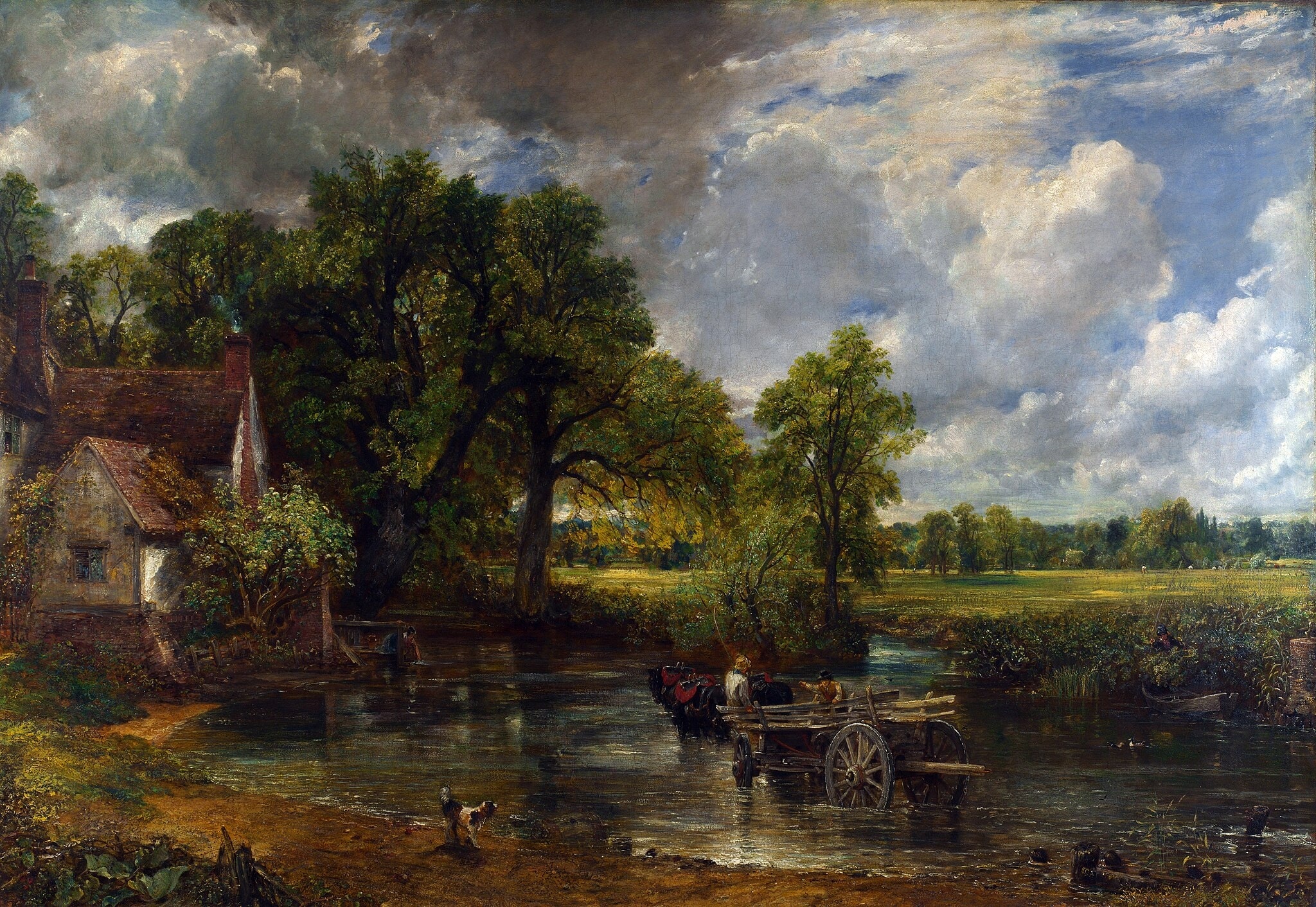
The whitewashed farmhouse on the Stour—Willy Lott’s Cottage—anchors the left bank of John Constable’s The Hay Wain. Rooted in the artist’s boyhood landscape and refined through years of study, it becomes the painting’s emblem of a settled, working rural life.
Historical Context
Constable paints a real place: the tenant farmhouse on the millpond of the River Stour at Flatford, Suffolk, occupied in his day by Willy Lott. The house stood opposite Constable’s family mill, a view he knew from childhood and sketched repeatedly from the early 1800s; it appears at the far left of The Hay Wain with whitewashed walls and red‑tiled roofs beside a riverside platform where a woman draws water 12.
The artist developed this element through his characteristic process for the large Stour "six‑footer" canvases: first a small oil study from nature, then a full‑scale studio sketch, before completing the final painting in 1821 45. The cottage remained integral at every stage. Beyond the studio, the building’s afterlife matters too: today it is Grade I listed for its historical and artistic associations within the Flatford group, underscoring that Constable’s motif was—and is—a tangible site in the English landscape 3. In a period of industrial change, Constable fixed his great landscape in the remembered, local geography of home 12.
Symbolic Meaning
Within the painting’s world, the cottage signifies rustic continuity and domestic peace. National Gallery scholarship traces how the motif accrued a legend of steadfastness—linked to the anecdote that Willy Lott scarcely left his home—while clarifying that Lott was in fact a substantial tenant farmer. The image therefore communicates stability embedded in the rhythms of rural work rather than picturesque poverty 2. In Constable’s hands, the lit gable, tended garden, and water‑step humanize the landscape as a lived place where labor and dwelling meet 12.
Art historians situate that meaning within broader debates. Michael Rosenthal argues that Constable’s cottages and working scenes helped define an ethos of specifically English "Englishness": domestic, unheroic, and rooted in characteristic scenery 7. Social historians counterbalance the comfort of that ideal. John Barrell and Ann Bermingham read Constable’s rural imagery as a selective vision that naturalizes order and underplays hardship amid enclosure and agrarian change 89. Applied to The Hay Wain, the cottage can be read two ways at once: as a truthful emblem of settled community and as a carefully curated symbol that omits the harsher edges of early nineteenth‑century countryside life 1289.
Artistic Technique
Constable renders the house with warm, raking light that ignites the whitewashed gable and the russet tiles, while quick, high touches animate foliage—effects critics dubbed “Constable’s snow” 1. The motif synthesizes open‑air oil studies with studio resolution: the artist layered impasto, transparent glazes, and dry‑brush accents across the wall surfaces, roof, and hedgerow in the full‑size sketch and the finished canvas 24. Technical and comparative study shows he adjusted elements as the composition matured and varied the cottage’s appearance across related drawings and oils, emphasizing pictorial needs over strict topography 26. The kneeling figure at the water‑step, retained from earlier studies, gives the structure an inhabited, domestic presence within the scene 12.
Connection to the Whole
Compositionally the cottage is the canvas’s left‑hand anchor, a mass that balances the central hay wain and the small craft at far right, knitting architecture, labor, and riverine nature into one continuous field 2. It establishes the painting’s tonal key—warm earths against cool water and sky—and provides a near focus from which the eye travels out through the trees to the sunlit meadows 1. In art‑historical dialogue, Constable substitutes a modern English farmhouse for classical ruins as the ennobling built form, aligning the scene with Dutch and Flemish ford traditions while insisting on local truth. The result grounds Landscape: Noon in lived place and makes the dignity of everyday rural life the painting’s argument and appeal 12.
Explore the Full Painting
This is just one fascinating element of The Hay Wain. Discover the complete interpretation, symbolism, and hidden meanings throughout the entire work.
← View full analysis of The Hay WainSources
- National Gallery, London — The Hay Wain (overview/in‑depth)
- National Gallery (Egerton 2000), catalogue entry ‘The Hay Wain’
- Historic England — Willy Lott’s Cottage (Grade I list entry)
- V&A — John Constable’s sketches (full‑size sketch and technique)
- Yale Center for British Art — Sketch for ‘The Hay Wain’, ca. 1820
- British Museum — ‘Willy Lott’s cottage’ (Constable study)
- Michael Rosenthal — Constable and Englishness
- John Barrell — The Dark Side of the Landscape (excerpt)
- Ann Bermingham — ‘Redesigning Nature: John Constable and the Landscape of Enclosure’