How Much Is The Holy Trinity Worth?
Last updated: April 2, 2026
Quick Facts
- Methodology
- comparable analysis
Masaccio’s Holy Trinity is an in-situ fresco in Santa Maria Novella, protected under Italian cultural-heritage law and therefore unsaleable. For planning and comparative purposes, a hypothetical, portable, legally tradable masterpiece of equivalent stature by Masaccio is estimated at $300–$600 million. This range is anchored to top-tier Old Master benchmarks and the work’s canonical, top-of-oeuvre status.
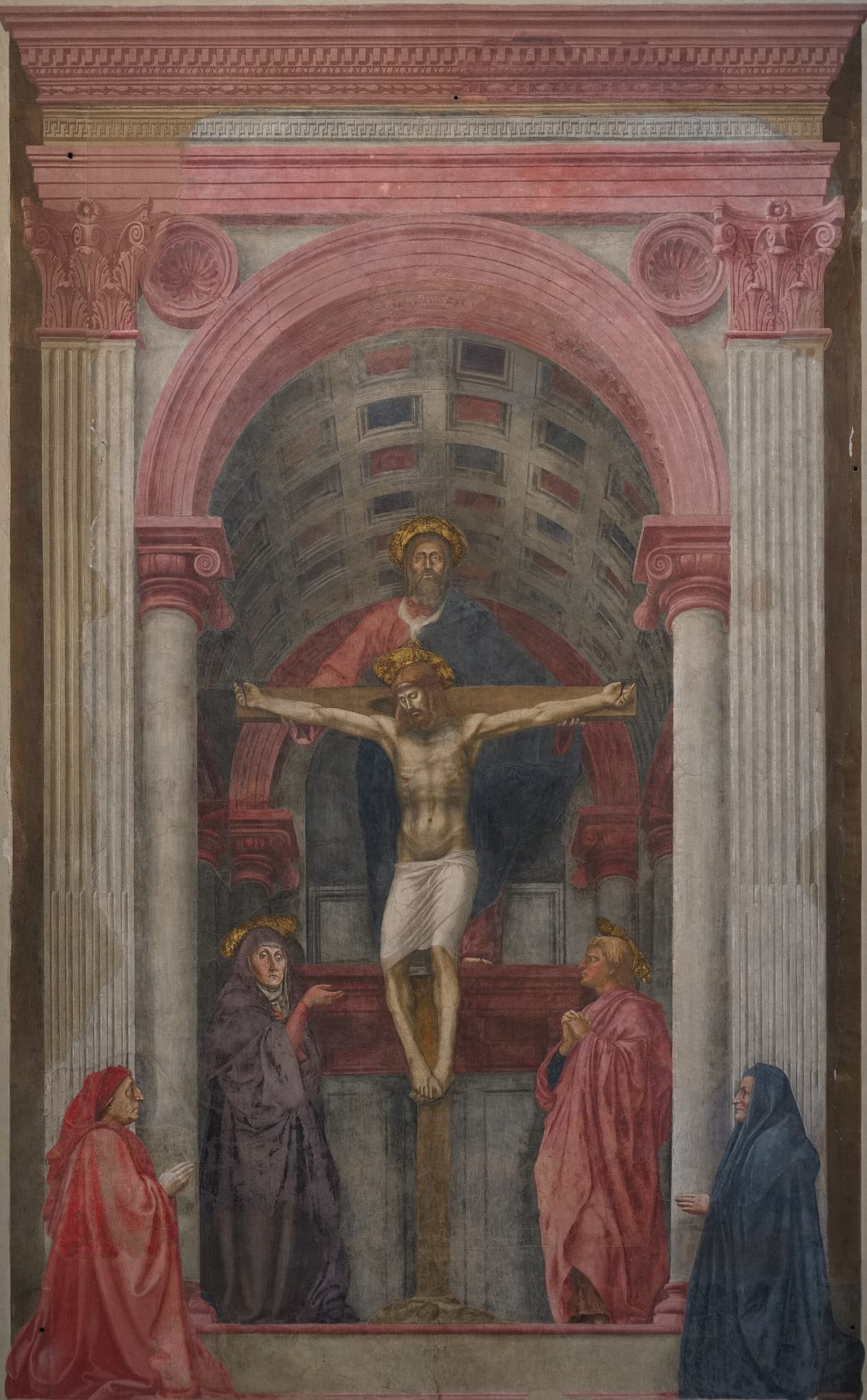
The Holy Trinity
Masaccio, c. 1425–1427 • Fresco (buon fresco with some a secco details)
Read full analysis of The Holy Trinity →Valuation Analysis
Conclusion: Masaccio’s Holy Trinity has no practical market value because it is a wall-bound fresco in the Basilica of Santa Maria Novella and part of Italy’s protected cultural patrimony [1][2]. For planning and comparison only, we model what a portable, legally tradable, fully autograph Masaccio of comparable artistic importance would command in today’s trophy market. The indicated fair-market range is $300–$600 million.
Why it is unsaleable: The fresco was designed and executed in situ and forms an integral part of a protected church interior. Under Italy’s Codice dei beni culturali e del paesaggio (Legislative Decree 42/2004), cultural property of the public domain is inalienable and export is strictly controlled; a work of this type effectively cannot be sold or exported [1][2]. This makes any real transaction impossible; the figure provided is a notional, comparative indication only.
Comparable market anchors: There is no public auction record for an autograph Masaccio. Pricing therefore relies on adjacent Old Master trophies. Botticelli’s Portrait of a Young Man Holding a Roundel achieved $92.2m (Sotheby’s, 2021), establishing a modern benchmark for prime Quattrocento Florentine painting [3]. As an upper bound for a unique, culturally iconic Renaissance image, Leonardo’s Salvator Mundi realized $450.3m (Christie’s, 2017) [4]. Earlier, ultra-rare proto/early Renaissance icons also signal depth at the very top: Cimabue’s small panel Christ Mocked brought ~$26.6m (2019) [5], and Duccio’s Madonna and Child privately sold to The Met at a reported ~$45m (2004) [6].
Positioning Masaccio’s Holy Trinity: Within Masaccio’s tiny oeuvre, Holy Trinity stands alongside the Brancacci Chapel as a signature, canonical achievement: an early, fully realized application of single-point linear perspective and monumental naturalism that reshaped Western painting [1]. It is exactly the kind of foundational, museum-defining work that catalyzes intense competition among a handful of global institutions and UHNW collectors when portability and title permit. Relative to Botticelli’s peak auction result, Masaccio’s greater scarcity and art-historical primacy would plausibly command several multiples, while Leonardo’s $450m provides a credible ceiling reference for a singular, devotional image of transformative importance.
Estimate rationale: The $300–$600m range balances (i) Masaccio’s extreme rarity and seminal status; (ii) the demonstrated willingness-to-pay for unique Renaissance icons; and (iii) the market’s strong preference for “trophy” works with incontestable scholarship and cultural resonance. Because Holy Trinity is immovable and unsaleable, any insurance (if applicable) would typically orient to conservation risk rather than replacement value; such figures, where they exist, are not public and are not directly comparable to market value [2].
Key Valuation Factors
Art Historical Significance
High ImpactHoly Trinity is a cornerstone of Early Renaissance art, widely recognized as one of the first fully realized applications of single-point linear perspective and a decisive shift toward monumental naturalism. It encapsulates Masaccio’s revolutionary treatment of space, light, and human presence, integrating theology with rigorous geometry. As a top-of-oeuvre work—rivaled only by the Brancacci Chapel cycle—it sits at the center of art-historical narratives and teaching. Foundational works with broad cultural resonance command disproportionate premiums because they transcend connoisseurship to become symbols of epochal change. In the thin market for early Italian masterworks, such primacy is a major value accelerator.
Rarity and Supply Constraints
High ImpactMasaccio died young, leaving an exceptionally small, tightly held oeuvre dominated by in-situ frescoes and museum panels. There is effectively no modern auction record for secure autograph paintings by the artist, and none are likely to surface. This structural scarcity concentrates demand on the idea of a portable, museum-quality Masaccio—precisely the kind of object for which collectors and institutions stretch estimates. In markets where authenticity, authorship, and period-defining importance converge but supply is near-zero, prices can disconnect from conventional comparables as competition becomes winner-take-all. Rarity thus exerts an outsized positive impact on any hypothetical fair-market indication.
Market Benchmarks and Trophy Dynamics
High ImpactRecent trophy sales demonstrate the upper bound and elasticity of demand for unique Renaissance icons. Botticelli’s $92.2m portrait (2021) established a modern benchmark for prime Quattrocento works, while Leonardo’s Salvator Mundi at $450.3m (2017) revealed the ceiling for singular, culturally magnetic masterpieces. Proto/early Renaissance touchstones—Cimabue (~$26.6m) and Duccio (~$45m, private)—show that even small panels can attract extraordinary bids. Against these anchors, a secure, portable, fully autograph Masaccio of Holy Trinity’s art-historical weight would plausibly command several multiples of Botticelli and approach the Leonardo reference band, supporting a $300–$600m range in today’s top-end, highly selective market.
Medium, Condition, and Portability
Medium ImpactAs a wall-bound fresco integrated with its architectural setting, Holy Trinity is inherently immovable and unsaleable; portability is a key determinant of market price realization. For valuation purposes, we explicitly model a counterfactual: a securely attributed, portable panel or fresco fragment of equivalent artistic status in stable, museum-grade condition. Condition would be scrutinized—original surface, restorations, and structural stability—because conservation risk is capitalized into price at this level. While the real fresco’s immovability precludes sale, the hypothetical value isolates artistic stature from logistical constraints, reflecting what an analogous, tradable Masaccio masterpiece would likely achieve at auction or private treaty.
Legal Status and Ownership Context
High ImpactThe work forms part of Italy’s protected cultural patrimony within a state-owned church complex. Under Italy’s cultural-heritage code, such property is inalienable and non-exportable, effectively removing it from commerce. This eliminates any real-market price discovery and shifts the exercise to a comparative modeling of demand. In practice, Italian state protections and pre-emption rights also shape the broader early-Renaissance market by constraining supply and redirecting rare works into public collections. For Holy Trinity, legal status decisively suppresses practical market value to zero, while the modeled figure reflects the price dynamics that would prevail if the same masterpiece were portable and freely tradable.
Sale History
The Holy Trinity has never been sold at public auction.
Masaccio's Market
Masaccio (1401–1428) is among the most consequential figures of the Early Renaissance, yet his autograph works are vanishingly scarce and overwhelmingly immovable frescoes in Florence and Pisa. There is effectively no modern auction record for a secure, portable Masaccio painting, and his key works reside in churches or museums. As a result, market analysis relies on adjacent benchmarks from top-tier quattrocento and trecento masters. Demand from institutions and a small circle of ultra-high-net-worth collectors for foundational, museum-defining objects is intense, and pricing for truly singular early Italian masterpieces can be non-linear. If a museum-quality, fully autograph, portable Masaccio of prime importance were to surface, it would likely command a price at or beyond the top Botticelli level, potentially several hundred million dollars.
Comparable Sales
Salvator Mundi
Leonardo da Vinci
Ceiling benchmark for a unique, fully autograph Renaissance painting of Christ; signals the trophy-market potential for singular, museum-grade Old Masters.
$450.3M
2017, Christie's New York
~$591.7M adjusted
Portrait of a Young Man Holding a Roundel
Sandro Botticelli
Top auction result for a prime Quattrocento Florentine master; closest market proxy for once-in-a-generation early Renaissance trophies (though secular portrait, not a fresco).
$92.2M
2021, Sotheby's New York
~$109.6M adjusted
The Man of Sorrows
Sandro Botticelli
Religious subject by a leading Florentine master; demonstrates demand for late-Quattrocento devotional imagery by blue-chip names.
$45.4M
2022, Sotheby's New York
~$49.9M adjusted
Christ Mocked
Cimabue
Rare proto-Renaissance panel depicting Christ; signals pricing for exceptionally scarce early Italian masterpieces in small scale.
$26.6M
2019, Actéon, Senlis
~$33.4M adjusted
Madonna and Child (Stoclet Madonna)
Duccio di Buoninsegna
Museum-acquired, canonical early Italian panel; a key benchmark for early devotional icons of supreme rarity and art-historical weight.
$45.0M
2004, Private sale to The Metropolitan Museum of Art
~$76.7M adjusted
Rest on the Flight into Egypt
Titian
Record-setting High Renaissance painting; evidences renewed depth and competition for blue-chip Renaissance works at auction.
$22.2M
2024, Christie's London
~$23.3M adjusted
Current Market Trends
Old Masters have seen renewed competitiveness at the top end: quality, freshness, and unimpeachable attribution attract deep bidding, while middling material remains selective. Recent headline results for Renaissance and early Italian works (e.g., Botticelli’s $92.2m; a record for Titian; high-profile institutional interventions) indicate robust trophy demand despite constrained supply. Legal frameworks—especially in Italy—continue to limit export and encourage state or institutional acquisitions, tightening private availability. In this K-shaped environment, canonical, museum-grade masterpieces with clear provenance and scholarship command significant premiums and can outperform estimates materially. Against this backdrop, a portable, fully autograph Masaccio of Holy Trinity’s stature would occupy the absolute apex of buyer demand.
Sources
- Basilica of Santa Maria Novella – Masaccio’s Holy Trinity
- Italy’s Cultural Heritage Code (Legislative Decree 42/2004)
- Sotheby’s – Botticelli, Portrait of a Young Man Holding a Roundel (2021)
- Christie’s – Leonardo da Vinci, Salvator Mundi Press Release (2017)
- Gazette Drouot – A Magisterial Bid for Cimabue in Senlis (2019)
- The Metropolitan Museum of Art – Acquisition of Duccio’s Madonna and Child (2004)