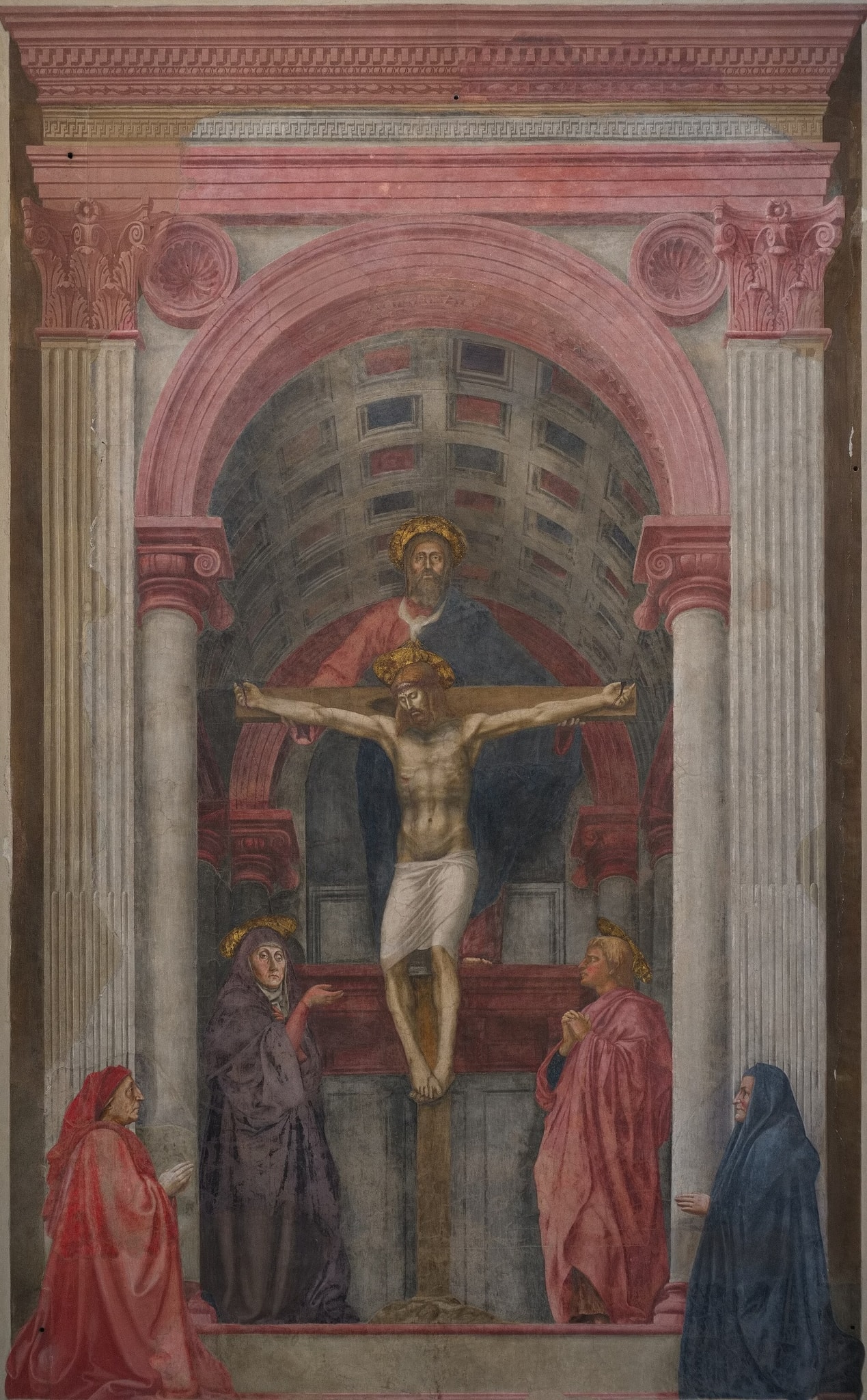
The Holy Trinity
by Masaccio
Masaccio’s The Holy Trinity stages salvation as a rigorously ordered reality: a "Throne of Mercy" Trinity set inside a mathematically precise, coffered barrel vault. With one‑point perspective, the fictive chapel opens to the nave, placing kneeling donors at our eye level while Mary presents Christ and John prays in grief [1][2].
Study Print Studio
Create a personal study print
Build a companion study sheet around the part of this painting that speaks to you most. Choose a detail, shape an interpretation, and walk away with something personal and display-worthy.
Fast Facts
- Year
- c. 1425–1427
- Medium
- Fresco (buon fresco with some a secco details)
- Dimensions
- c. 667 x 317 cm
- Location
- Basilica of Santa Maria Novella, Florence (left nave, third bay)
Click on any numbered symbol to learn more about its meaning
Meaning & Symbolism
Masaccio builds a doctrinal diagram of redemption through architecture, optics, and gesture. The pink stone triumphal arch and the flanking Corinthian columns announce victory and authority, while the coffered barrel vault recesses with strict one‑point perspective, its orthogonals converging around the ledge where the donors kneel. That alignment is not decorative; it sets the viewer’s eye level within the fictive chapel so that everyday sight is conscripted into faith. At the center, the crucified Christ hangs with anatomical gravity, his sagging torso and extended arms stretched along the transverse beam that God the Father physically supports—a compact statement of the Throne of Mercy: the Father offers the Son; the Spirit, a small white dove, descends on the shared axis between their heads, binding the Godhead and the sacrifice into one legible vertical 12. Mary’s solemn, outturned hand does not narrate; it indicts us as participants, directing our attention toward the body on the cross. Opposite her, St. John’s clasped hands and turned head model the proper affect of contemplative grief. The kneeling donors at the architectural threshold—painted at our scale and light—act as proxies for modern beholders, bridging the nave’s physical floor to the painted altar beam just behind them 12.
The fresco’s spatial calculus serves liturgy and doctrine at once. Originally a real altar projected in front of the painted entablature; the vanishing point and coffer lines drive the gaze to that zone, making the Eucharistic table the optical and theological hinge of the work 13. Beneath it, in the original lower register, a stone sarcophagus with a skeleton proclaimed in the vernacular, “I once was what you are; what I am you will become”—a memento mori that secured the argument’s base in mortality 23. Read vertically, the program ascends from death (skeleton) to sacrament (altar) to the saving mystery (Trinity), compressing salvation history into a single, ordered view. Read horizontally, it unites intercession and witness: Mary’s authoritative presentation and John’s prayer frame the crucifixion, while the donors’ kneeling presence asserts that grace addresses the living now. The disciplined geometry—likely grounded in contemporary Florentine measurement and perspective practice—authorizes this theology by reason’s own language: space behaves lawfully, bodies cast consistent light, and the fictive chapel holds proportional coherence, so the claim that the divine inhabits the real appears not visionary but inevitable 127.
Why The Holy Trinity is important is inseparable from how it looks. Masaccio’s naturalism—Christ’s weighted abdomen, the foreshortened coffers receding like counted beats—makes the sacred persuasive rather than remote. The Romanizing framework is not classicism for its own sake; it repurposes the triumphal arch to declare that Christ’s death is history’s decisive victory. The donors’ placement at our eye level and the alignment of sightlines to the altar operationalize a Dominican theology of mediation: truth is taught through ordered images, intercession, and sacrament 125. After the lower tomb’s rediscovery in 1952, scholars recognized that the work’s full meaning depends on the two‑register structure; the skeleton’s admonition sharpens the urgency of Mary’s gesture and John’s prayer, and the fictive architecture clarifies the path from mortality to mercy 36. The result is a foundational Renaissance synthesis: measured space, embodied faith, and public pedagogy joined in one fresco that remade how painting could think.
Explore Deeper with AI
Ask questions about The Holy Trinity
Popular questions:
Powered by AI • Get instant insights about this artwork
💬 Ask questions about this artwork!
Interpretations
Formal-Technical: Measurement as Theology
Beyond “one-point perspective,” recent reconstructions suggest Masaccio organized the fictive chapel with a proportional grid tied to the Florentine braccio, integrating civic measurement into sacred space. This calibrated scaffolding stabilizes coffers, entablatures, and ledges, staging a theologically charged procession—death, sacrament, Trinity—within a mathematically “true” container. Such metrological exactitude does more than impress; it naturalizes doctrine by yoking ratio (measure) to mysterium (Trinity). The viewer’s eye is disciplined by orthogonals that converge near the altar level, translating geometry into liturgical pedagogy. In this reading, the painting is an instrument that literally measures belief, aligning bodily sight with ecclesial truth, and turning Renaissance perspectival science into a catechetical device 145.
Source: Max Planck Institute for the History of Science; Cambridge University Press
Liturgical Choreography: The Altar as Optical Hinge
Originally a real altar projected before the fictive entablature, and Masaccio’s orthogonals drive sight exactly there. The image thus anticipates the congregant’s processional movement down Santa Maria Novella’s nave, “catching” the eye at average height and translating approach into contemplation. Within a Dominican milieu that prized ordered teaching, the painted chapel functions as a visual homily: Mary and John frame, the donors model attention, and the altar—site of the Eucharist—becomes the hinge where painted sacrifice meets sacramental presence. This is not generic piety; it is a choreographed pedagogy in which optics guides devotion, anchoring the Trinity’s mystery in the repeatable acts of Mass and gaze 12.
Source: Smarthistory; Basilica di Santa Maria Novella (official site)
Function Debate: Altarpiece, Tomb, or Both?
After the 1952 rediscovery of the lower skeleton register, scholars reframed the fresco as a two‑storey monument that integrates a cadaver tomb with a theologically charged “altarpiece.” Ursula Schlegel argued that the work’s original meaning depends on this vertical coupling: the memento mori below intensifies the sacrificial mystery above. Patronage studies complicate matters further: the kneeling pair has been linked (not conclusively) to the Lenzi family, whose nearby tomb inscription dates 1426, while other archival hints point to the Berti. The hybrid—memorial plus Eucharistic image—fits Florentine practice yet remains singular in its perspectival ambition, underscoring how commemorative memoria, lay status, and liturgy interlock in one program 237.
Source: The Art Bulletin (Ursula Schlegel); Encyclopaedia Britannica
Political Theology of Roman Forms
Masaccio’s pink‑stone triumphal arch and classical orders do not merely “antique” the sacred; they re-signify imperial architecture as a Christian claim about history. The triumphal typology—once celebrating emperors—now frames the Throne of Mercy, proclaiming that victory belongs to the Crucified. Set in a Dominican church that shaped public preaching, the Romanizing decorum lends juridical weight and civic legibility to doctrine: measured coffers and authoritative pilasters make grace look lawful, public, and non-esoteric. The fresco thus reads as political theology in paint: classical power vocabularies are appropriated and baptized, so that the state’s architectural rhetoric validates salvation’s new order 1.
Source: Smarthistory (Zucker & Harris)
Conservation & Reception: What 1952 Changed
For nearly four centuries, Vasari’s renovations obscured the lower tomb; nineteenth‑century moves further disrupted context. Only in 1952 was the cadaver sarcophagus found and the fresco reunited and returned to its wall. Leonetto Tintori’s treatment clarified palette, giornata joins, and spatial logic, while the work’s two‑register meaning—death/sacrament/Trinity—became obvious rather than conjectural. This shift altered modern reception: what once looked like a majestic Crucifixion in a perspective niche re-emerged as an integral funerary‑liturgical ensemble. Conservation thus served as hermeneutics; recovering physical strata restored theological syntax, allowing viewers to read the fresco as a compressed catechesis on mortality and mercy rather than a standalone devotional image 36.
Source: The Art Bulletin; City of Florence/OPD
Related Themes
About Masaccio
Masaccio (1401–1428) revolutionized painting by joining Brunelleschian perspective with sculptural chiaroscuro, yielding convincing bodies in coherent space. His brief career—centered on the Brancacci Chapel and Holy Trinity—set the template for Quattrocento naturalism and influenced generations from Filippino Lippi to Piero della Francesca [1][2].
View all works by Masaccio →