How Much Is The Elevation of the Cross Worth?
Last updated: February 24, 2026
Quick Facts
- Methodology
- extrapolation
Rubens’s The Elevation of the Cross is a canonical Baroque masterpiece, never sold on the open market and effectively non‑marketable under Flemish patrimony law. Based on artist records and top Old Master trophy benchmarks, a realistic hypothetical fair‑market range is $200–400 million, well above any Rubens price achieved to date. This reflects its unmatched importance, scale and scarcity relative to anything by the artist that has traded publicly.
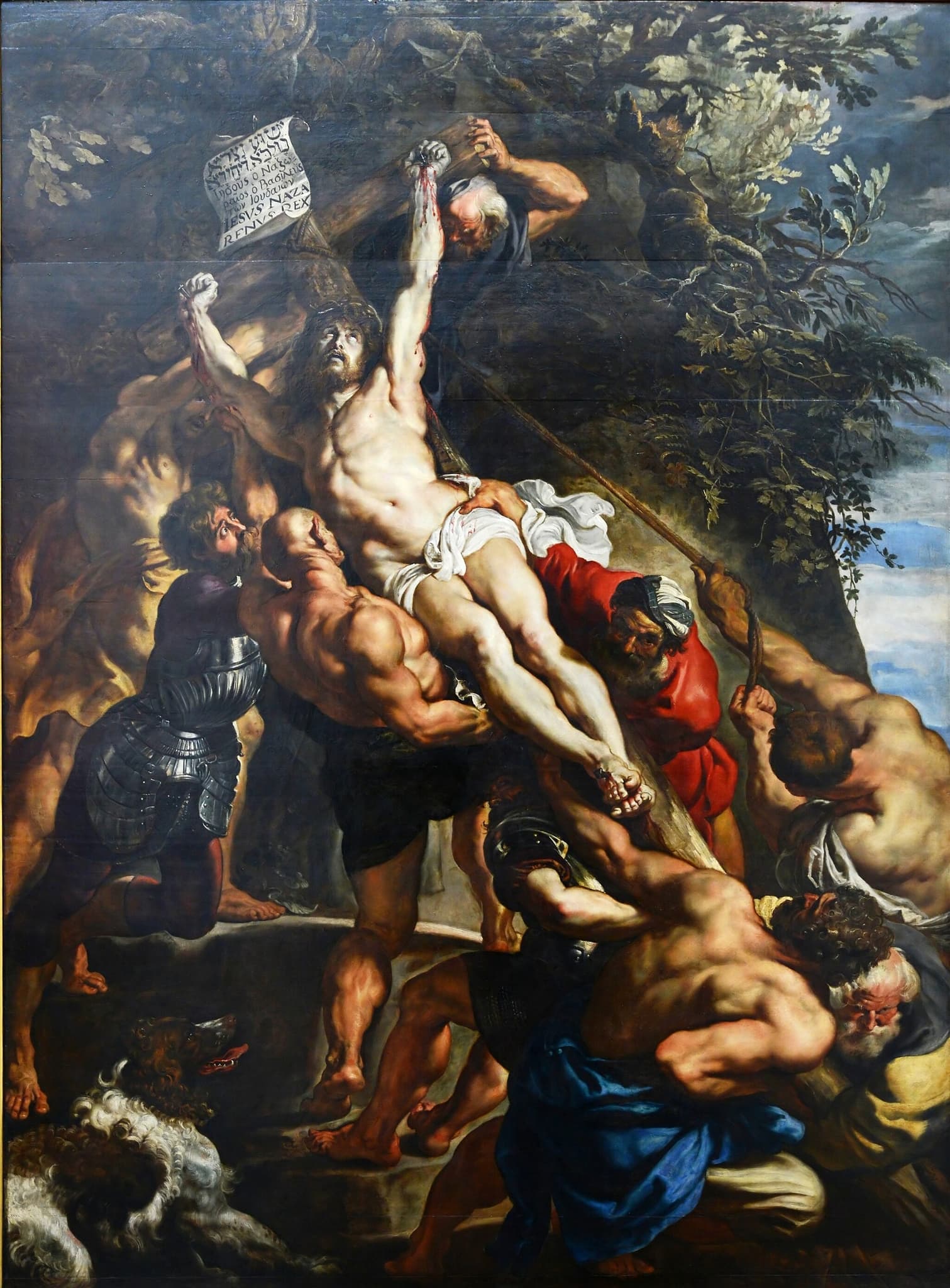
The Elevation of the Cross
Peter Paul Rubens, 1609–1610 • Oil on panel
Read full analysis of The Elevation of the Cross →Valuation Analysis
Work and status. Peter Paul Rubens’s The Elevation (Raising) of the Cross (1610–11), a monumental oil-on-panel triptych created for Antwerp’s St. Walburga and now in the Cathedral of Our Lady, is a cornerstone of Baroque painting and of Rubens’s oeuvre. It has never been publicly sold; wartime seizures aside, its continuous ecclesiastical provenance and role in Antwerp’s cultural identity make it a paradigmatic non‑market masterpiece [1].
Legal encumbrance. The triptych is effectively inalienable in practice under the Flemish Masterpiece (Topstukkendecreet) regime, which restricts export of top-tier heritage and enables state intervention. Any transaction would face extreme legal and political hurdles; thus this appraisal is a hypothetical fair‑market proxy akin to an indemnity/insurance valuation, not a realizable auction figure [2].
Artist benchmarks. Rubens’s market supports very high prices for prime autograph works. The artist’s auction record is The Massacre of the Innocents at £49.5m (~$76.7m at the time; materially higher in today’s dollars) [5]. Lot and His Daughters made £44.9m (~$58.2m) in 2016 [4], and Salome Presented with the Head of Saint John the Baptist achieved $26.9m in 2023, confirming current trophy-level demand [3]. The Antwerp Elevation surpasses all of these in art-historical stature, scale, and cultural significance.
Cross-category capacity. Nine‑figure capacity for singular Old Master trophies is established: the Louvre/Rijksmuseum jointly acquired Rembrandt’s pendant portraits for ~€160m [6]; Botticelli’s Young Man Holding a Roundel realized $92.2m at auction [7]; and the category ceiling was reset by Leonardo’s Salvator Mundi at $450.3m [8]. Against these comparables, a canonical, museum‑defining Rubens altarpiece—far rarer on the market than any of the above—supports a value comfortably above the artist’s adjusted record and consistent with a $200–400 million fair‑market range.
Scale, format and demand. The work’s monumental triptych format and sacred subject limit private residential placement and imply complex logistics (panel structure, installation). However, for state actors, leading museums, or consortia, these very attributes are virtues: unrivaled public impact, educational value, and brand visibility. In such a buyer pool, guarantees and public-private structures can bridge funding and preemption issues, sustaining nine‑figure outcomes for cultural trophies.
Conclusion. Synthesizing artist-specific records, inflation-aware comparables, and demonstrated market capacity for museum-grade Old Master icons, a defensible hypothetical fair‑market value for Rubens’s The Elevation of the Cross is $200–400 million. This range presumes clear title, legal permissibility, and stable condition; any significant structural concerns typical of large panels would affect price discovery but are unlikely to alter the order of magnitude for a work of this significance [1][2][3][5].
Key Valuation Factors
Art Historical Significance
High ImpactThe Elevation of the Cross is a foundational statement of Rubens’s Antwerp period, fusing Italianate dynamism with Northern naturalism at a monumental scale. It is regularly cited alongside the Descent from the Cross as an apex of Baroque history painting and a defining image of Counter‑Reformation Antwerp. Its continuous liturgical and civic role, extensive scholarship, and ubiquity in art‑historical literature elevate it above virtually all Rubens works that have reached the market. This level of canonization commands a premium well beyond the artist’s auction comparables and aligns it with state‑level cultural trophies that have achieved nine‑figure prices.
Rarity and Supply
High ImpactMuseum-caliber Rubens altarpieces are for all practical purposes unavailable. The market has only seen a handful of prime autograph multi‑figure works in recent decades, and none approaches the canonical status or scale of the Antwerp triptych. Extreme scarcity creates a steep rarity premium: a buyer able to acquire a singular, globally recognized Rubens of this order would face no near‑term substitutes. This scarcity effect, corroborated by the nine‑figure prices for top Old Master trophies, supports a valuation far above the artist’s historical auction record.
Legal/Patrimony Status
High ImpactUnder the Flemish Masterpiece (Topstukkendecreet) framework, works designated as top heritage face export controls and potential state intervention. While this sharply limits real‑world tradability and implies that any transaction would require government engagement, the same framework underscores the work’s national importance and strengthens its cultural premium. For hypothetical fair‑market valuation (e.g., indemnity/insurance contexts), the existence of robust state and institutional buyer pools for patrimony‑level works suggests that legal encumbrance affects deal structure more than the fundamental price level.
Scale and Format
Medium ImpactThe triptych’s monumental size and panel construction introduce logistical and conservation considerations (transport, climate control, mounting) and limit private domestic display. These factors can narrow the buyer base to institutions and consortia. However, in that cohort, scale is an advantage: the work’s impact, public draw, and reputational value are maximized in a museum or national setting. Any structural condition issues typical of large panels would be accounted for in underwriting but are unlikely to shift the order of magnitude for such a celebrated masterpiece.
Market Benchmarks and Capacity
High ImpactRubens’s top auction results ($58–77m historical) anchor the artist’s pricing, while cross‑artist Old Master trophies—Rembrandt’s pendant portraits (~€160m), Botticelli’s $92.2m, and Leonardo’s $450.3m—demonstrate demonstrated capacity for nine‑figure acquisitions of canonical works. Given that The Elevation of the Cross outranks any Rubens painting traded publicly in quality and importance, extrapolating above the adjusted artist record into the $200–400m band is consistent with observable market behavior for singular cultural icons.
Sale History
The Elevation of the Cross has never been sold at public auction.
Peter Paul Rubens's Market
Peter Paul Rubens occupies the top tier of the Old Masters market, with sustained global demand for autograph works across formats—from studies and bozzetti to large multi‑figure compositions. His auction record remains The Massacre of the Innocents at £49.5m (~$76.7m at the time), while Lot and His Daughters achieved £44.9m (~$58.2m) and Salome Presented with the Head of Saint John the Baptist realized $26.9m in 2023. Supply of major, museum‑grade Rubens paintings is extremely limited; when high‑quality works appear, they attract deep institutional and seasoned private interest. Pricing is highly quality‑ and condition‑sensitive, but for prime works the category has proven capable of sustained eight‑figure outcomes and, for a canonical masterpiece, credible nine‑figure valuation.
Comparable Sales
The Massacre of the Innocents
Peter Paul Rubens
Same artist; large, dramatic multi-figure religious history painting from Rubens’s early Antwerp period—closest market analogue and the artist’s auction record.
$76.7M
2002, Sotheby's London
~$135.8M adjusted
Lot and His Daughters
Peter Paul Rubens
Same artist; major autograph Old Testament scene of substantial size and ambition; second-highest Rubens auction result.
$58.2M
2016, Christie's London
~$76.2M adjusted
Salome Presented with the Head of Saint John the Baptist
Peter Paul Rubens
Same artist; recent trophy-level religious subject establishing current demand for prime autograph Rubens on the open market.
$26.9M
2023, Sotheby's New York
~$28.5M adjusted
Portraits of Maerten Soolmans and Oopjen Coppit (pair)
Rembrandt van Rijn
Top-tier Baroque masterpieces acquired by state museums; demonstrates nine-figure institutional capacity for canonical works comparable in cultural stature to a Rubens altarpiece.
$180.0M
2016, Private treaty (Rijksmuseum & Louvre joint state acquisition)
~$235.8M adjusted
Young Man Holding a Roundel
Sandro Botticelli
Old Master trophy benchmark showing market capacity near $100m for a canonical, museum-quality Renaissance painting; useful ceiling reference for pre-Modern masterpieces.
$92.2M
2021, Sotheby's New York
~$108.8M adjusted
Salvator Mundi
Leonardo da Vinci
Category ceiling for Old Masters and a sacred subject; illustrates the upper bound of market appetite for singular, globally recognized masterpieces.
$450.3M
2017, Christie's New York
~$571.9M adjusted
Current Market Trends
Old Masters experienced a weak 2024 with no $10m+ auction lots, followed by a selective 2025 rebound anchored by strong single‑owner sales and renewed institutional/private engagement. Trophy scarcity remains the defining feature: quality, freshness, and realistic estimates drive success. The period has seen high‑profile benchmarks (e.g., Botticelli at $92.2m, Rembrandt double‑portrait state acquisition ~€160m), indicating robust capacity for singular cultural works. Guarantees and consortium structures are common at the top end, with state involvement in patrimony‑level cases. In this context, a canonical Rubens altarpiece would command exceptional attention and nine‑figure pricing if ever hypothetically tradable.
Sources
- CODART Canon: The Elevation of the Cross (Rubens)
- Flanders Government – Topstukkendecreet (Masterpiece Decree)
- Sotheby’s – Masters Week 2023 results (Rubens Salome at $26.9m)
- Christie’s – Rubens: Lot and His Daughters sets Christie’s record
- Forbes – Rubens Record Sale (2002)
- DW – Louvre and Rijksmuseum acquire Rembrandt portraits (~€160m)
- Sotheby’s – Botticelli Young Man Holding a Roundel sells for $92.2m
- Christie’s – Salvator Mundi sells for $450.3m