How Much Is Dance in the Country Worth?
Last updated: January 25, 2026
Quick Facts
- Methodology
- comparable analysis
Hypothetical fair market value for Renoir’s Dance in the Country is $100–150 million. As a canonical 1883 ‘Dance’ canvas of museum caliber, it would command a price above recent Renoir norms and approach (but remain below) the artist’s inflation-adjusted peak, assuming lawful sale and optimal market conditions.
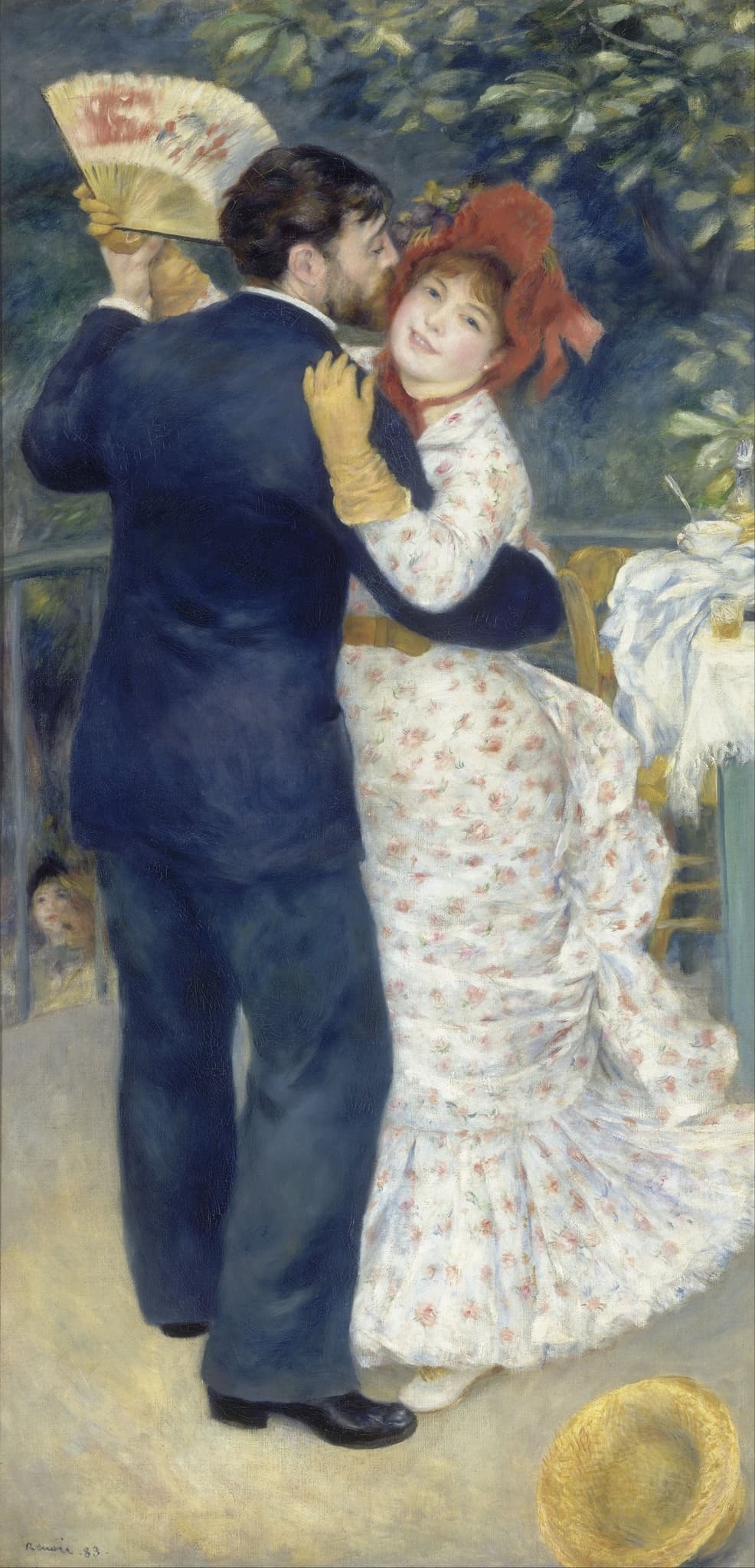
Dance in the Country
Pierre-Auguste Renoir, 1883 • Oil on canvas
Read full analysis of Dance in the Country →Valuation Analysis
Conclusion: Dance in the Country (1883) warrants a hypothetical fair market value of $100–150 million, positioning it among the most valuable Renoirs that could plausibly come to market. The estimate reflects its status as a first‑rank, large‑scale figure composition from the celebrated ‘Dance’ trio, its museum‑caliber execution, and extreme rarity of comparable supply. The work resides in the Musée d’Orsay and is inalienable under French law; this valuation assumes an exceptional, lawful sale scenario with full global exposure and superior condition. [1][3]
Comparables and price ceiling: The anchor benchmark is Renoir’s auction record, Bal du moulin de la Galette, at $78.1 million (Sotheby’s New York, 1990). Adjusted for time, that price implies a significantly higher contemporary ceiling. While today’s Impressionist buyers prioritize Monet and Cézanne at the very top, a once‑in‑a‑generation Renoir masterpiece would attract deep, international competition and set a fresh contemporary high for the artist. This estimate therefore sits below the likely value of Bal du moulin de la Galette in today’s dollars, yet well above ordinary Renoir results, reflecting Country’s stature within the oeuvre. [2]
Market depth today: Recent results confirm robust appetite for quality Renoir oils: Sotheby’s London achieved about $8.7–$8.9 million for Bouquet de lilas (1878) in June 2024, comfortably above estimate, and Christie’s sold Baigneuse (1891) for $10.41 million in November 2025. These sales—while far from masterpiece territory—demonstrate healthy eight‑figure capacity for strong works and provide a floor from which to extrapolate for a landmark subject. A highly finished, large, multi‑figure ‘Dance’ painting would trade at a multiple of these figures due to its art‑historical primacy, scale, and broad appeal. [4][5]
Art‑historical significance and rarity: Dance in the Country is one of three iconic 1883 ‘Dance’ canvases, pivotal to Renoir’s Ingresque turn and his most ambitious figure painting cycle after Bal du moulin and Luncheon of the Boating Party. It is extensively published, frequently exhibited, and instantly recognizable—attributes that concentrate demand among institutions and top private collectors. Large, multi‑figure Renoirs from the narrow 1876–83 arc very rarely surface; this scarcity is the core driver of valuation premium. [1]
Constraints and assumptions: As an inalienable work in a French national museum, the painting is not commercially available; any sale would require extraordinary legal steps. The estimate assumes such steps are satisfied, export is authorized, the painting is in excellent condition, and the sale benefits from full marketing and competitive global bidding. Under those assumptions, the $100–150 million range accurately situates the work below Renoir’s absolute icon (Bal du moulin) but comfortably above recent top Renoir transactions—consistent with its rank in the canon and current market dynamics. [1][3][4][5]
Key Valuation Factors
Art Historical Significance
High ImpactDance in the Country is a cornerstone of Renoir’s 1883 ‘Dance’ cycle—arguably his most important sequence after Bal du moulin de la Galette and Luncheon of the Boating Party. It marks the artist’s pivot toward a more classical, Ingresque finish and stands as a definitive, large‑scale figure painting from a pivotal moment in his career. The composition’s refinement, scale, and publication and exhibition history elevate it into the very top tier of Renoir’s oeuvre. Works of this caliber are cultural touchstones, not just market assets, and attract demand from leading institutions and marquee private collections. This centrality to Renoir’s narrative is a primary driver of value.
Rarity and Demand
High ImpactThere is near‑zero market turnover for large, multi‑figure Renoir masterpieces from 1876–83. Most comparable works reside in major museums worldwide and are effectively off‑market. When supply is this constrained, pricing is set by competition among a small number of determined bidders who value rarity over short‑term comparables. The ‘Dance’ canvases are among the few Renoirs capable of commanding nine‑figure attention today. Given the work’s wide recognition, cross‑cultural appeal, and suitability for museum display, demand would likely extend across the U.S., Europe, and Asia, with several potential institutional and private buyers willing to compete at a premium.
Market Benchmarks and Price Ceiling
High ImpactRenoir’s standing record is $78.1 million (1990), and while recent sales for strong—but not iconic—works range from roughly $8–25 million, these figures understate what a true masterpiece can achieve. In today’s market, an artwork of this stature would likely approach but remain below the inflation‑adjusted value of Bal du moulin de la Galette, the artist’s most famous painting. Setting the estimate at $100–150 million places Dance in the Country well above ordinary Renoir pricing, yet responsibly beneath the absolute ceiling implied by Renoir’s singular icons. This reflects both the painting’s status and current collector preferences within blue‑chip Impressionism.
Condition, Scale, and Provenance
Medium ImpactAt approximately 180 × 90 cm, the work’s imposing, vertical format and highly finished surface are optimal for marquee presentation. Its long history in French state collections (now Musée d’Orsay) confers unimpeachable provenance and scholarly standing. This valuation assumes excellent, stable condition consistent with museum care. Any significant condition issues (e.g., structural interventions, overcleaning, discoloration) would require a downward adjustment. Conversely, a pristine conservation record, comprehensive literature, and a strong exhibition dossier support placement at the upper end of the range by de‑risking buyer concerns and enhancing lender appeal for future institutional shows.
Legal and Marketability Considerations
Medium ImpactAs part of a French national museum collection, the painting is inalienable under the French Heritage Code, meaning any sale is exceptionally unlikely and would require special authorization. This legal status constrains marketability rather than intrinsic value. The estimate explicitly assumes a lawful path to deaccession and export, clear title, and full marketing. If such conditions were met, the resulting scarcity premium and attention would likely amplify bidding. However, the complexity and rarity of such a transaction can affect sale structure (e.g., private treaty with state involvement, guarantees) and timing, factors considered in the mid‑to‑upper nine‑figure positioning.
Sale History
Dance in the Country has never been sold at public auction.
Pierre-Auguste Renoir's Market
Pierre‑Auguste Renoir is a blue‑chip pillar of the Impressionist canon with a deep, global market. His all‑time auction record is $78.1 million for Bal du moulin de la Galette (Sotheby’s, 1990), and while many oils trade between $2–20 million, top‑tier figural paintings regularly reach the high seven to low eight figures. Demand is highly quality‑selective: iconic subjects, prime periods (late 1870s to early 1880s), museum‑level provenance, and strong condition command significant premiums. Recent seasons have shown renewed depth for vetted, high‑quality Renoirs, but the very highest prices are reserved for rare, landmark compositions that can anchor an institution or major private collection—precisely the category to which the ‘Dance’ pictures belong.
Comparable Sales
Bal du moulin de la Galette
Pierre-Auguste Renoir
Same artist; iconic multi‑figure dance scene (1876) of comparable ambition and near‑monumental scale. Sets the historical ceiling for Renoir and is thematically closest to the “Dance” works.
$78.1M
1990, Sotheby's New York
~$185.9M adjusted
Berthe Morisot et sa fille, Julie Manet
Pierre-Auguste Renoir
Same artist; major two‑figure portrait (1894), highly finished and museum‑level. Demonstrates recent willingness to pay strong eight figures for top Renoir figural subjects.
$24.4M
2022, Christie's New York
~$26.6M adjusted
Square de la Trinité
Pierre-Auguste Renoir
Same artist; late‑1870s Parisian scene with multiple figures (1878–79). Close in period and subject of urban leisure, though smaller and less iconic than the “Dance” canvases.
$11.9M
2023, Christie's New York
~$12.6M adjusted
Baigneuse
Pierre-Auguste Renoir
Same artist; large, highly finished single‑figure nude (1891). Recent eight‑figure benchmark for blue‑chip Renoir figure painting with museum‑level quality.
$10.4M
2025, Christie's New York
Buste de femme, de profil
Pierre-Auguste Renoir
Same artist; close in date (1884) to the 1883 “Dance” series and representative of Renoir’s contemporaneous Ingresque turn. Smaller single‑figure work useful for period‑specific calibration.
$7.2M
2022, Sotheby's London
~$7.8M adjusted
Bouquet de lilas
Pierre-Auguste Renoir
Same artist; not subject‑analogous, but a strong 2024 evening‑sale result. Helps gauge current market depth for high‑quality Renoir oils in the present cycle.
$8.7M
2024, Sotheby's London
~$9.0M adjusted
Current Market Trends
The late‑19th/Impressionist segment has benefited from a broad ‘flight to quality,’ with collectors prioritizing blue‑chip names, strong provenance, and museum‑caliber works. After a cautious 2023, marquee evening sales in 2024–2025 showed renewed confidence and competitive bidding for best‑in‑class material, while mid‑market lots remained selective. Recent Renoir results in the high seven and low eight figures demonstrate healthy demand, and category bellwethers (notably top Monets and other Modern masters) have reinforced liquidity at the upper end. Against this backdrop, a first‑rank Renoir masterpiece would attract global bidding and has the potential to reset the artist’s contemporary price ceiling.
Sources
- Musée d’Orsay – Danse à la campagne (RF 1979-64) object page
- The Washington Post – Renoir record $78.1m (May 18, 1990)
- Legifrance – Code du patrimoine (Art. L451-5): Inalienability of public museum collections
- Artnet News – By the Numbers: Sotheby’s London Evening Sale, June 25, 2024
- HENI News – Renoir, Baigneuse (1891) achieves $10.41m at Christie’s, Nov 2025