Dance in the Country

by Pierre-Auguste Renoir

Dance in the Country shows a couple swept into a close embrace on a café terrace, their bodies turning in a soft spiral as foliage and sunlight dissolve into dappled color. Renoir orchestrates bourgeois leisure—the tossed straw boater, a small table with glass and napkin, the woman’s floral dress and red bonnet—to stage a moment where decorum and desire meet. The result is a modern emblem of shared pleasure, poised between Impressionist shimmer and a newly firm, linear touch.

Fast Facts

Year
1883
Medium
Oil on canvas
Dimensions
180.3 x 90.0 cm
Location
Musée d’Orsay, Paris
Dance in the Country by Pierre-Auguste Renoir (1883) featuring Folding fan, Yellow gloves, Straw boater hat, Café tableware

Click on any numbered symbol to learn more about its meaning

Meaning & Symbolism

Renoir composes intimacy as motion. The dancers’ bodies form a gentle helix—his navy suit curving around her pale, rose‑sprigged dress—so that the eye travels from their interlocked hands to her tilted, smiling face and down to the rippling hem that skims the terrace. The raised fan behind the man’s head is not a coded message but an accessory of flirtation, a fashionable prop that licenses play while keeping up appearances 7. Her long yellow gloves reinforce propriety—19th‑century etiquette required gloves at public dances—even as her torso yields to his lead, fusing behavioral decorum with bodily closeness 6. At their feet, the straw boater lies abandoned like a punctuation mark to spontaneity, a sign that the music overruled manners and drew them in mid‑leisure onto the floor 4. Renoir anchors this instant in the material culture of café sociability. To the right, a small table cluttered with a white cloth, cup and spoon, decanter and half‑filled glass signals that the couple has just risen, leaving the trace evidence of talk and drinking; the Frick checklist for this canvas describes precisely these props, underscoring the narrative of interrupted conviviality 3. The floral dress visually rhymes with the leaves that cloud the background, so the woman’s body reads as a naturalized figure of pleasure: human and environment echo each other, and sensation—light, touch, music—becomes a shared atmosphere rather than a private feeling. Meanwhile, the man’s dark suit, rendered with firmer contours, anchors the swirl and reveals the painter’s post‑Italy turn toward clearer drawing and modeled form, the same classicizing impulse that reshaped works like The Umbrellas 5. The picture’s dappled light retains Impressionism’s shimmer, but the drafting of hands, faces, and the dress’s ruched weight declares Renoir’s desire for durable form within modern life’s flux. The painting’s social intelligence depends on contrast and pairing. Conceived alongside Dance in the City and Dance at Bougival, this vertical full‑length asserts an outdoor register of freedom and warmth that plays against the City canvas’s controlled elegance 24. In this country scene, signals of etiquette (gloves, the fan) coexist with permissive cues (tossed hat, close cheek‑to‑cheek posture), modeling how the bourgeois public negotiated desire without scandal. Identifying the sitters as Paul Lhote and Aline Charigot—Renoir’s future wife—grounds the tableau in the artist’s immediate milieu and intensifies its air of lived sociability rather than staged allegory 1. The scale and format align with Renoir’s ambition in the early 1880s to revitalize the full‑length tradition for modern subjects, an ambition his dealer Paul Durand‑Ruel actively promoted in exhibitions that often presented the three dances together 38. Why Dance in the Country is important is thus twofold. Aesthetically, it crystallizes Renoir’s synthesis of Impressionist luminosity with classical line, a pivot that would define his mature style 5. Culturally, it codifies the pleasures of the Belle Époque—music, drinking, flirtation, outdoor cafés—into a persuasive image of social harmony. The small theater of objects and gestures—the fan aloft, the gloves intact, the table askew—makes a claim: modern happiness is public, tactile, and shared, yet choreographed by taste. In that balance between abandon and decorum lies the painting’s lasting charm and its lucid reading of its time.

Explore Deeper with AI

Ask questions about Dance in the Country

Popular questions:

Powered by AI • Get instant insights about this artwork

💬 Ask questions about this artwork!

Interpretations

Formal Analysis: Line against Light

Dance in the Country crystallizes Renoir’s post‑Italy pivot toward firmer contour while preserving Impressionist optical play. The man’s navy suit and the carefully drafted hands and face act as structural armatures, stabilizing a field of dappled light and textile shimmer; the floral dress registers as a moving color‑mass rather than a merely decorative surface 1. This resolution echoes the two‑phase making of The Umbrellas, where Renoir reworked earlier feathery handling into a more Ingres‑like linear clarity 4. Here, contour never suppresses sensation: the hem’s ripples, foliage flicker, and glassware glints keep perception lively, but the bodies hold their weight in space. The result is a modern classicism—sensuous, publicly legible, and built to endure beyond the instant it depicts 14.

Source: National Gallery, London

Fashion Semiotics: Fans, Gloves, and Managed Intimacy

Renoir mobilizes fashion as a technology of manners. The raised fan functions as an accessoire de contenance, a stylish license for flirtation without committing to scandal; period fashion culture trained viewers to read such gestures even if the so‑called “secret language of fans” was largely a 19th‑century marketing myth 57. The long gloves enforce propriety at a public dance—magazines and etiquette culture deemed gloves obligatory—so touch is buffered even as bodies press close 6. These accessories do not symbolize abstract virtues; they script socially legible behavior in real time, allowing rhythm, heat, and proximity to unfold under the cover of taste. Renoir’s close observation of costume thus becomes a critique and celebration of how fashion choreographs desire in public 567.

Source: Musée d’Orsay (Impressionism & Fashion)

Market and Display: Durand‑Ruel’s Theatrical Triptych

The canvas belongs to a trio—Country, City, Bougival—shaped for maximum public impact by dealer Paul Durand‑Ruel, who exhibited them together and brought Renoir’s modern fêtes to international audiences (notably New York in 1886) 19. Their vertical, life‑size scale borrows the grand portrait format but fills it with popular leisure, converting high art’s prestige into a showcase for modern sociability 11. This theatrical grouping offered collectors mood‑calibrated options: indoor elegance, open‑air warmth, or bustling suburb. The triptych logic—contrast and complement—also made Renoir’s stylistic pivot legible at scale, promoting his hybrid of line and light as a signature product in the burgeoning market for Impressionism 1191.

Source: Philadelphia Museum of Art (Durand‑Ruel exhibition)

Social History: Café Sociability and Public Happiness

The vacated table—cloth, cup, spoon, decanter, half‑filled glass—documents interrupted conviviality, pinning the dance to café culture rather than allegory 3. On the terrace floor, a tossed straw boater doubles down on spontaneity, a cue widely noted in the trio’s Bougival counterpart for its sensuous ambience 8. Renoir scripts a politics of pleasure: modern happiness is public, tactile, and shared, yet carefully staged by etiquette and taste. The terrace becomes a civic stage where middle‑class leisure is performed as harmony—music audible, drink visible, touch negotiated. Small objects do the heavy lifting: they authenticate the scene’s social reality while keeping desire within the bounds of decorum 38.

Source: The Frick Collection

Studio Practice: Casting, Substitution, and the Social Circle

While Orsay identifies the sitters as Paul Lhote and Aline Charigot in the finished painting 1, a Louvre drawing records an earlier study for the “grand tableau” with Edmond Renoir and Suzanne Valadon—evidence of casting substitutions across the project 10. Renoir’s circle thus populated the trio variably, blurring the line between portrait and type. This fluid modeling supports the works’ dual function: intimate records of a milieu and polished, market‑ready images. Recognizing Valadon’s presence in preparatory stages (without mistaking her for the final sitter here) clarifies how Renoir iterated pose, costume, and chemistry to achieve the painting’s particular register of warmth and ease 101.

Source: Musée du Louvre (Drawings Department)

Comparative Space: City Restraint vs. Country Warmth

Designed as a pair with Dance in the City, the Country canvas asserts an outdoor register of freedom and warmth against the ballroom’s cool control 2. Costumes and gestures do the comparative work: floral dress and foliage “rhyme” in Country, while satin restraint governs City; gloves are emphatic here, yet cheek‑to‑cheek proximity and a tossed hat relax the code 211. Seen with Bougival, the trio reads as a set of spatialized moods—urban, pastoral, and suburban—each calibrating tempo, touch, and etiquette differently. The pairing makes Renoir’s argument explicit: modern pleasure is not a single scene but a spectrum of choreographies embedded in locale and décor 2118.

Source: Musée d’Orsay

Related Themes

About Pierre-Auguste Renoir

Pierre-Auguste Renoir (1841–1919) emerged from craft training into the avant-garde circle around Monet, Sisley, and Bazille, helping to found Impressionism. In the mid‑1870s he focused on outdoor scenes of modern leisure in and around Montmartre, using dappled light and high-chroma color to capture transient sensations [1][2][5].
View all works by Pierre-Auguste Renoir

More by Pierre-Auguste Renoir
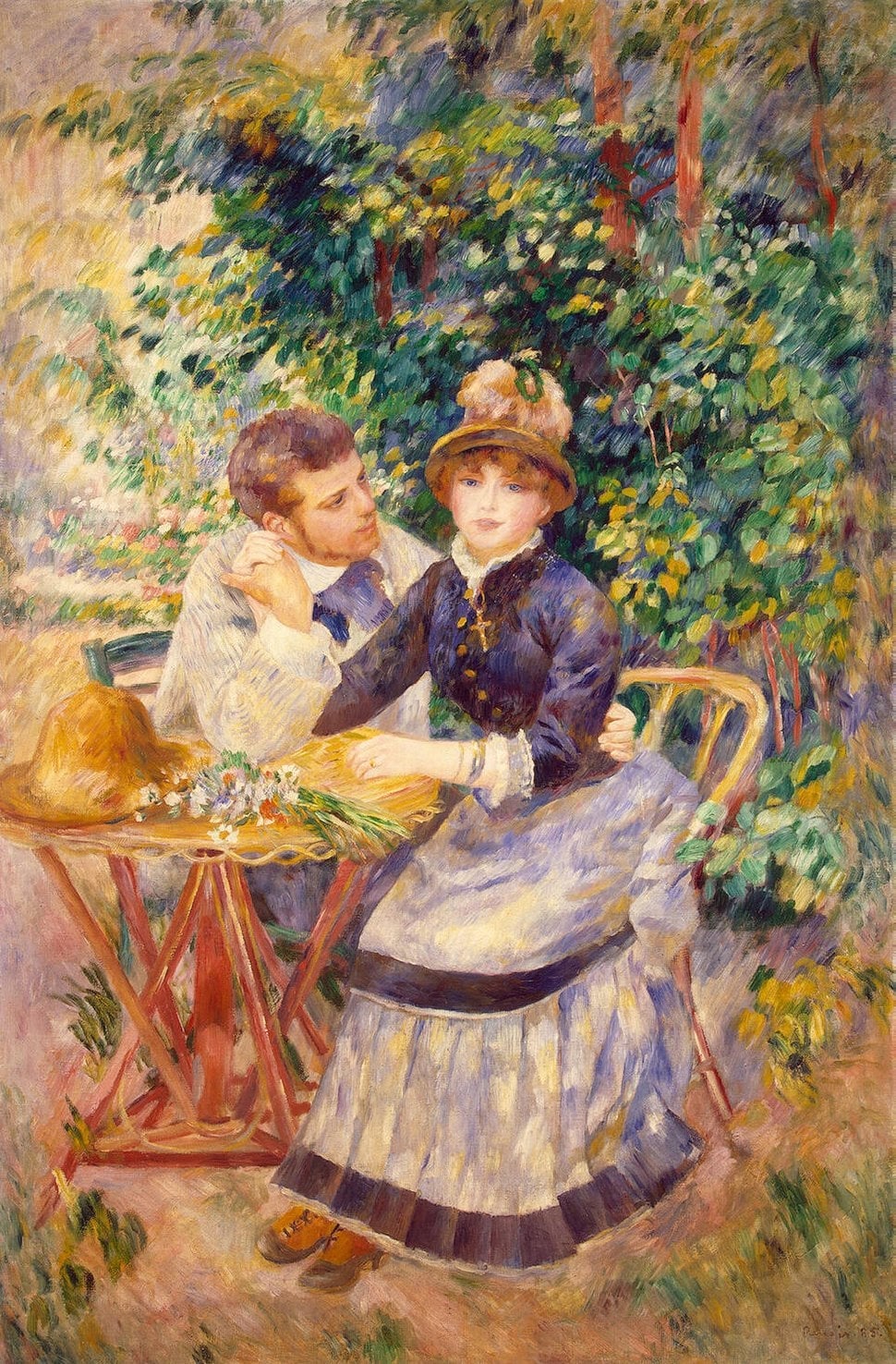
In the Garden by Pierre-Auguste Renoir

In the Garden

Pierre-Auguste Renoir (1885)

In the Garden presents a charged pause in modern leisure: a young couple at a café table under a living arbor of leaves. Their lightly clasped hands and the bouquet on the tabletop signal courtship, while her calm, front-facing gaze checks his lean. Renoir’s flickering brushwork fuses figures and foliage, rendering love as a <strong>transitory, luminous sensation</strong> <sup>[1]</sup><sup>[3]</sup>.
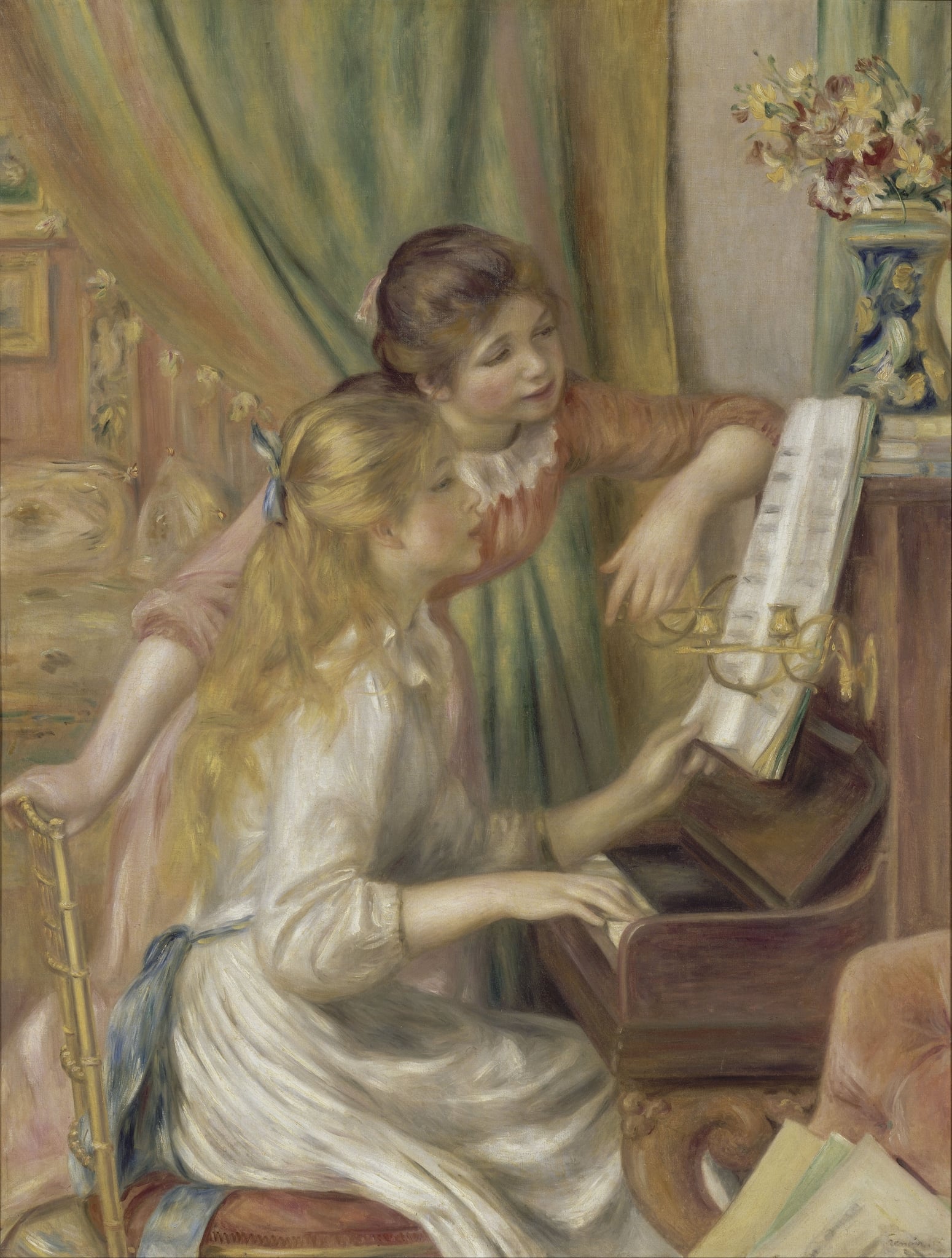
Young Girls at the Piano by Pierre-Auguste Renoir

Young Girls at the Piano

Pierre-Auguste Renoir (1892)

Renoir’s Young Girls at the Piano turns a quiet lesson into a scene of <strong>attunement</strong> and <strong>bourgeois grace</strong>. Two adolescents—one seated at the keys, the other leaning to guide the score—embody harmony between discipline and delight, rendered in Renoir’s late, <strong>luminous</strong> touch <sup>[1]</sup><sup>[2]</sup>.

Pont Neuf Paris by Pierre-Auguste Renoir

Pont Neuf Paris

Pierre-Auguste Renoir (1872)

In Pont Neuf Paris, Pierre-Auguste Renoir turns the oldest bridge in Paris into a stage where <strong>light</strong> and <strong>movement</strong> bind a city back together. From a high perch, he orchestrates crowds, carriages, gas lamps, the rippling Seine, and a fluttering <strong>tricolor</strong> so that everyday bustle reads as civic grace <sup>[1]</sup>.
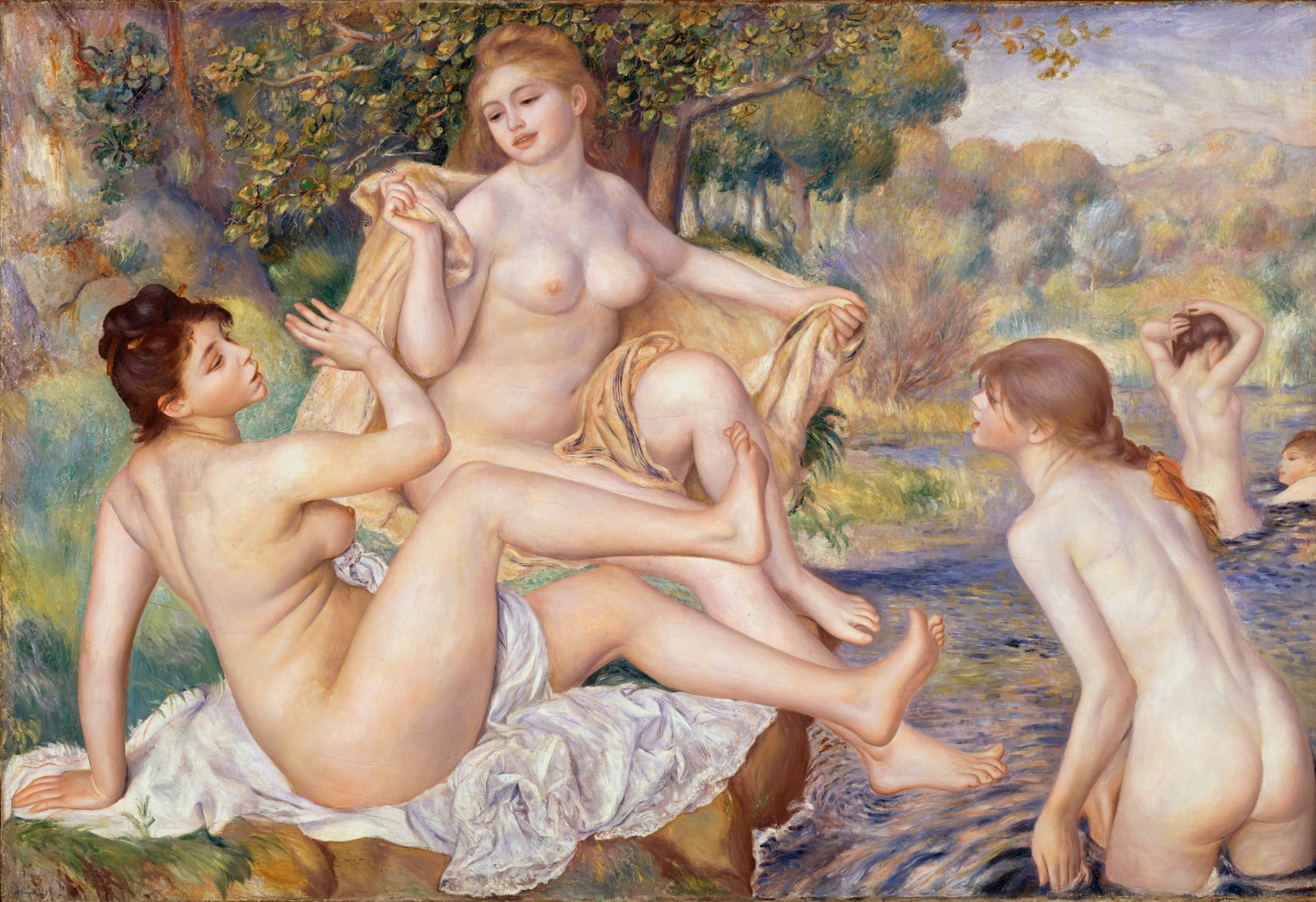
The Large Bathers by Pierre-Auguste Renoir

The Large Bathers

Pierre-Auguste Renoir (1884–1887)

Pierre-Auguste Renoir’s The Large Bathers unites modern bodies with a pastoral grove to stage an <strong>Arcadian ideal</strong>. Three monumental nudes form interlocking curves and triangles while two background figures splash and groom, fusing <strong>sensual warmth</strong> with <strong>classical order</strong> <sup>[1]</sup><sup>[2]</sup>.

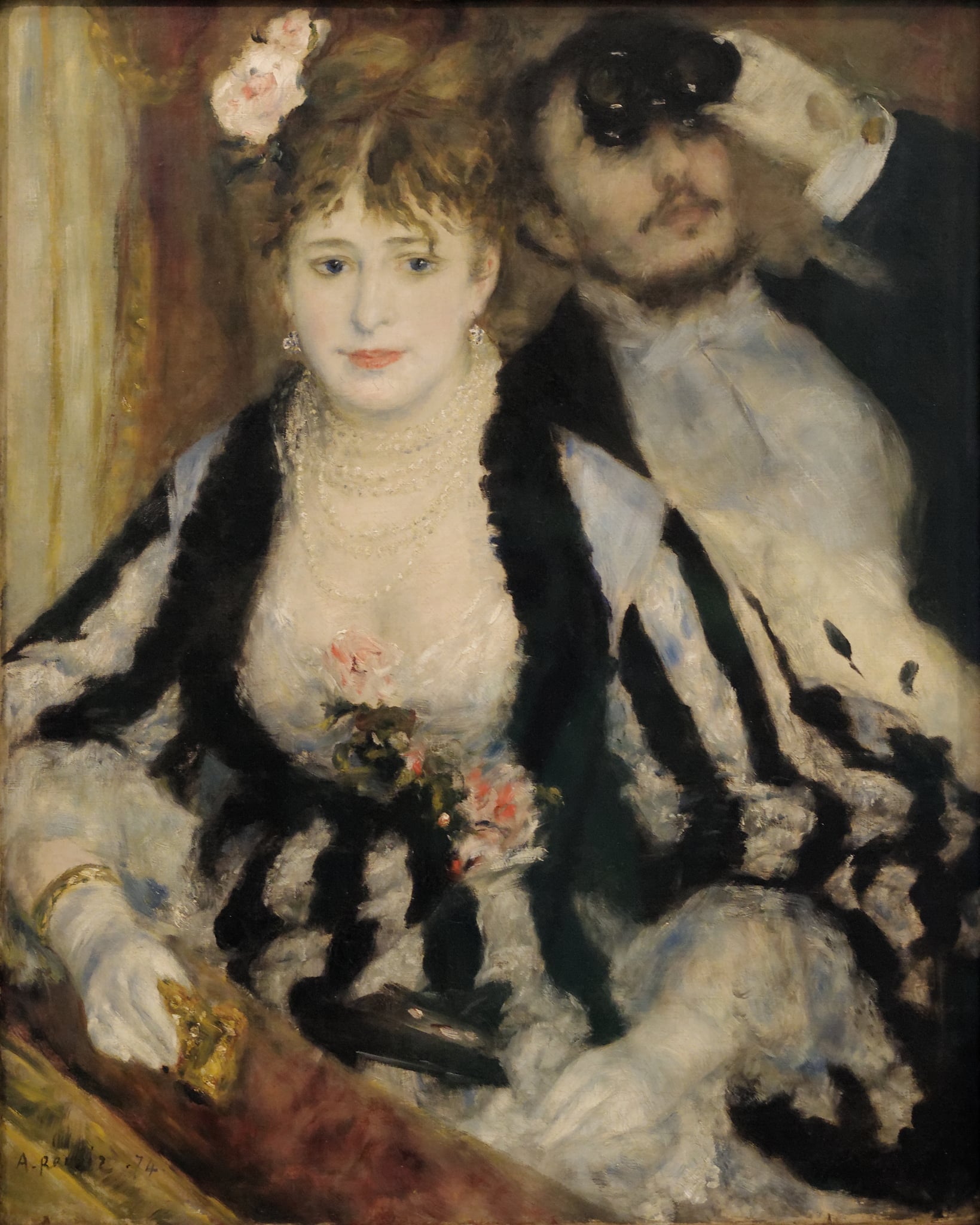
The Loge by Pierre-Auguste Renoir

The Loge

Pierre-Auguste Renoir (1874)

Renoir’s The Loge (1874) turns an opera box into a <strong>stage of looking</strong>, where a woman meets our gaze while her companion scans the crowd through binoculars. The painting’s <strong>frame-within-a-frame</strong> and glittering fashion make modern Parisian leisure both alluring and self-conscious, turning spectators into spectacles <sup>[1]</sup><sup>[2]</sup>.

The Swing by Pierre-Auguste Renoir

The Swing

Pierre-Auguste Renoir (1876)

Renoir’s The Swing fixes a fleeting, sun-dappled exchange in a Montmartre garden, where a woman in a white dress with blue bows steadies herself on a swing while a man in a blue jacket addresses her. The scene crystallizes <strong>modern leisure</strong>, <strong>flirtation</strong>, and <strong>optical shimmer</strong>, as broken strokes scatter light over faces, fabric, and ground <sup>[1]</sup><sup>[4]</sup>.