How Much Is Girl with a Watering Can Worth?
Last updated: January 25, 2026
Quick Facts
- Insurance Value
- $150.0M (Reasoned replacement estimate based on artist record, period desirability, and museum-caliber status)
- Methodology
- comparable analysis
Renoir’s Girl with a Watering Can (1876, National Gallery of Art) is a prime‑year, museum‑canonical icon. Based on the artist’s historic record and recent market benchmarks for strong Renoirs, a hypothetical auction estimate of $90–130 million is appropriate, with insurance at $150 million.
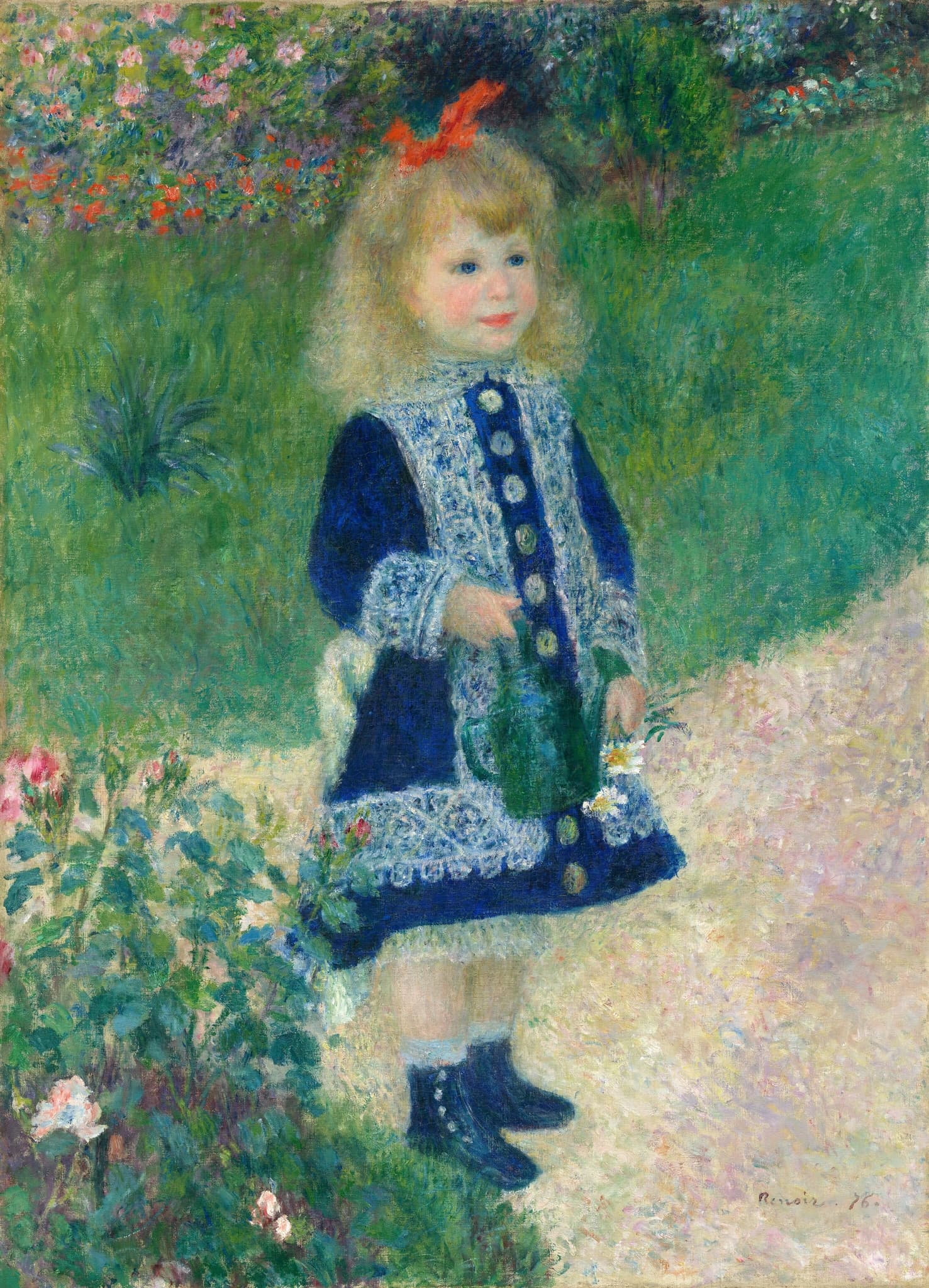
Girl with a Watering Can
Pierre-Auguste Renoir, 1876 • Oil on canvas
Read full analysis of Girl with a Watering Can →Valuation Analysis
Conclusion: Girl with a Watering Can is a peak‑period, widely reproduced Renoir icon from 1876, held by the National Gallery of Art (Chester Dale Collection). If hypothetically offered today, we estimate a public auction value of $90–130 million (premium‑inclusive), and a replacement/insurance value of $150 million, reflecting the work’s singular cultural prominence and practical irreplaceability [1].
Comparables and benchmarks: Renoir’s top historical auction benchmark remains Au Moulin de la Galette (1876), sold for $78.1 million in 1990—an amount that would equate to roughly the high‑$100 millions in today’s dollars, and still the clearest ceiling for Renoir’s absolute masterpieces [2]. Recent market evidence underscores the selectivity of demand: high‑quality Renoirs continue to achieve solid eight‑figure prices, such as $24.4 million for Berthe Morisot et sa fille, Julie Manet (Christie’s, 2022), while other strong works have transacted around $10–12 million in 2021–2025 marquee sales [3][4]. Against this landscape, a prime‑year, signature 1876 icon with exceptional public recognition justifies a substantial premium over recent portrait/figure results, yet should be positioned below the ambition and scale of Moulin.
Art‑historical weight and subject appeal: Painted in 1876—the same year as Moulin de la Galette—Girl with a Watering Can exemplifies Renoir’s high‑Impressionist palette and touch in a single‑figure child portrait that has become emblematic of the artist’s popular appeal. Its size (c. 100 × 73 cm), refined execution, and ubiquity in textbooks, posters, and museum displays confer brand‑level recognizability that typically commands outsized demand from trophy‑motivated buyers [1]. This “name‑image” effect is central to the valuation premium.
Market context: The Impressionist market remains selective at the very top, with 2024 seeing fewer $10m+ lots offered, though late‑2025 marquee weeks showed renewed appetite and a flight to quality. Blue‑chip Impressionist trophies (notably Monet) have led rebounds, suggesting sustained depth for canonical names when quality is unimpeachable [5]. In a supply‑constrained segment where most prime 1870s Renoirs reside in museums, a work of this fame would likely attract global competition, potentially including guarantees, which supports the $90–130 million range.
Insurance rationale: Museums commonly insure irreplaceable masterpieces at levels above likely auction outcomes. Given the painting’s stature, prime year, subject fame, and the artist’s historic record, a $150 million replacement value is defensible despite the absence of a modern public sale for this specific work [1][2]. Final pricing would be fine‑tuned by condition and technical reports, but nothing in the public record contradicts a top‑tier valuation.
Key Valuation Factors
Art Historical Significance
High ImpactPainted in 1876, Girl with a Watering Can sits squarely within Renoir’s high‑Impressionist peak, the same year as Au Moulin de la Galette. It distills the artist’s celebrated handling of light, color, and texture into a single‑figure format that has become one of his most reproduced images. The painting’s place in the National Gallery of Art’s core narrative of Impressionism, its frequent publication, and its recognition by general audiences elevate it beyond a typical portrait. In art‑historical terms it is a canonical work—instantly legible as “Renoir”—and functions as a signature image for the artist’s 1870s figure painting. This stature materially strengthens price resilience and auction competitiveness.
Period and Quality
High ImpactThe year 1876 is among the most coveted in Renoir’s oeuvre, encompassing works created at the heart of the Impressionist project. Collectors consistently ascribe a premium to 1870s canvases for their chromatic freshness and bravura brushwork. Girl with a Watering Can displays these hallmarks at an attractive, substantial scale (about 100 × 73 cm), offering the tactile, high‑key palette and soft, atmospheric modeling that buyers prize. Prime‑period quality—combined with the work’s exceptional visibility—positions it well above the pricing of later portraits or smaller, less iconic subjects, and supports a nine‑figure estimate in a competitive, trophy‑oriented sale.
Subject and Iconicity
High ImpactRenoir’s child portraits are among his most beloved and commercially reliable subjects, but very few match the cultural imprint of Girl with a Watering Can. The image’s warmth, intimacy, and instantly recognizable blue dress and watering can have made it a mainstay of museum merchandising and art education. This kind of pop‑cultural penetration—paired with authoritative museum ownership—creates a brand effect that can lift bidding beyond the norms implied by recent Renoir portrait prices. The work’s memorability and cross‑market appeal (Western, U.S., and Asian buyers) significantly widen the potential bidder base for a hypothetical sale.
Rarity and Supply
High ImpactThe supply of true 1870s Renoir masterpieces in private hands is extremely thin; most headline works reside in major museums. That scarcity means that when an icon of this caliber is even hypothetically considered for sale, competitive intensity can be outsized relative to recent comparables. The market’s selective but deep demand for blue‑chip Impressionist trophies, combined with a dearth of directly substitutable 1876 figure paintings, supports valuation at a premium to typical eight‑figure Renoirs. Scarcity also informs the insurance recommendation: replacing an equally famous 1870s Renoir in similar condition and scale would be impracticable at any price.
Provenance and Exhibition
Medium ImpactA long tenure in the National Gallery of Art (Chester Dale Collection) confers unimpeachable provenance and cemented exhibition/publication history. While museum ownership removes near‑term marketability, it also enhances perceived quality and cultural value. Such provenances reduce transactional risk and often translate into strong pricing when works are restituted, deaccessioned, or privately exchanged. Further condition and technical details would refine pricing, but the institutional context and publication record already align with a top‑tier valuation for this painting.
Sale History
Girl with a Watering Can has never been sold at public auction.
Pierre-Auguste Renoir's Market
Pierre‑Auguste Renoir remains one of the most liquid and recognized Impressionists. His auction record is $78.1 million for Au Moulin de la Galette (1990), a benchmark that in today’s dollars sits in the high‑$100 millions, underscoring the potential for apex works. Recent strong results demonstrate selective but durable demand: top portraits and figure subjects have transacted in the low‑ to mid‑eight figures, while lesser works cluster in the mid‑five to low‑seven figures. Collectors prize prime 1870s canvases, iconic subjects, and pristine condition. Given constrained supply of peak‑period masterpieces, the best Renoirs can still outperform category averages when they surface, especially under strong guarantees and global promotion.
Comparable Sales
Au Moulin de la Galette (Bal du moulin de la Galette)
Pierre-Auguste Renoir
Same artist and same year (1876) as Girl with a Watering Can; apex Impressionist masterpiece that anchors Renoir’s top-end market and sets an upper bound for prime 1870s icons.
$78.1M
1990, Sotheby's New York
~$187.4M adjusted
Berthe Morisot et sa fille, Julie Manet
Pierre-Auguste Renoir
Same artist; major portrait subject with strong market reception; recent high-water mark for Renoir portraits, useful to gauge current demand even though it’s a later (1894) work.
$24.4M
2022, Christie's New York
~$26.8M adjusted
Jeune fille à la corbeille de fleurs
Pierre-Auguste Renoir
Same artist; single young girl subject closely aligned to Girl with a Watering Can’s child-portrait theme; later (c. 1890), but a strong subject-matter comp.
$12.9M
2021, Sotheby's New York
~$15.2M adjusted
Square de la Trinité
Pierre-Auguste Renoir
Same artist; late-1870s canvas (1878–79) from the prime Impressionist decade; while a city scene rather than a child portrait, it benchmarks pricing for quality 1870s oils.
$11.9M
2023, Christie's New York
~$12.5M adjusted
Baigneuse
Pierre-Auguste Renoir
Same artist; core Renoir figure subject with a recent eight-figure 2025 result; shows current appetite for strong figural oils, though it’s a later period work.
$10.4M
2025, Christie's New York
L’enfant et ses jouets – Gabrielle et le fils de l’artiste, Jean
Pierre-Auguste Renoir
Same artist; child-centered subject (with Gabrielle and Jean), offering a recent, directly thematic comp at a smaller/lower tier—useful for subject-driven demand context.
$2.1M
2025, Drouot, Paris
Current Market Trends
The Impressionist sector has been supply‑constrained at the marquee level, with 2024 auction values softening on fewer $10m+ offerings, followed by renewed depth for blue‑chip trophies in late‑2025. The market has clearly flown to quality: masterworks by canonical names (e.g., Monet) led rebounds, while mid‑tier lots remained price‑sensitive. For Renoir, this bifurcation means prime‑period, name‑image icons can achieve exceptional outcomes, whereas non‑core subjects or later works may underperform. In this environment, a singular, museum‑famous 1876 Renoir portrait warrants a nine‑figure estimate and a higher insurance buffer, supported by global demand and extreme scarcity.
Sources
- National Gallery of Art (NGA): Girl with a Watering Can object record
- UPI: Renoir draws $78.1 million (Sotheby’s 1990, Au Moulin de la Galette)
- Christie’s sale reporting: Renoir market highlights (incl. Berthe Morisot et sa fille, Julie Manet, $24.4m, 2022)
- Artnet News: By the Numbers—Sotheby’s London June 2024 Evening Sale (category benchmarks)
- Christie’s: November 2025 20th Century Evening—market recap (Impressionist trophies performance)
- Art Basel & UBS Art Market Report 2025—Auction trends and category shares