Girl with a Watering Can

by Pierre-Auguste Renoir

Renoir’s 1876 Girl with a Watering Can fuses a crisply perceived child with a dissolving garden atmosphere, using prismatic color and controlled facial modeling to stage innocence within modern leisure [1]. The cobalt dress, red bow, and green can punctuate a haze of pinks and greens, making nurture and growth the scene’s quiet thesis.

Fast Facts

Year
1876
Medium
Oil on canvas
Dimensions
100 x 73 cm (39 3/8 x 28 3/4 in)
Location
National Gallery of Art, Washington, DC
Girl with a Watering Can by Pierre-Auguste Renoir (1876) featuring Daisies, Watering can, Roses, Cobalt blue dress with lace

Click on any numbered symbol to learn more about its meaning

Meaning & Symbolism

Renoir builds the image as a pact between clarity and shimmer. The child’s face—gently modeled, with small, warm highlights at the cheeks and a precise, alert gaze—receives the most controlled handling, while the surrounding lawn, border shrubs, and pale, dappled path break into flickering strokes of green, pink, and lilac. This calibrated contrast, noted by the National Gallery of Art, makes the figure feel anchored amid a vibrating envelope of light, an Impressionist solution tailored to figure painting 1. Chromatically, the saturated cobalt dress edged in dense lace and dotted with bright buttons becomes a primary chord, counterbalanced by the sharp red bow above and the deep green of the watering can below; these three accents triangulate the body and hold the composition against the swirl of foliage. The path’s curving pale band leads the eye from the signature at lower right past the child’s boots to the small roses at lower left, then back to the daisies she holds—an orchestrated circuit that keeps attention circulating through care, clothing, and cultivation. Meaning emerges through ordinary things treated with unusual tenderness. In 19th‑century domestic gardens, a watering can was a common tool of upkeep—practical, repetitive, and emblematic of quiet labor 4. Placed at the child’s hip, it recodes labor as affection: the garden needs watering, and childhood needs tending. The daisies gripped in her hand and the roses at her feet resonate with a period audience’s floriographic habits—daisies for innocence, roses for love—without locking the painting into a fixed program; Renoir leverages these cultural connotations as atmosphere rather than doctrine 36. The point is not that the child “symbolizes” innocence, but that innocence appears as a nurtured state, something made and maintained, like a border of perennials. Socially, the dress does as much work as the flowers. Late‑1870s viewers were primed to read children’s attire as signals of class and care; Renoir’s concurrent society portraits operationalize clothing and setting to project refinement and modern domestic virtue 2. Here, the rich velvet blue, firm lace trims, and neat boots declare resources and attention, yet the task at hand—watering and gathering simple blossoms—keeps status from hardening into display. Renoir thus squares a bourgeois ideal: luxury softened by tender usefulness. The face’s calm alertness and the slightly off‑center stance further avoid stiffness, producing an immediacy that critics have long connected to Renoir’s empathetic “stooping” to the child’s scale, even as his facture remains deliberately crafted 1. Historically, Girl with a Watering Can marks Renoir’s maturing strategy in the later 1870s: carrying Impressionist color outdoors into figure subjects while tightening the drawing and strokes in key passages—especially heads and hands—to satisfy portrait expectations 12. That hybrid solved a market problem and an artistic one, enabling him to keep the prismatic envelope of light while shaping personalities that viewers could recognize as types if not individuals. The sitter is unknown, and the oft‑repeated claim about Monet’s garden lacks secure corroboration; the painting’s authority lies not in biography but in how it constructs a persuasive modern ideal 1. In this sense, why Girl with a Watering Can is important is that it crystallizes Renoir’s synthesis: plein‑air luminosity disciplined to express affection, status, and the ethics of care. Its enduring appeal comes from that balance—color as warmth, touch as attention—by which the everyday labor of watering becomes a philosophy of nurture, and Impressionism becomes a language for feeling as much as for light 127.

Explore Deeper with AI

Ask questions about Girl with a Watering Can

Popular questions:

Powered by AI • Get instant insights about this artwork

💬 Ask questions about this artwork!

Interpretations

Material Culture of the Garden (Cultural History)

Reading the watering can as a period object clarifies Renoir’s ethics of care. In Victorian domestic gardening, cans mediated everyday maintenance before widespread plumbing, emblematic of quiet, repetitive labor that sustained plant life 4. Renoir’s can—angled at the child’s hip—folds that maintenance into a tender pedagogy: tending the garden and tending the child are parallel acts. The scattered daisies and border roses further echo contemporary floriographic habits—innocence and affection as ambient cues rather than a fixed iconographic program 36. This object‑centered lens shows how a modest tool anchors the painting’s affect: care is material, rhythmic, and learned, and Impressionist light becomes the atmospheric register of that steady work 1.

Source: Smithsonian Gardens

The Child as Modern Construct (Social Art History)

Rather than a biographical portrait, the image synthesizes a modern ideal of girlhood—poise without stiffness, charm without coyness. Late‑1870s viewers read children’s attire and comportment as indices of class and domestic virtue, a code Renoir also mobilizes in society portraits like Madame Charpentier and Her Children 2. Here, the refined blue dress and alert gaze meet an outdoor setting that prevents formality from ossifying into display. The sitter’s anonymity (the museum cautions against specific identifications) strengthens the picture’s typological aim: a broadly legible, aspirational image of cared‑for childhood, illuminated by prismatic color and a selectively tightened facture in the head and hands 12.

Source: Smarthistory

Color Architecture and Optical Choreography (Formal Analysis)

Renoir builds a color triangulation—cobalt dress, red bow, green can—that stabilizes the figure amid a vibrating surround. The painter’s controlled handling concentrates on the head, while foliage dissolves into prismatic flecks that register outdoor light 1. This calibrated distribution of finish and optical “buzz” exemplifies the artist’s late‑1870s strategy: retain Impressionist luminosity yet marshal it to articulate personality and poise. Colin B. Bailey’s account of Renoir’s planning underscores how such effects were composed, not accidental—the disciplined placement of accents and the curving path’s visual “circuit” guide attention in loops, keeping the gaze within a closed, affectionate system 15.

Source: The Morgan Library & Museum (Colin B. Bailey)

Costume as Social Technology (Fashion Studies)

The dress does more than decorate; it operates. In Renoir’s milieu, children’s clothing communicated household resources, taste, and parental supervision. The firm lace edging, bright buttons, and polished boots perform a rhetoric of care that bourgeois audiences were primed to decode 2. Renoir tempers that display by assigning the child a useful task—watering—aligning fashion with moral economy: luxury expressed as well‑kept, well‑tended life rather than mere conspicuousness 12. This reading reframes the canvas as a choreography of textiles and tasks, in which adornment becomes a social instrument that translates capital into virtue, and Impressionist sparkle into a sheen of everyday responsibility.

Source: Smarthistory

Hybrid Impressionism as Market Strategy (Reception/Practice)

The painting exemplifies Renoir’s late‑1870s solution to a double bind: keep the outdoor luminosity that defined Impressionism while satisfying expectations for legible faces and decorum in figure painting. By tightening drawing in the head and hands and letting the garden shimmer, he produced portraits with broad appeal—recognizable types, radiant color, and polished affect 15. This hybrid—visible here in the pact between clarity and shimmer—positioned Renoir for major successes with family portraits at decade’s end, where attire and setting signaled status yet retained immediacy 2. The result is not compromise but strategy: a format that met the market without abandoning the movement’s optical commitments.

Source: National Gallery of Art, Washington

Related Themes

About Pierre-Auguste Renoir

Pierre-Auguste Renoir (1841–1919) emerged from craft training into the avant-garde circle around Monet, Sisley, and Bazille, helping to found Impressionism. In the mid‑1870s he focused on outdoor scenes of modern leisure in and around Montmartre, using dappled light and high-chroma color to capture transient sensations [1][2][5].
View all works by Pierre-Auguste Renoir

More by Pierre-Auguste Renoir
In the Garden by Pierre-Auguste Renoir

In the Garden

Pierre-Auguste Renoir (1885)

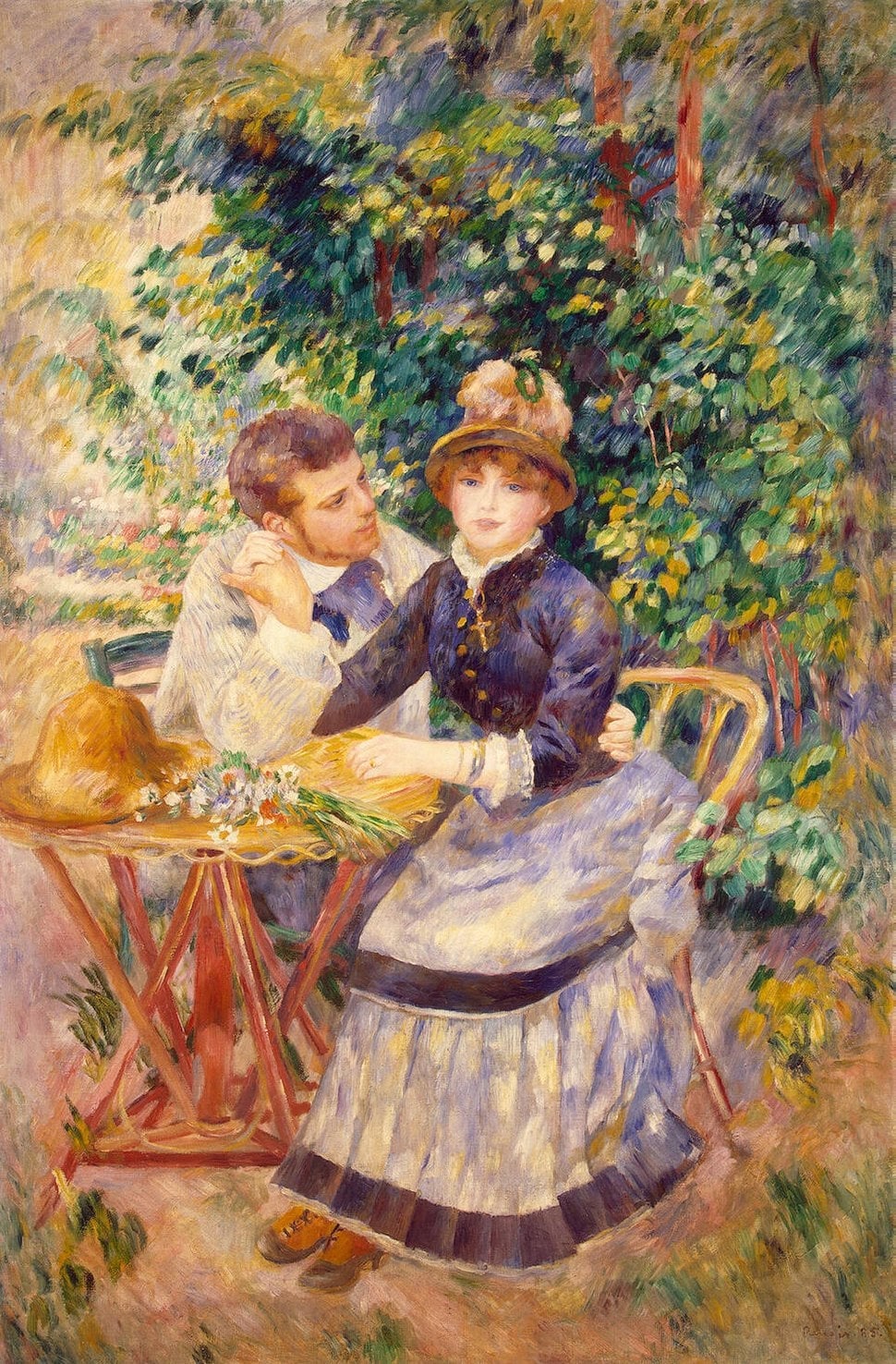
In the Garden presents a charged pause in modern leisure: a young couple at a café table under a living arbor of leaves. Their lightly clasped hands and the bouquet on the tabletop signal courtship, while her calm, front-facing gaze checks his lean. Renoir’s flickering brushwork fuses figures and foliage, rendering love as a <strong>transitory, luminous sensation</strong> <sup>[1]</sup><sup>[3]</sup>.
Young Girls at the Piano by Pierre-Auguste Renoir

Young Girls at the Piano

Pierre-Auguste Renoir (1892)

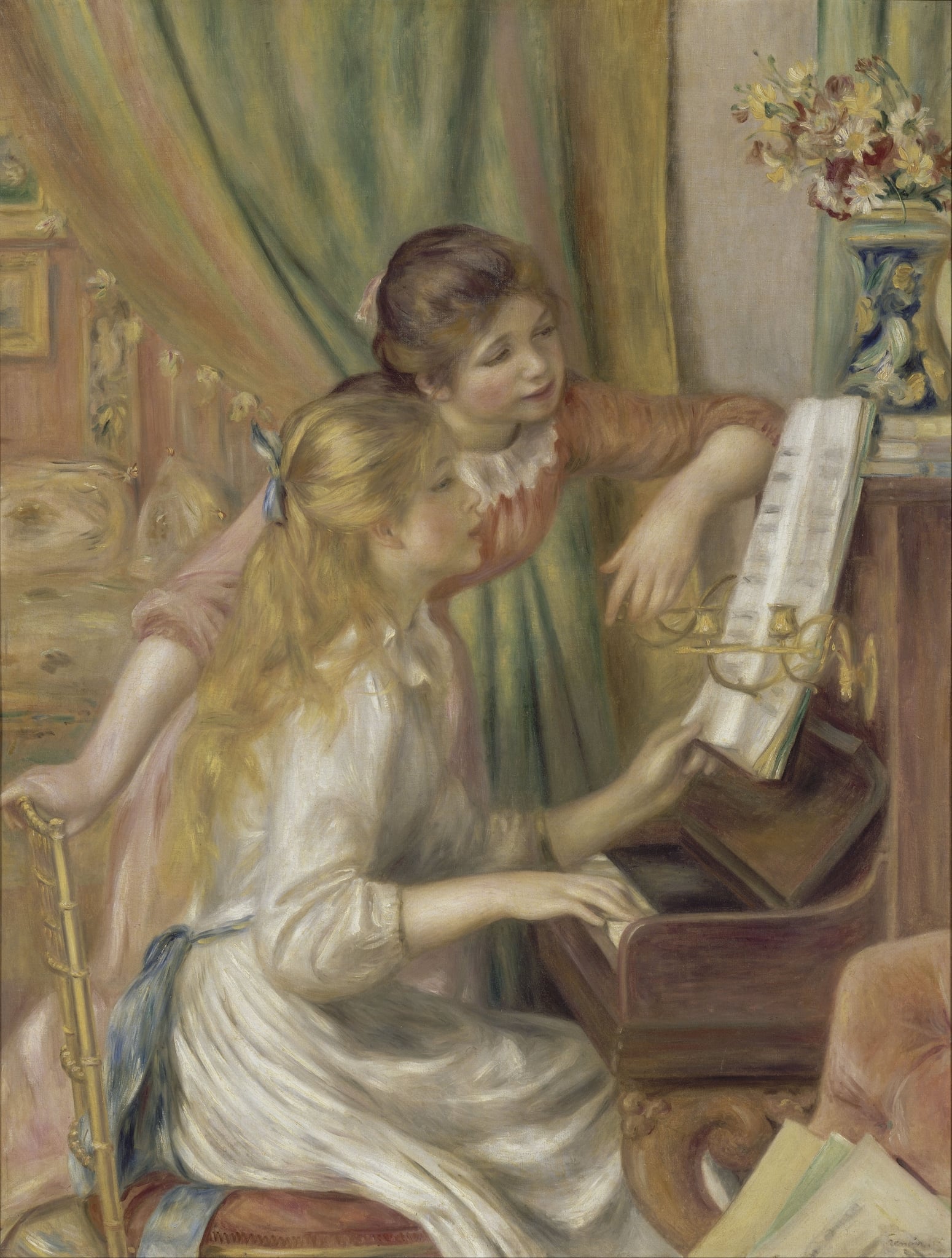
Renoir’s Young Girls at the Piano turns a quiet lesson into a scene of <strong>attunement</strong> and <strong>bourgeois grace</strong>. Two adolescents—one seated at the keys, the other leaning to guide the score—embody harmony between discipline and delight, rendered in Renoir’s late, <strong>luminous</strong> touch <sup>[1]</sup><sup>[2]</sup>.

Pont Neuf Paris by Pierre-Auguste Renoir

Pont Neuf Paris

Pierre-Auguste Renoir (1872)

In Pont Neuf Paris, Pierre-Auguste Renoir turns the oldest bridge in Paris into a stage where <strong>light</strong> and <strong>movement</strong> bind a city back together. From a high perch, he orchestrates crowds, carriages, gas lamps, the rippling Seine, and a fluttering <strong>tricolor</strong> so that everyday bustle reads as civic grace <sup>[1]</sup>.
The Large Bathers by Pierre-Auguste Renoir

The Large Bathers

Pierre-Auguste Renoir (1884–1887)

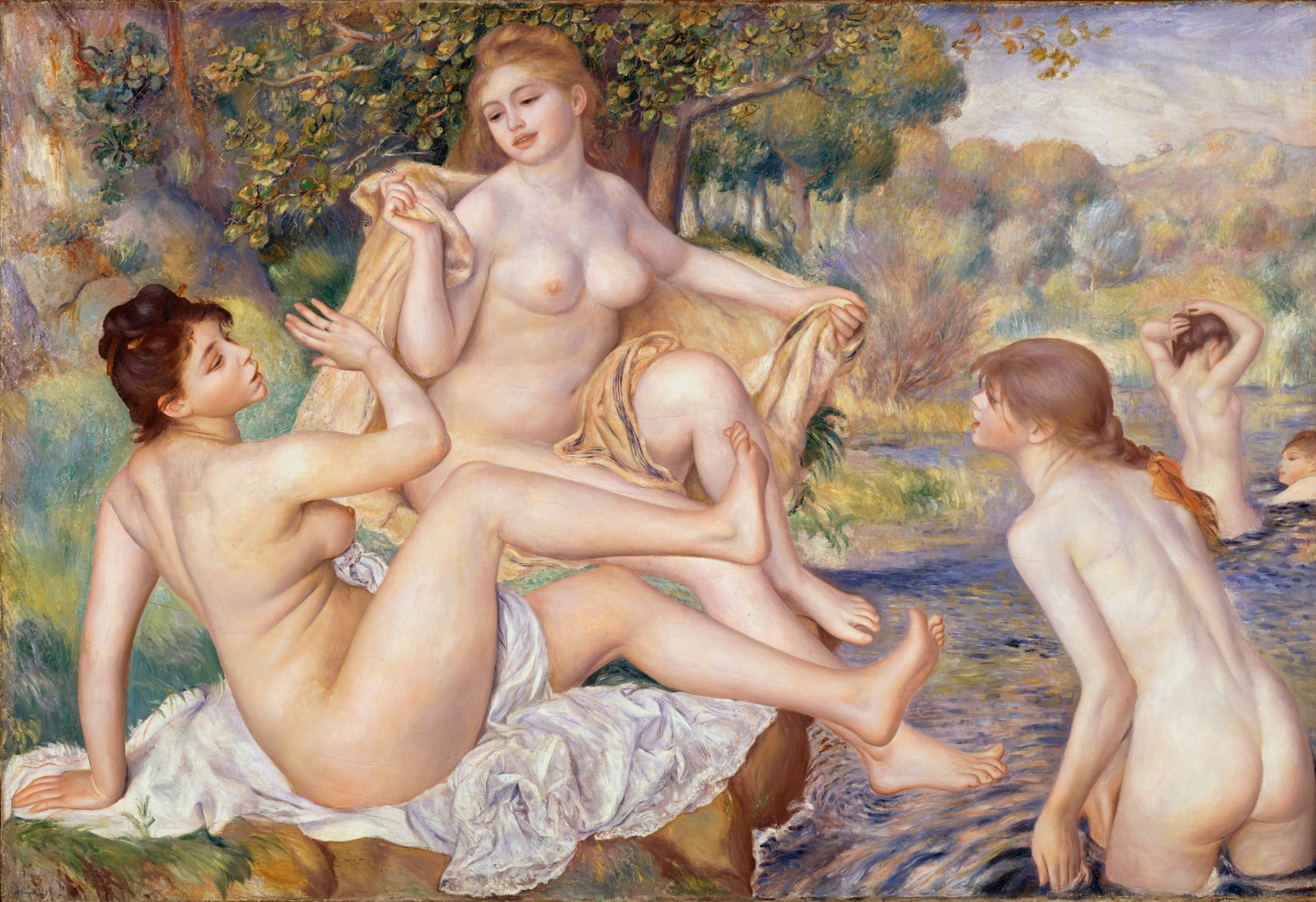
Pierre-Auguste Renoir’s The Large Bathers unites modern bodies with a pastoral grove to stage an <strong>Arcadian ideal</strong>. Three monumental nudes form interlocking curves and triangles while two background figures splash and groom, fusing <strong>sensual warmth</strong> with <strong>classical order</strong> <sup>[1]</sup><sup>[2]</sup>.

The Loge by Pierre-Auguste Renoir

The Loge

Pierre-Auguste Renoir (1874)

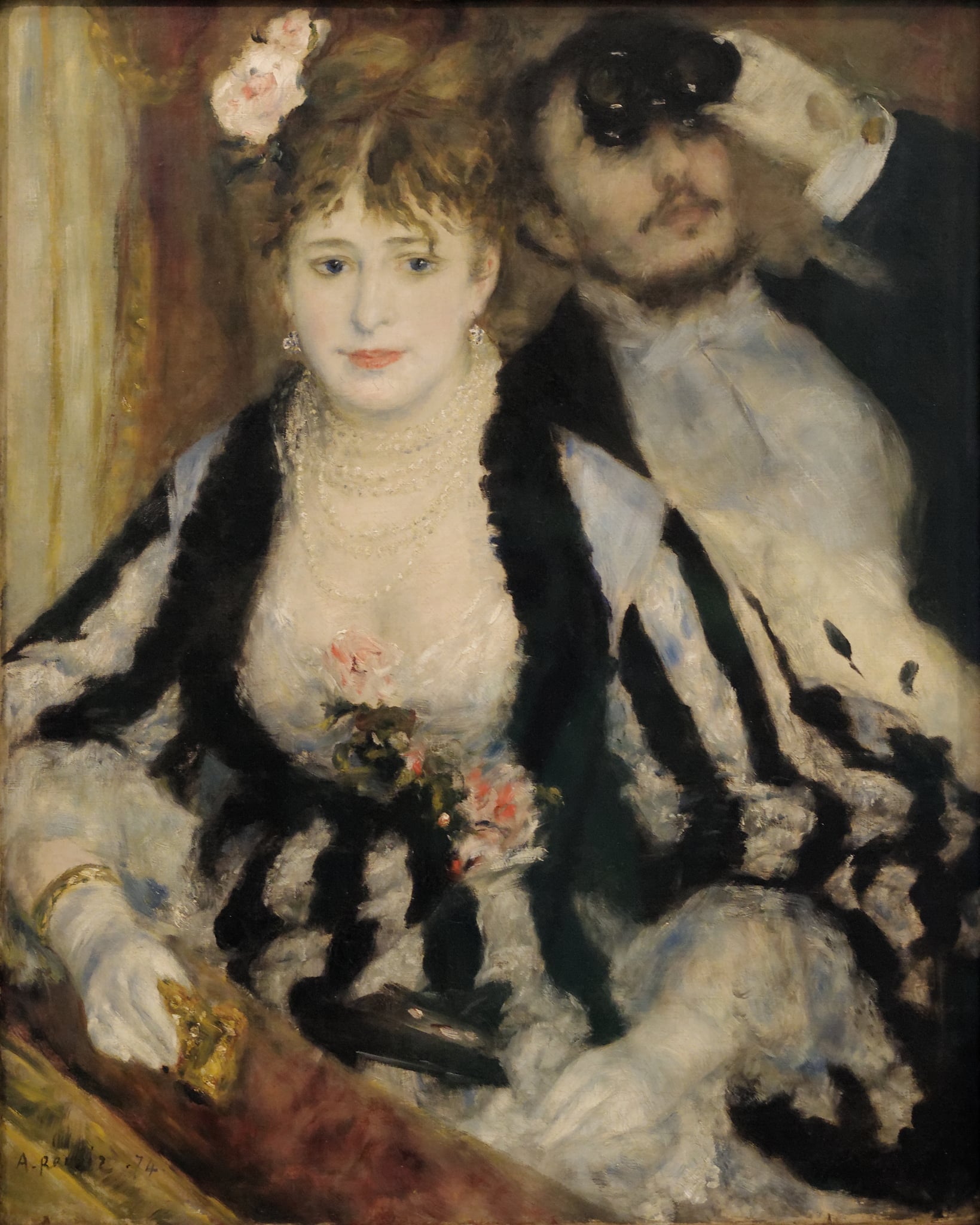
Renoir’s The Loge (1874) turns an opera box into a <strong>stage of looking</strong>, where a woman meets our gaze while her companion scans the crowd through binoculars. The painting’s <strong>frame-within-a-frame</strong> and glittering fashion make modern Parisian leisure both alluring and self-conscious, turning spectators into spectacles <sup>[1]</sup><sup>[2]</sup>.

The Swing by Pierre-Auguste Renoir

The Swing

Pierre-Auguste Renoir (1876)

Renoir’s The Swing fixes a fleeting, sun-dappled exchange in a Montmartre garden, where a woman in a white dress with blue bows steadies herself on a swing while a man in a blue jacket addresses her. The scene crystallizes <strong>modern leisure</strong>, <strong>flirtation</strong>, and <strong>optical shimmer</strong>, as broken strokes scatter light over faces, fabric, and ground <sup>[1]</sup><sup>[4]</sup>.