How Much Is The Birth of Venus Worth?
Last updated: February 5, 2026
Quick Facts
- Methodology
- comparable analysis
The Birth of Venus has no public sale history and is inalienable state property at the Uffizi, so any price is necessarily hypothetical. Based on top-tier trophy-market comparables (Leonardo’s $450.3m Salvator Mundi, Rembrandt’s €175m Standard-Bearer, and major Titian mythologies) and Botticelli’s own $92.2m auction record, a rational unconstrained estimate is $700 million–$1.2 billion. This reflects the work’s unmatched cultural primacy, extreme scarcity, and proven global capacity for blue-chip Renaissance trophies.
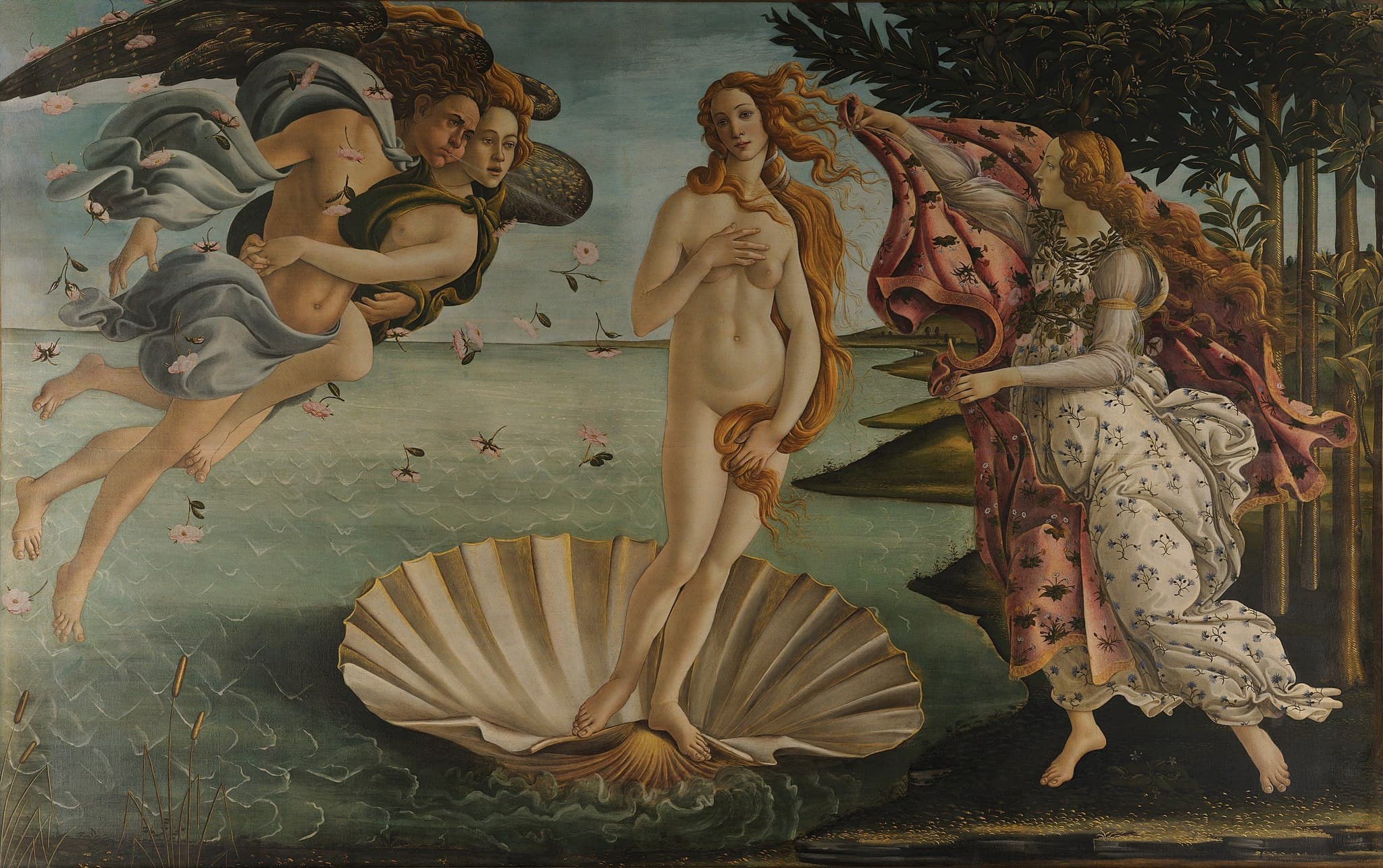
The Birth of Venus
Sandro Botticelli, c. 1484–1486 • Tempera on canvas
Read full analysis of The Birth of Venus →Valuation Analysis
Conclusion: In an unconstrained, legally transferable global sale, Sandro Botticelli’s The Birth of Venus would command a price at the very apex of the art market. While the painting has no public sale history and is inalienable state property of the Uffizi under Italian cultural heritage law, its hypothetical market value sits convincingly in the $700 million–$1.2 billion range. This estimate reflects its status as a universally recognized icon, the pinnacle of Botticelli’s oeuvre, and a cornerstone of Early Renaissance art history [1][2].
Comparables and price formation: The clearest anchor is Leonardo da Vinci’s Salvator Mundi, which realized $450.3 million at auction in 2017—still the top public auction price for any artwork and a direct demonstration of global capacity for singular Renaissance trophies [3]. Sovereign/consortium buying further underscores the ceiling: Rembrandt’s The Standard-Bearer was acquired by the Netherlands for €175 million in 2022, a modern reference for state-level cultural spending [4]. Major Renaissance mythologies of comparable cultural weight, such as Titian’s Diana and Actaeon and Diana and Callisto, were jointly secured for UK institutions for £50 million (2009) and £45 million (2012) respectively—roughly ~$100 million each in today’s terms—despite being far less globally iconic than Botticelli’s Venus [6]. Within Botticelli’s own market, the 2021 record of $92.2 million for Portrait of a Young Man Holding a Roundel demonstrates deep demand for autograph masterpieces, yet it is orders of magnitude less culturally resonant than The Birth of Venus [5].
Positioning above existing benchmarks: The Birth of Venus is one of a tiny handful of images that transcend the art market and function as global cultural symbols. At full scale, with an ideal mythological subject and indelible association with Medici Florence and the Uffizi, it has no true substitute. Given the combination of universal recognition, scarcity of comparable Botticelli masterpieces in private hands, and demonstrable sovereign and ultra‑high‑net‑worth capacity, a result exceeding the Leonardo auction watermark is defensible in today’s trophy-driven context [3][4][5].
Key sensitivities and assumptions: This range assumes (a) legal transferability and export, (b) broadly marketed global competition including sovereign and foundation buyers, and (c) condition commensurate with its long-term museum stewardship. Any restriction that limits buyer eligibility (e.g., domestic-only sale) or impairs liquidity would depress value; conversely, a seamless, guarantee‑backed presentation to a worldwide audience would support the indicated range. The painting’s state ownership and non‑exportable status are decisive in practice, but they do not diminish its theoretical market value; they simply prevent price discovery [1][2].
Key Valuation Factors
Art Historical Significance
High ImpactThe Birth of Venus is one of the most iconic images in Western art and the apex of Botticelli’s mythological output. Its subject, scale, and execution crystallize the ideals of Early Renaissance Florence, and its institutional anchoring at the Uffizi reinforces its canonical status. Works at this level of cultural primacy trade at a premium that often decouples from conventional artist-price metrics. In a trophy-driven market, significance translates directly into a broader global buyer base, deeper competition, and willingness to pay above empirical comparables, especially when the work is among the artist’s top one or two most famous creations.
Rarity & Substitutability
High ImpactBotticelli masterpieces of the first rank almost never reach the market, and nothing comparable to The Birth of Venus exists in private hands. The absence of close substitutes—particularly at this scale and with this mythological subject—creates a scarcity premium. Buyers who specifically seek an instantly recognizable Renaissance icon cannot pivot to an equivalent; this supply constraint magnifies competitive pressure and supports a valuation that sits at or above the highest realized prices for Renaissance works. In market terms, Venus functions as a singular, non-fungible cultural asset, driving price formation well beyond routine Old Masters benchmarks.
Market Benchmarks & Trophy Demand
High ImpactRecent history shows ample capacity for blue-chip Renaissance trophies: Leonardo’s Salvator Mundi achieved $450.3m at auction (2017), sovereign buyers paid €175m for Rembrandt’s The Standard-Bearer (2022), and major Titian mythologies required tens of millions of pounds in public funding. Botticelli’s own record stands at $92.2m (2021) for a portrait far less culturally potent than Venus. These data points collectively support a value regime in which The Birth of Venus would surpass ordinary Old Masters ceilings and sit at the very top of global trophy pricing, especially under competitive, well-structured sale conditions.
Legal/Marketability Constraints
High ImpactAs property of the Italian state in the Uffizi, the painting is inalienable and non‑exportable under Italy’s Cultural Heritage Code, which prevents real-world price discovery. The estimate provided assumes a purely hypothetical scenario in which the work is legally transferable and can be offered to the full global buyer pool. Any constraint—such as domestic-only transfer or prohibitive export limits—would materially reduce achievable price by narrowing demand and financing options. Conversely, a fully open, guarantee‑supported, international sale to sovereign, institutional, and private buyers would underpin the indicated valuation range.
Sale History
The Birth of Venus has never been sold at public auction.
Sandro Botticelli's Market
Sandro Botticelli occupies a rarefied position within the Old Masters market. Supply is exceptionally limited, and top-quality autograph works draw cross-category trophy buyers. The artist’s auction record is $92.2 million (Sotheby’s, 2021) for Portrait of a Young Man Holding a Roundel, with a second major result of $45.4 million for The Man of Sorrows (Sotheby’s, 2022). More recently, a rediscovered early work achieved about $12.6 million in London (2024), reflecting healthy institutional and private appetite for fresh, well-documented material. While the market is selective, the best Botticellis trigger global competition, and there is demonstrable headroom for culturally resonant masterpieces beyond the current record.
Comparable Sales
Portrait of a Young Man Holding a Roundel
Sandro Botticelli
Same artist; late-career masterpiece and artist auction record. Establishes Botticelli’s 21st‑century market ceiling for an autograph work.
$92.2M
2021, Sotheby's New York
~$109.9M adjusted
The Man of Sorrows
Sandro Botticelli
Same artist; late devotional icon that drew global bidding. Confirms robust demand for high‑quality autograph Botticelli paintings.
$45.4M
2022, Sotheby's New York
~$50.1M adjusted
Salvator Mundi
Leonardo da Vinci
Top auction benchmark for an Old Master and Renaissance trophy painting; demonstrates global capacity for a singular, canonical image.
$450.3M
2017, Christie's New York
~$592.2M adjusted
The Standard-Bearer
Rembrandt van Rijn
Sovereign acquisition of a nation‑defining Old Master masterpiece. A modern reference for state/consortium spending on cultural trophies.
$199.0M
2022, Private sale (acquired by the Netherlands/Rijksmuseum)
~$219.3M adjusted
Diana and Actaeon
Titian
High‑profile institutional purchase of a large Renaissance mythological nude—close in subject category and cultural weight within the period.
$72.0M
2009, Private treaty acquisition (National Galleries of Scotland & National Gallery, London)
~$108.6M adjusted
Diana and Callisto
Titian
Companion to Diana and Actaeon; another major Renaissance mythological canvas acquired by UK institutions, underscoring pricing for top‑tier myths.
$71.0M
2012, Private treaty acquisition (National Galleries of Scotland & National Gallery, London)
~$100.0M adjusted
Current Market Trends
Old Masters experienced a softer 2024 on thin trophy supply and macro caution, followed by a more constructive tone into 2025 as high-quality consignments and institutional purchases improved sell-through and confidence. Recent headline results—a Titian auction record, a sovereign Rembrandt acquisition, and strong bidding for rediscoveries—show that buyers will stretch for rarity, condition, and clear scholarly pedigree. The category remains selective with widespread use of guarantees, but cross-category collectors continue to engage with Renaissance blue chips. Against this backdrop, ultimate trophies—especially universally recognized icons—sit above routine market dynamics and can command prices at the very top of the global art market.
Sources
- Uffizi Galleries – Object record: The Birth of Venus
- Italian Cultural Heritage and Landscape Code (Legislative Decree 42/2004)
- Christie’s – Salvator Mundi sells for $450.3 million (2017)
- Rijksmuseum – Rembrandt’s The Standard-Bearer secured for the Netherlands (2022)
- Sotheby’s – Botticelli portrait sells for $92.2 million (2021)
- National Galleries of Scotland – Titian’s Diana and Actaeon and Diana and Callisto