The Cobblestone Street in Café Terrace at Night
A closer look at this element in Vincent van Gogh's 1888 masterpiece
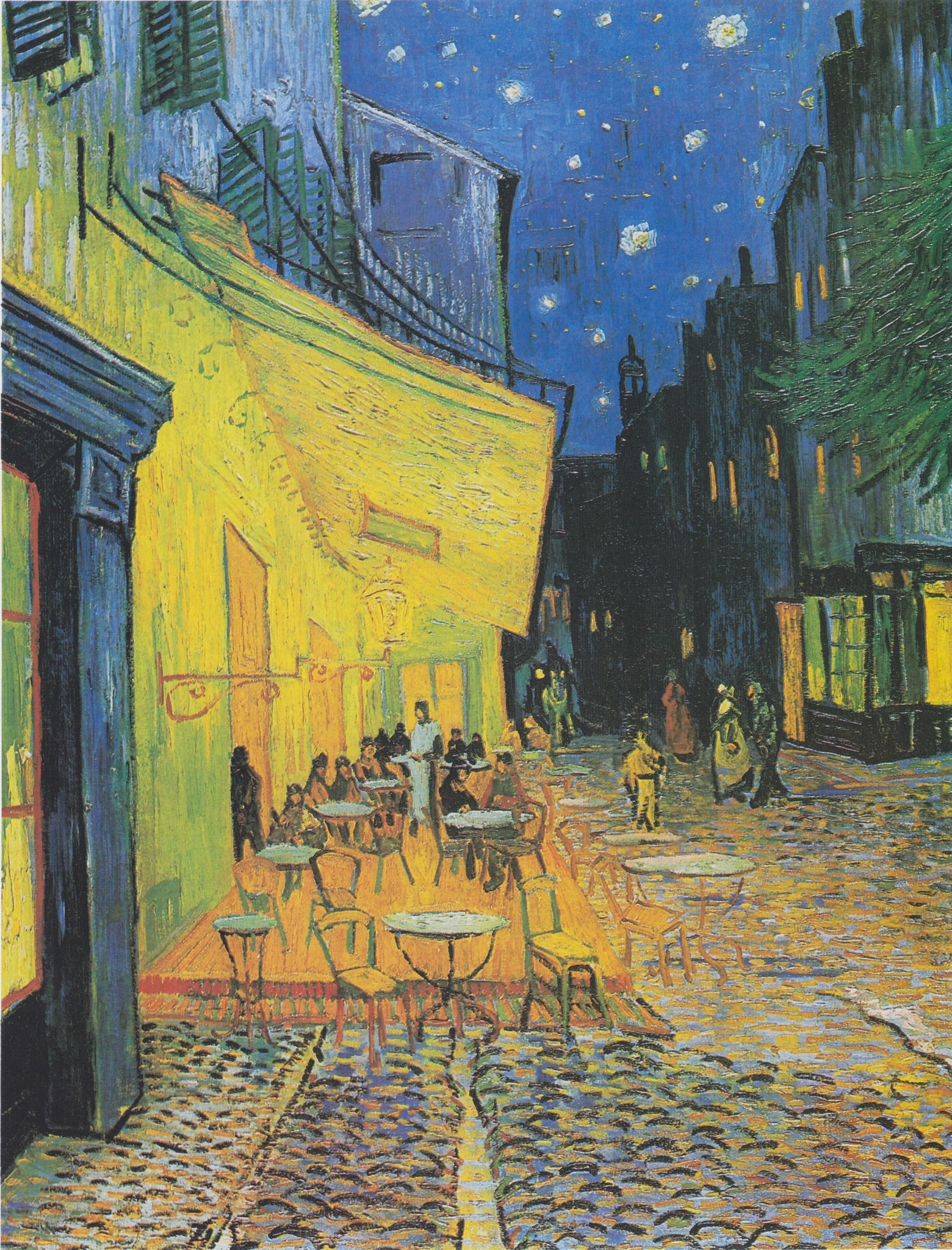
The cobblestone street in Café Terrace at Night is Van Gogh’s luminous runway: a diagonal plane of Arles’s Place du Forum that soaks up gaslight and turns violet‑pink and blue‑violet. Painted on site in mid‑September 1888, the stones carry his daring 'night without black' experiment and lead the viewer from café warmth into the starlit city.
Historical Context
Vincent van Gogh painted Café Terrace at Night in Arles in mid‑September 1888, working outdoors after dark to test how artificial light transforms color. In a letter to his sister written 9–14 September, he describes a “huge yellow lantern” that casts reflections over the terrace, façade, pavement, and “even … the cobblestones of the street,” which take on a violet‑pink tinge—evidence of his plan to make a nocturne “without black.” 2 The Kröller‑Müller Museum confirms that he executed the painting sur le motif, in the dark, and stresses how abundant yellow‑orange gaslight heightens surrounding blues. 1
The scene records the Place du Forum at a precise moment—corresponding to the sky visible on the night of 16–17 September—and situates the cobbled street as the modern city’s ground plane under gaslight. By choosing this motif, Van Gogh aligned himself with contemporary explorations of color at night while anchoring the work in lived urban experience. 12
Symbolic Meaning
The illuminated cobbles embody late‑19th‑century modernity. Gaslight turned nighttime streets into realms of sociability, safety, and spectacle; in Van Gogh’s Arles, the glowing stones become a welcoming path that pushes back the blue night and draws viewers toward communal life at the café. Curators connect this chromatic, civic transformation to earlier Paris experiments—especially Louis Anquetin’s Avenue de Clichy—where yellow lamps dramatize sidewalks against a cool twilight; Van Gogh’s cobbles are the Arles answer to that urban theater. 3
They are also the painting’s clearest expression of Van Gogh’s color program. Rejecting traditional black for night, he stages complementary contrasts—yellow/orange gaslight versus blue‑violet shadow—directly on the street surface. The artist’s own letter details the lantern’s pink‑violet reflections on the stones, while the museum notes how warm light intensifies the surrounding blues. Together these accounts position the street as more than topography: it is the site where expressive color proves its power to recode darkness into feeling, turning ordinary paving into a field of palpable warmth and coolness in dynamic equilibrium. 21
Artistic Technique
Van Gogh renders the cobbles with short, assertive strokes that articulate individual stones while fusing into a vibrating field under gaslight. He avoids black, mixing blue‑violet passages with touches of yellow and pink reflection to achieve luminous shadow and glow—the effect he described as a “night picture without black.” 21
Compositional lines in the paving set the perspective grid and pull the eye diagonally toward the work’s vanishing point near the white‑clad waiter, a structure he also mapped in a large pen‑and‑ink study. 46 The result is a textured, chromatic plane that is both tactile and directional, guiding movement through space as it showcases the drama of warm and cool color.
Connection to the Whole
The cobblestone street is the painting’s entry ramp and argument at once. Its orthogonals usher viewers from the picture’s edge into the café’s glow and onward to the star‑filled sky, locking foreground, human activity, and nocturnal cosmos into a single visual arc. The vanishing point’s placement near the waiter tethers perspective to sociability, while the street’s chromatic contrasts restate the work’s thesis: a radiant, inhabited night achieved without black. 42
Because Van Gogh painted in situ at the precise September night echoed by the heavens above, the stones convey not just place but sensation—the immediate shimmer of gaslight across Arles’s paving—binding the painting’s observational accuracy to its modern, communal spirit. 1
Explore the Full Painting
This is just one fascinating element of Café Terrace at Night. Discover the complete interpretation, symbolism, and hidden meanings throughout the entire work.
← View full analysis of Café Terrace at NightSources
- Kröller‑Müller Museum, Caféterras bij nacht (Place du Forum), curatorial entry
- Van Gogh, Letter 678 to Wilhelmina, Arles, 9–14 September 1888
- Wadsworth Atheneum, 'Nocturnal Scene' (Anquetin and gaslight pavements)
- Prestel, Masters of Art: Van Gogh (composition and vanishing point)
- Metropolitan Museum of Art, Pickvance, Van Gogh in Arles (1984)
- Dallas Museum of Art via Google Arts & Culture, pen-and-ink study of Café Terrace
- The Art Newspaper, influence discussion linking Anquetin and Van Gogh