Café Terrace at Night
Study Print Studio
Create a personal study print
Build a companion study sheet around the part of this painting that speaks to you most. Choose a detail, shape an interpretation, and walk away with something personal and display-worthy.
Fast Facts
- Year
- 1888
- Medium
- Oil on canvas
- Dimensions
- 80.7 × 65.3 cm
- Location
- Kröller‑Müller Museum, Otterlo
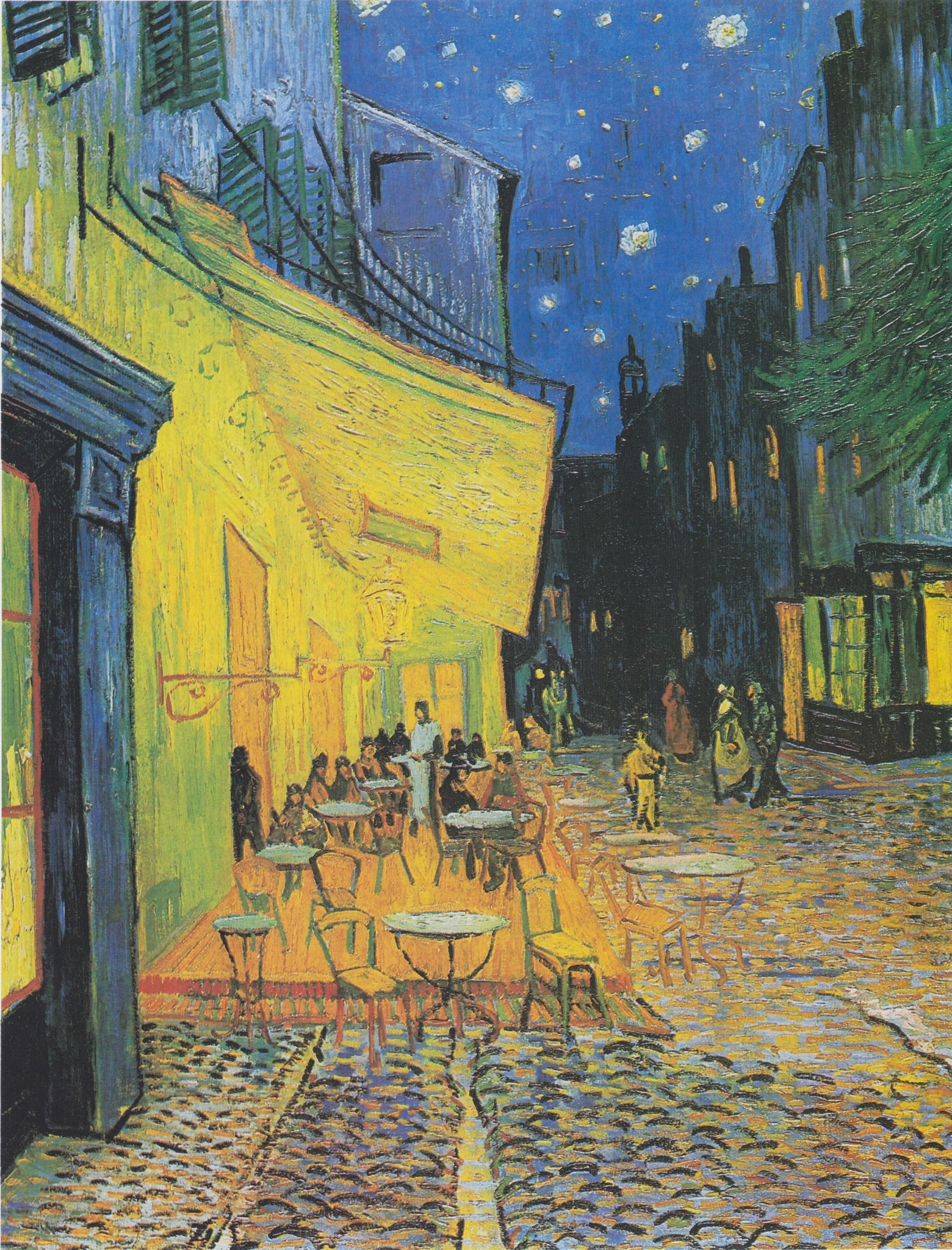
Click on any numbered symbol to learn more about its meaning
Meaning & Symbolism
Explore Deeper with AI
Ask questions about Café Terrace at Night
Popular questions:
Powered by AI • Get instant insights about this artwork
Interpretations
Formal Analysis: Lineage and Device
Source: The Art Newspaper; The Metropolitan Museum of Art
Historical Context: Nocturne as Experiment
Source: Van Gogh Letters (Huygens Institute/Van Gogh Museum); Kröller-Müller Museum; The Metropolitan Museum of Art
Urban Sociology: Light as Social Architecture
Source: Kröller-Müller Museum; The Metropolitan Museum of Art
Cosmology & Phenomenology: The Starred Canopy
Source: Kröller-Müller Museum
Speculative Symbolic Reading: The ‘Last Supper’ Hypothesis
Source: IAFOR Think (Jared Baxter); Van Gogh Letters; Kröller-Müller Museum
Explore Specific Elements
Dive deeper into individual scenes and details within Café Terrace at Night.
The Starlit Sky
The starlit sky in Café Terrace at Night is a carefully observed Arles firmament, painted outdoors in saturated blues, violets, and greens that keep the night vividly alive. As the first flowering of Van Gogh’s nocturnal ambitions, it fuses modern gaslight with eternal starlight to inaugurate a new, hope-charged vision of the night.
The Yellow Awning
The yellow awning in Café Terrace at Night is the café’s canvas canopy, turned into a radiant field by a large gas lamp. Its sulfur‑lemon glow anchors the left side of the painting, staging a drama between man‑made light and the deep blue night sky. This luminous sheet is both a modern sign of café culture and the chromatic engine of Van Gogh’s nocturne.
The Cobblestone Street
The cobblestone street in Café Terrace at Night is Van Gogh’s luminous runway: a diagonal plane of Arles’s Place du Forum that soaks up gaslight and turns violet‑pink and blue‑violet. Painted on site in mid‑September 1888, the stones carry his daring 'night without black' experiment and lead the viewer from café warmth into the starlit city.
Related Themes
About Vincent van Gogh
More by Vincent van Gogh
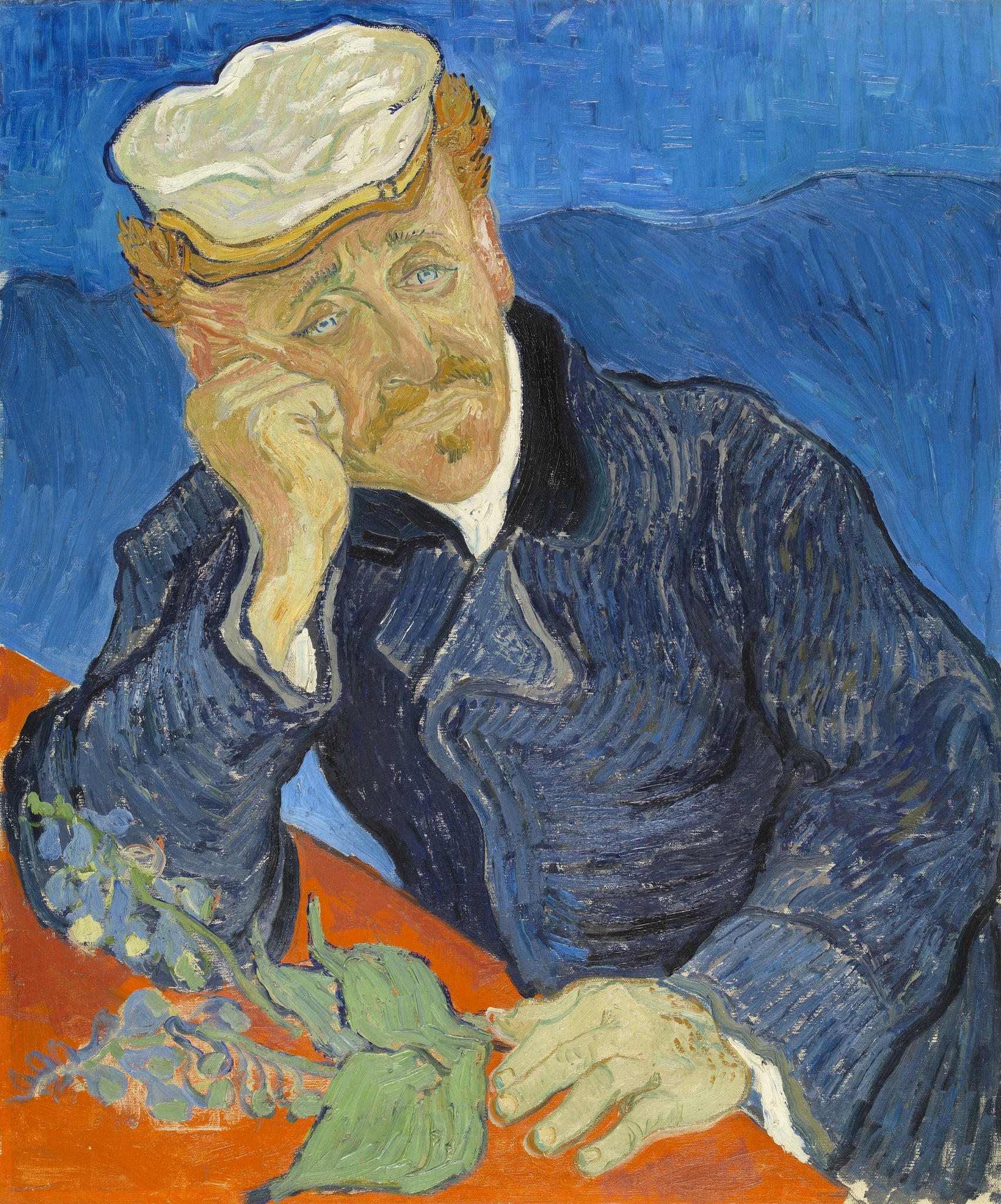
Portrait of Dr. Gachet
Vincent van Gogh (1890)
Portrait of Dr. Gachet distills Van Gogh’s late ambition for a <strong>modern, psychological portrait</strong> into vibrating color and touch. The sitter’s head sinks into a greenish hand above a <strong>blazing orange-red table</strong>, foxglove sprig nearby, while waves of <strong>cobalt and ultramarine</strong> churn through coat and background. The chromatic clash turns a quiet pose into an <strong>empathic image of fragility and care</strong> <sup>[1]</sup><sup>[2]</sup>.
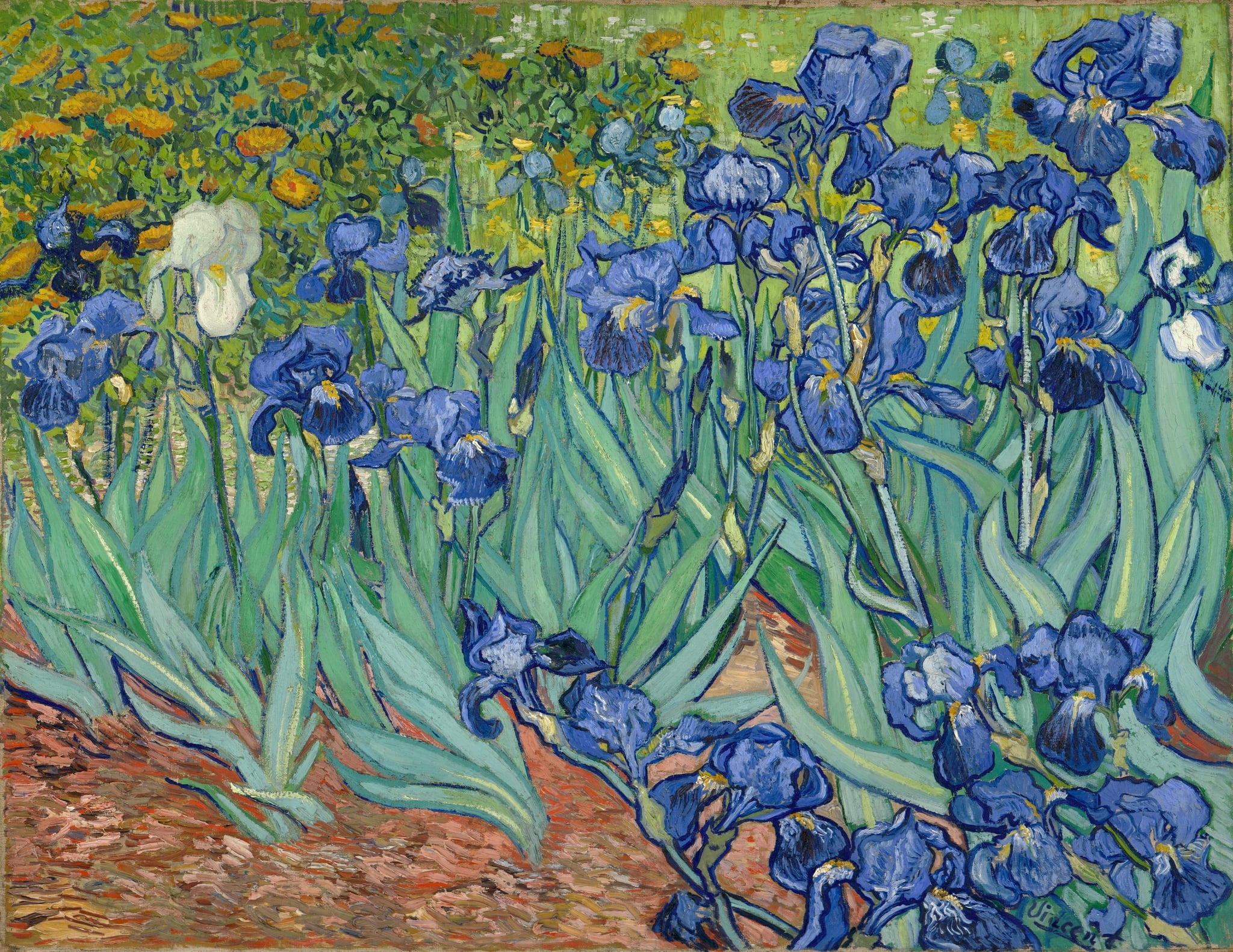
Irises
Vincent van Gogh (1889)
Painted in May 1889 at the Saint-Rémy asylum garden, Vincent van Gogh’s <strong>Irises</strong> turns close observation into an act of repair. Dark contours, a cropped, print-like vantage, and vibrating complements—violet/blue blossoms against <strong>yellow-green</strong> ground—stage a living frieze whose lone <strong>white iris</strong> punctuates the field with arresting clarity <sup>[1]</sup><sup>[2]</sup>.
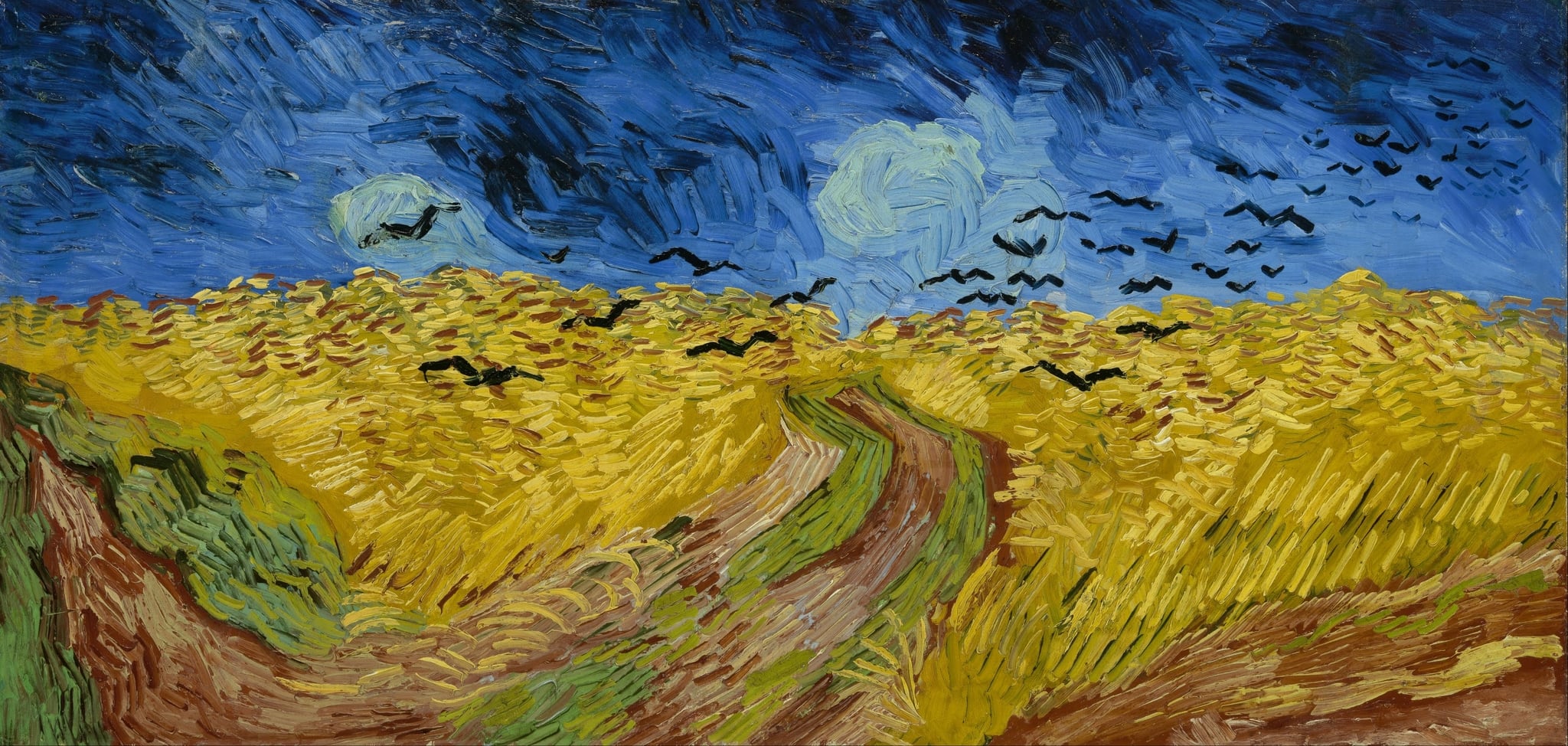
Wheatfield with Crows
Vincent van Gogh (1890)
A panoramic wheatfield splits around a rutted track under a storm-charged sky while black crows rush toward us. Van Gogh drives complementary blues and yellows into collision, fusing <strong>nature’s vitality</strong> with <strong>inner turbulence</strong>.
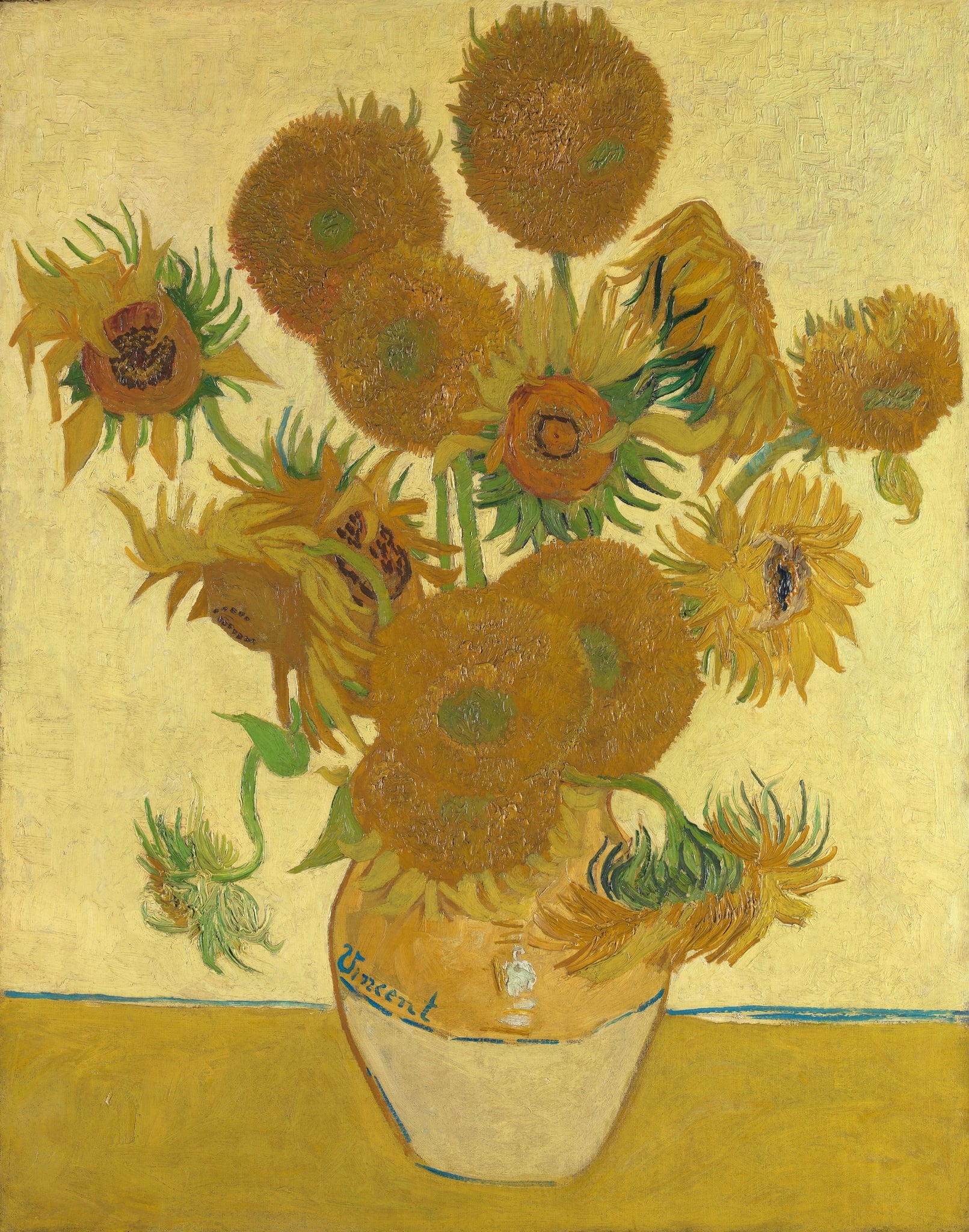
Sunflowers
Vincent van Gogh (1888)
Vincent van Gogh’s Sunflowers (1888) is a <strong>yellow-on-yellow</strong> still life that stages a full <strong>cycle of life</strong> in fifteen blooms, from fresh buds to brittle seed heads. The thick impasto, green shocks of stem and bract, and the vase signed <strong>“Vincent”</strong> turn a humble bouquet into an emblem of endurance and fellowship <sup>[1]</sup><sup>[2]</sup>.
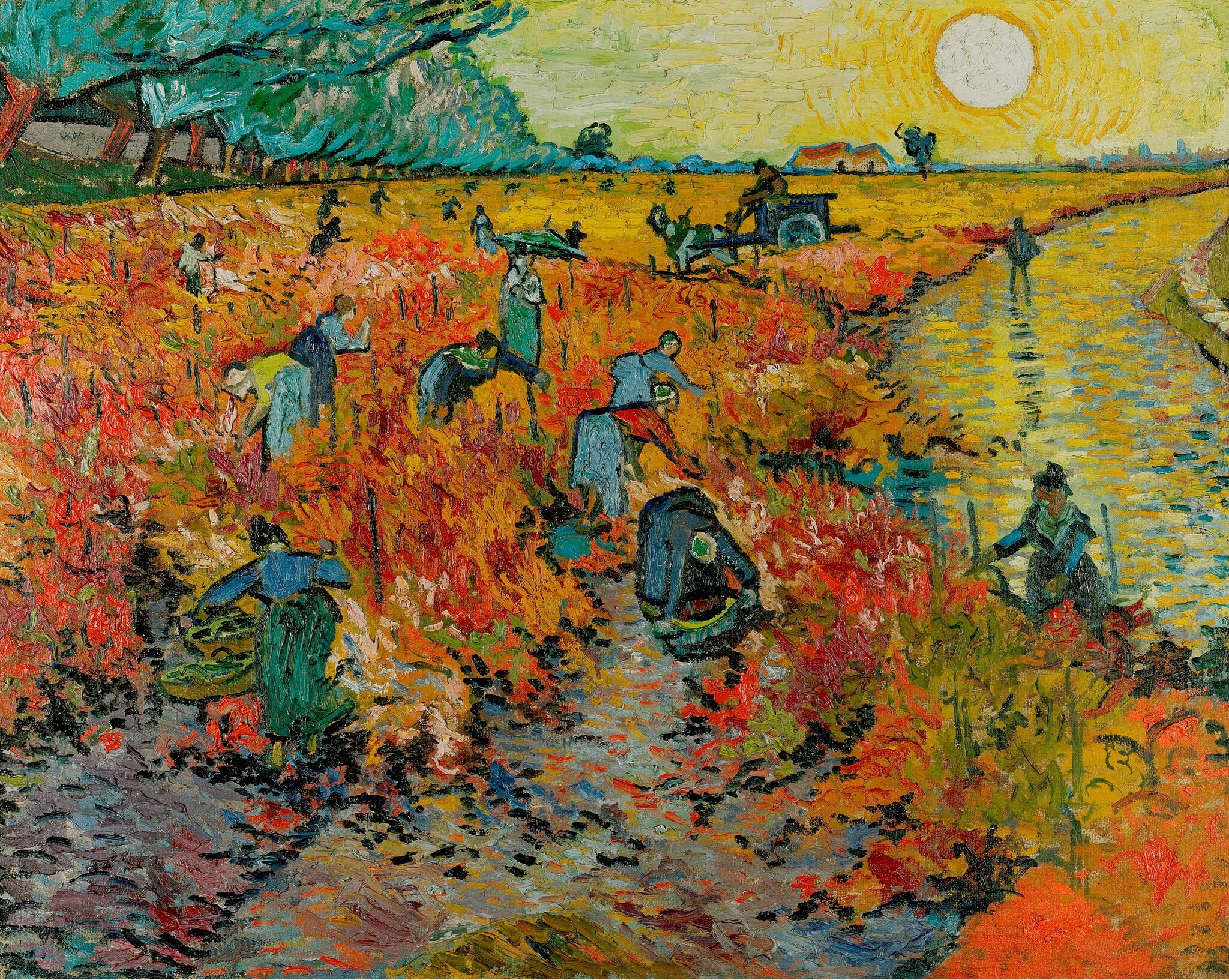
The Red Vineyard
Vincent van Gogh (1888)
In The Red Vineyard, Vincent van Gogh forges a vision of <strong>autumn labor under a blazing sun</strong>, where harvesters flow diagonally through scarlet vines while a band of <strong>yellow light</strong> flares along a reflective roadway. The scene fuses <strong>exhaustion and ripeness</strong>, turning work into a rhythmic, almost liturgical procession <sup>[1]</sup><sup>[3]</sup>.
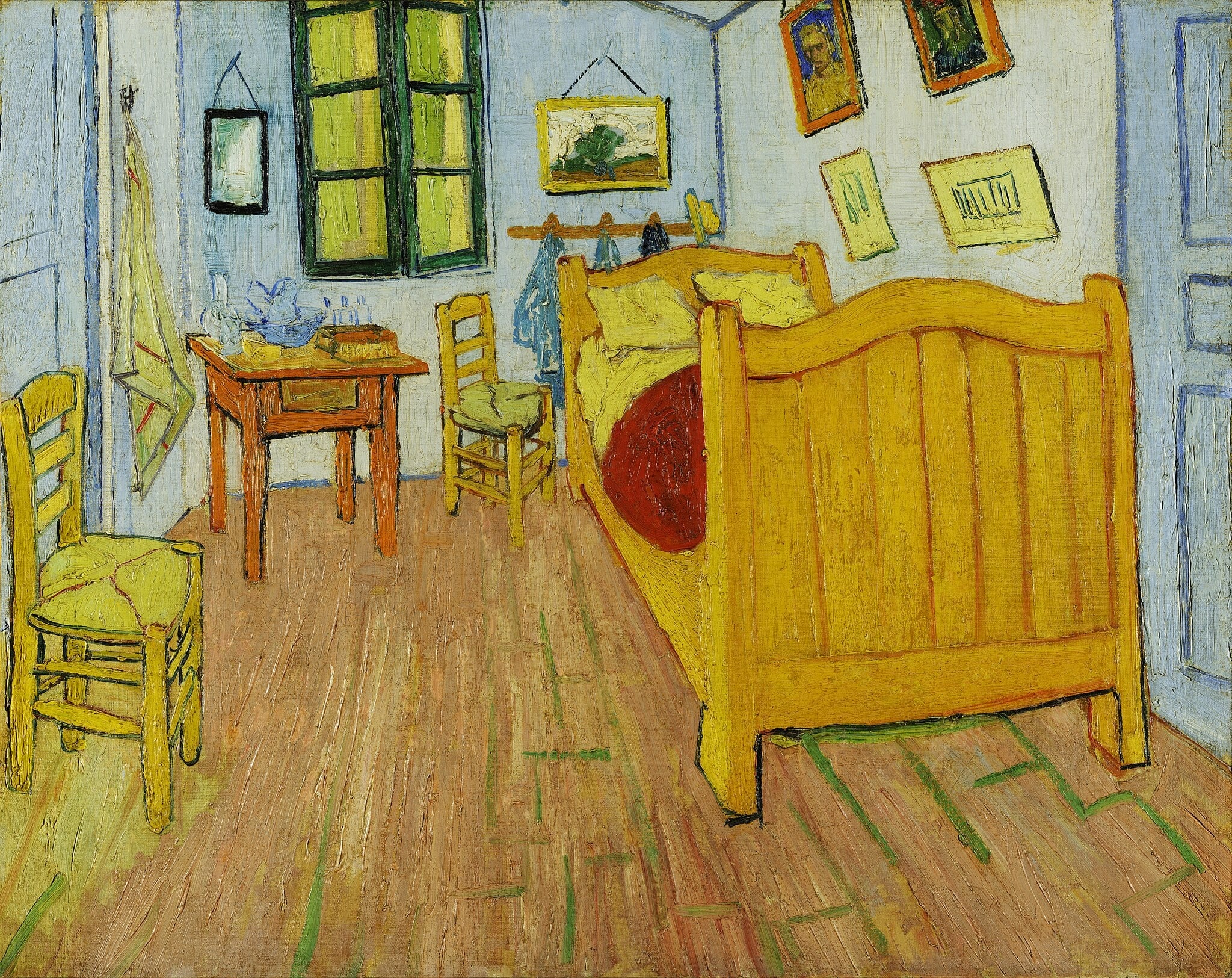
The Bedroom
Vincent van Gogh (1889)
Vincent van Gogh’s The Bedroom turns a modest room into a psychological stage, using <strong>clashing color</strong> and <strong>tilted space</strong> to test whether color alone can evoke rest. The bright yellow bed, twin chairs, and green‑shuttered window press forward as the floor tilts and pictures cant, so that <strong>refuge and unease</strong> exist side by side <sup>[1]</sup><sup>[2]</sup>.