The Starlit Sky in Café Terrace at Night
A closer look at this element in Vincent van Gogh's 1888 masterpiece
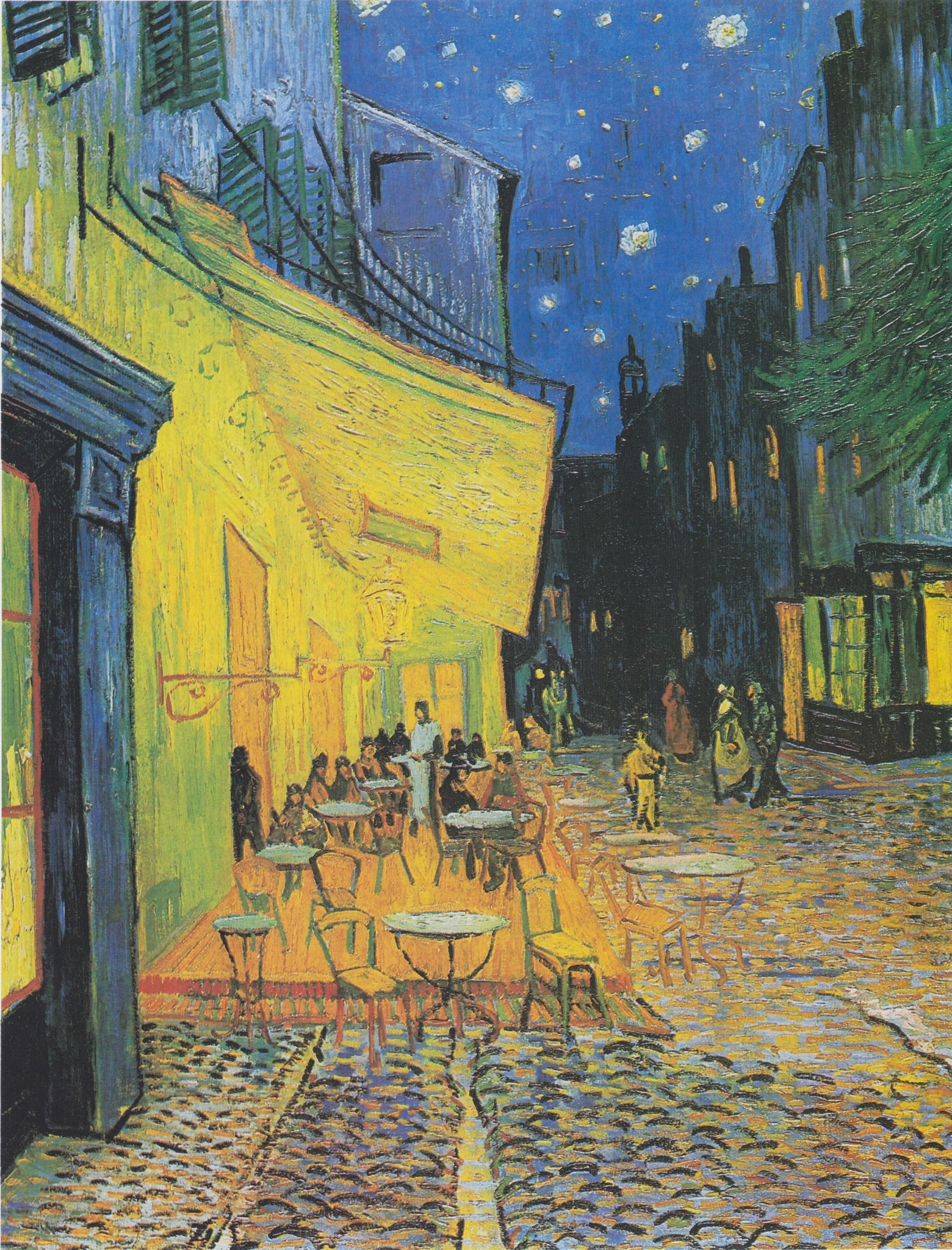
The starlit sky in Café Terrace at Night is a carefully observed Arles firmament, painted outdoors in saturated blues, violets, and greens that keep the night vividly alive. As the first flowering of Van Gogh’s nocturnal ambitions, it fuses modern gaslight with eternal starlight to inaugurate a new, hope-charged vision of the night.
Historical Context
In mid‑September 1888, Van Gogh set up his easel directly on the Place du Forum in Arles and worked at night beneath a café gas‑lamp. Writing to his sister, he described making a nocturne on the spot under a sky filled with stars, stressing that he did not rely on a daytime study or black paint but pursued a night without black using ranges of blue, violet, and green 1. This was a deliberate technical and experiential choice: to test color and perception under artificial light while looking into the open sky.
Weeks later he told Theo that he had finally achieved the “starry sky,” explicitly noting that it was executed at night under gaslight—confirmation that the painting records a real Arles evening rather than an imagined backdrop 2. He cast the result as a breakthrough in his long‑standing urge to tackle nocturnes directly, establishing a template for future explorations of night and color.
Symbolic Meaning
For Van Gogh in 1888, stars carried a clear symbolic charge: they were instruments for expressing hope and hinting at the eternal. In an early‑September letter he links the image of a star with the aim of conveying hope through color contrasts, signaling that the heavens could bear emotional and metaphysical content, not merely provide setting 9.
That same season he conceived a portrait of his friend Eugène Boch against a deep, star‑like blue meant to evoke “infinity,” confirming that a starry ground could figure poetic aspiration and inner life 5. Modern scholarship situates these choices within his broader late‑1888 turn to heightened, sometimes spiritualized nature, in which the night sky becomes a privileged vehicle for feeling and meaning 4.
In Café Terrace at Night, the concentrated constellation of bright stars suspended above a bustling terrace reads as a sign of consolation and vastness placed over ordinary sociability. The heavens function as a bridge to the infinite while the café hums below, giving the sky a role that is emphatically more than ornament: it encodes hope and transcendence in radiant, complementary color 49.
Artistic Technique
Van Gogh renders the sky as a night without black, building it from saturated blues, violets, and greens to keep darkness chromatically alive and optically vibrant 1. He leverages the observation that gaslight heightens adjacent blues, so the café’s sulphur‑yellow glow intensifies the cool upper band of sky, sharpening the complementary contrast that structures the scene 3. Compositional choices reinforce the effect: a deep one‑point perspective funnels down the street while punctuating stars echo the café’s lamp halos, stitching together celestial and urban light in a single rhythm 8.
Connection to the Whole
The starlit sky is the painting’s keystone, locking the warm, man‑made gaslight into dialogue with cool, eternal starlight. This chromatic counterpoint—cool sky against sulphur and lemon‑green terrace—creates the picture’s mood of electric intimacy under a limitless vault 13. Spatially, the starry band crowns the one‑point perspective, its bright nodes mirroring lamps below and guiding the eye through the nocturnal street 8. As the first of Van Gogh’s Arles canvases to stage a starry sky, it launches the artist’s mature exploration of night, a motif he would pursue immediately afterward and elevate into a defining theme of his late work 7.
Explore the Full Painting
This is just one fascinating element of Café Terrace at Night. Discover the complete interpretation, symbolism, and hidden meanings throughout the entire work.
← View full analysis of Café Terrace at NightSources
- Van Gogh, Letter 678 to Wilhelmina (Arles, 9 & 16 Sept 1888)
- Van Gogh, Letter 691 to Theo (Arles, c. 29 Sept 1888)
- Kröller‑Müller Museum, Terrace of a Café at Night—constellations and color under gaslight
- MoMA, Van Gogh and the Colors of the Night (exhibition resources)
- Musée d’Orsay, Eugène Boch (The Poet)—starry blue as “infinity”
- The Art Newspaper, on Anquetin’s influence and Van Gogh’s “night without black”
- Wikipedia, Café Terrace at Night—dating and sequence within the starry works
- Google Arts & Culture, related drawing and compositional evidence
- Van Gogh, Letter 673 to Theo (Arles, 3 Sept 1888) on hope and the star