The Yellow Awning in Café Terrace at Night
A closer look at this element in Vincent van Gogh's 1888 masterpiece
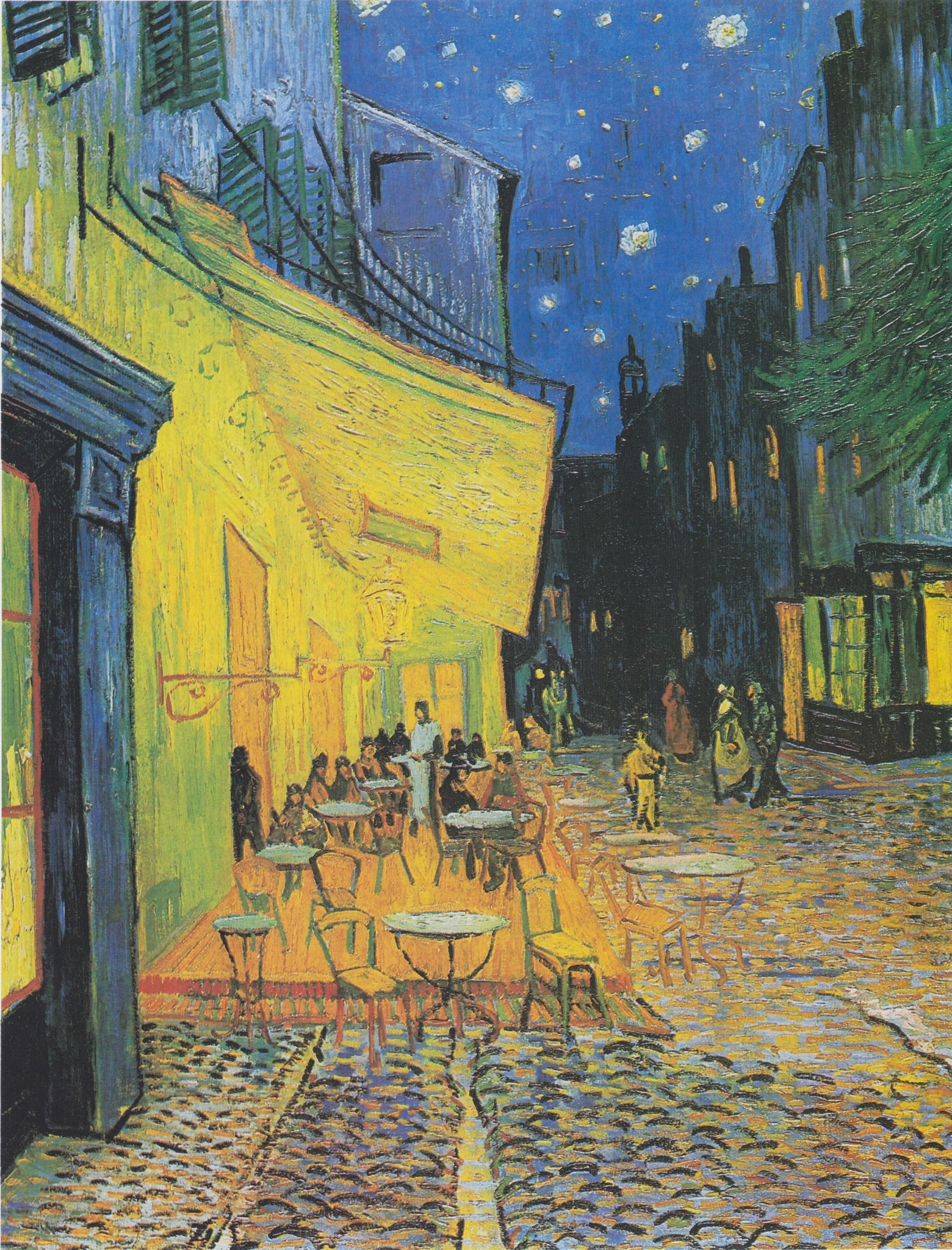
The yellow awning in Café Terrace at Night is the café’s canvas canopy, turned into a radiant field by a large gas lamp. Its sulfur‑lemon glow anchors the left side of the painting, staging a drama between man‑made light and the deep blue night sky. This luminous sheet is both a modern sign of café culture and the chromatic engine of Van Gogh’s nocturne.
Historical Context
Van Gogh painted Café Terrace at Night in Arles in mid‑September 1888, during his self‑declared campaign to make nocturnes directly under the stars. He described the set‑up vividly: a huge yellow lantern fixed beneath the café’s terrace covering lights the awning, façade, pavement, and even the cobblestones. That on‑site, gaslit illumination explains the awning’s sulfur‑yellow glow and the citron tints that spill across the terrace 1. In a companion letter, he stresses that the café was lit outside by a large gas lamp, confirming that the canopy’s color is the visible envelope of modern urban light rather than a studio conceit 2.
Arles in 1888 was the crucible for his night pictures without black, a technical and expressive challenge he pursued outdoors. The awning gave him the dominant warm plane he needed to oppose the blues and violets of the street and sky while keeping to his vow to render the night chromatically, not tonally. He also ties the scene to contemporary boulevard cafés, making the illuminated canopy a conspicuous marker of modern life at night 1.
Symbolic Meaning
For Van Gogh, yellow was not a neutral descriptor but a charged vocabulary of warmth, vitality, and hopeful illumination. In an August 1888 letter he names the qualities he is chasing—pale sulphur yellow, pale lemon, gold—terms that map directly onto the awning’s halo and the color it casts on the terrace below 5. Read through that program, the canopy’s radiance is more than accurate gaslight; it broadcasts conviviality and spiritual cheer, the benevolent light he sought to place at the heart of everyday life 6.
The awning also signifies modernity. Its glow is artificial, the visible signature of gaslight that made nighttime café culture possible; in museum interpretations, that man‑made illumination is essential to the work’s meaning as a contemporary nocturne 3. Some scholars have proposed a symbolic ‘Last Supper’ subtext: a central standing figure amid roughly twelve diners gathered under a yellow, halo‑like field. Within that reading, the awning’s light acquires sacral overtones as a canopy of grace sheltering an urban communion. While debated, this hypothesis underscores how fully Van Gogh’s yellow can carry spiritual resonance even in a secular café setting 7.
Artistic Technique
Van Gogh engineered the awning as the painting’s dominant warm mass to realize a night picture without black, setting sulfur and citron yellows against cobalt and violet blues for a high‑key complementary clash 1. He worked en plein air so the gas lamp’s chroma remained true, letting that single source tint adjacent planes and fuse the canopy into a continuous, radiant color field. A related study shows he carefully plotted the terrace perspective and the canopy’s diagonal, confirming its role as a compositional driver 8.
Materially, the effect aligns with the Arles palette’s chrome yellows—varied lead‑chromate tones capable of the lemon and sulfur notes visible here 9. The broad, simplified plane of the awning also echoes the flat, emphatic color blocks explored in Parisian nocturnes by Louis Anquetin, whose innovations Van Gogh actively absorbed and re‑cast in Arles 4.
Connection to the Whole
The yellow awning is the painting’s hinge—concentrating modern, man‑made light directly beneath the celestial blue, and locking the composition along its bold diagonal. It organizes the left half of the canvas, pushes the eye upward toward the stars, and throws warm reflections across the terrace and cobbles, staging the work’s strongest warm–cool opposition 18.
That opposition embodies Van Gogh’s larger Arles project: to make the night more richly colored than the day through color alone. As museums emphasize, the café’s gaslit canopy is indispensable to this experiment and to the picture’s mood of welcome and sociability; it shelters human gathering while its glow spills into the public street, a modern beacon set against the deep, timeless sky 31.
Explore the Full Painting
This is just one fascinating element of Café Terrace at Night. Discover the complete interpretation, symbolism, and hidden meanings throughout the entire work.
← View full analysis of Café Terrace at NightSources
- Van Gogh to Willemien, Letter 678 (Sept 9–14, 1888) — huge yellow lantern; night without black
- Van Gogh to Theo, Letter 681 (Sept 16, 1888) — café lit outside by a large gas lamp
- Kröller‑Müller Museum — Terrace of a Café at Night (object page and interpretation)
- The Art Newspaper — Anquetin’s gas‑lit nocturnes and influence on Van Gogh
- Van Gogh to Theo, Letter 659 (Aug 12, 1888) — on yellow: sulphur, lemon, gold
- Van Gogh Museum — Exhibition texts on Van Gogh’s yellow and its meanings
- Artnet News — The ‘Last Supper’ hypothesis for Café Terrace at Night
- MoMA — Van Gogh and the Colors of the Night (study for the terrace; Dallas Museum of Art)
- Scientific Reports (Nature) — Van Gogh’s Arles‑era chrome yellow pigments
- The Collector — Overview highlighting the dominance of the yellow canopy