The Murder of Crows in Wheatfield with Crows
A closer look at this element in Vincent van Gogh's 1890 masterpiece
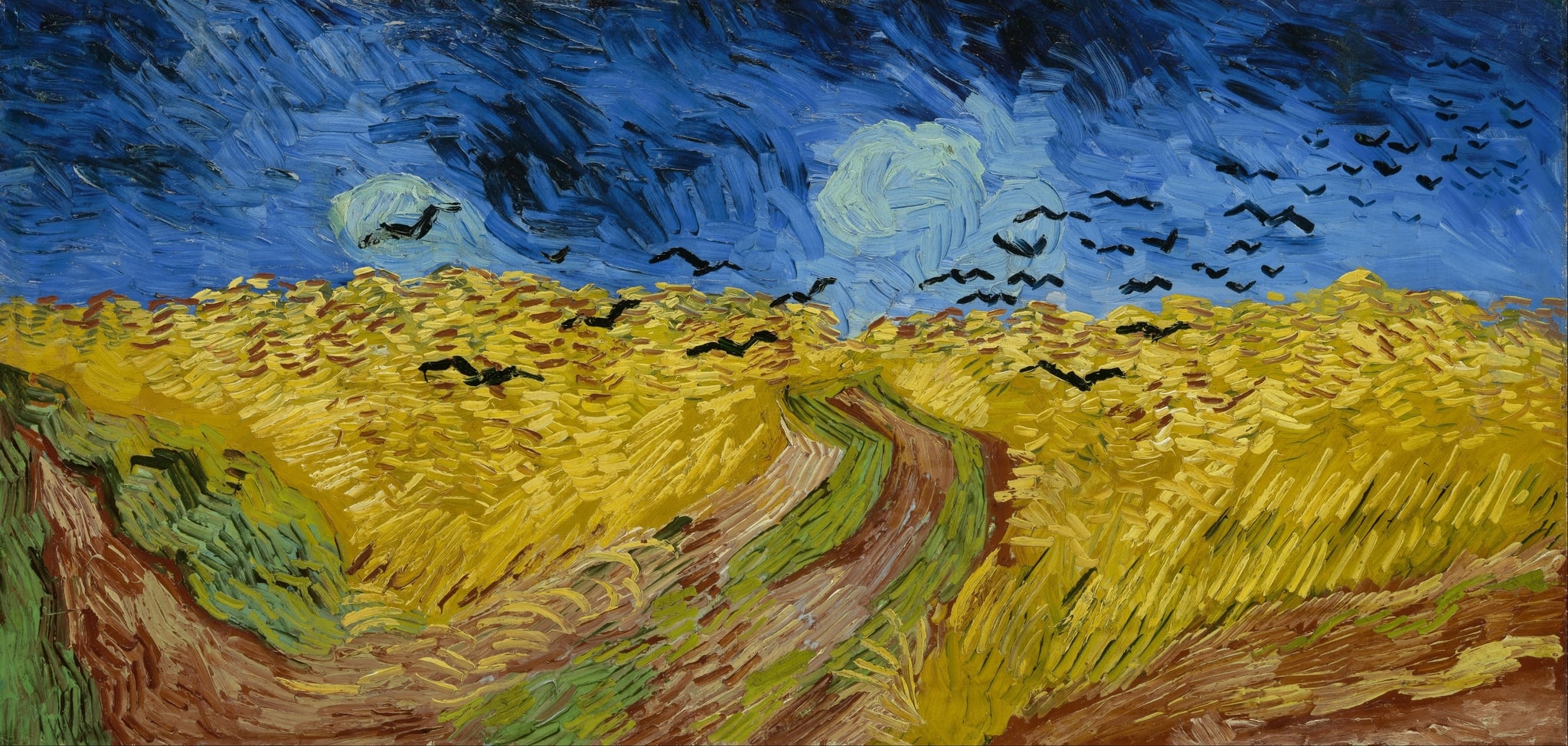
A dark flock of crows carves across the storm-blue sky in Van Gogh’s Wheatfield with Crows, turning a panoramic landscape into an oncoming encounter. Often called a “murder of crows” in English, this advancing wave of birds charges the scene with urgency and menace while channeling the artist’s late‑Auvers ambition to make nature speak feelings he described as “sadness, extreme loneliness.”
Historical Context
Vincent van Gogh painted Wheatfield with Crows in Auvers-sur-Oise during the first half of July 1890, days after writing that he had just completed three large canvases of "immense stretches of wheatfields under turbulent skies" to express "sadness, extreme loneliness," yet also the countryside’s "healthy and fortifying" force 1. The flock of crows belongs to this late sequence of double‑square panoramas, conceived as emotionally charged studies of weather, wind, and ripening grain in the weeks before his death on 29 July 1890 1.
Recent museum scholarship situates the painting alongside Wheatfield under Thunderclouds and reads the sky and birds through Van Gogh’s own July aims rather than as a simple omen. The Van Gogh Museum frames these works as embodiments of that dialectic—desolation counterpoised with natural vitality—and also underscores that Tree Roots was probably his final canvas, a correction that curbs earlier myths that overloaded the crows with terminal meaning 2.
Symbolic Meaning
Art-historical consensus holds that the silhouetted crows intensify a sense of threat and mortality: their black bodies surge beneath storm clouds, converting natural signs into a charged, almost thanatic register 34. Read this way, the birds sharpen the canvas’s emotional pitch, echoing the forked path and wind-torqued wheat as tokens of unease and exposure to the elements 34.
Yet authoritative voices also resist a one-note, doom-laden code. Grounding interpretation in Van Gogh’s July letter, scholars emphasize a dual program—"sadness, extreme loneliness" alongside what is "healthy and fortifying"—that keeps the birds within a living, cyclical nature rather than a single fatal emblem 12. Martin Bailey argues the work has been over‑mythologized and should be read within the Auvers group rather than as a solitary premonition 5. Broader studies link Van Gogh’s bird motifs to nature spirituality and cross-cultural imagery (including Japanese kachō‑ga), in which quick-flying birds can index time, flux, and seasonal change as much as threat 7. Taken together, the crows operate as polyvalent figures: harbingers of danger, yes, but also emblems of motion and life coursing through a charged landscape 257.
Artistic Technique
Van Gogh stages the crows across the upper register of a late double‑square canvas (about 50 × 100 cm), lifting the horizon and compressing a vast wheat plain beneath a weighty, agitated sky 2. He drops the birds in with quick, angular strokes of near‑black, their hard value contrast against storm-dark blues making them read at a distance as a rhythmic, forward-driving frieze 34.
Set against complementary yellows of the wheat, the crows punctuate the surface with staccato beats that amplify turbulence. Their directional sweep—visibly flying from the horizon toward the foreground—adds kinetic pressure, pushing the entire space outward toward the viewer 24.
Connection to the Whole
The flock completes the painting’s push–pull architecture. The forked track leads nowhere, the wheat leans under wind, and the sky rotates with heavy brushwork; the onrushing crows tie these forces together, knitting sky to ground and converting panorama into encounter 4.
Within Van Gogh’s stated July program, the birds help the canvas say what words cannot: a simultaneous experience of loneliness and the countryside’s fortifying life. Their menace coexists with vitality—ripening grain, wheeling flight—so the whole scene breathes in time with nature’s cycles rather than closing as a single symbol. This balance aligns the image with the sequence of Auvers wheatfields described in Letter 898 and affirmed by recent museum scholarship 12.
Explore the Full Painting
This is just one fascinating element of Wheatfield with Crows. Discover the complete interpretation, symbolism, and hidden meanings throughout the entire work.
← View full analysis of Wheatfield with CrowsSources
- Vincent van Gogh, Letter 898 (July 10, 1890) – "immense stretches of wheatfields…"; "sadness, extreme loneliness"
- Van Gogh Museum, Gallery texts – Van Gogh in Auvers (Wheatfield with Crows; Wheatfield under Thunderclouds; Tree Roots as last work)
- Encyclopedia Britannica – Wheat Field with Crows
- Web Gallery of Art – Entry on Wheat Field with Crows
- Martin Bailey, The Art Newspaper (2021) – On meaning and myth of Wheatfield with Crows
- Ronald Pickvance, Met exhibition catalogue – Van Gogh in Saint‑Rémy and Auvers (1986)
- University of Glasgow PhD thesis – A Painting of Wholeness: Wheatfield with Crows
- AP report on refined dating within July 1890