The Three Paths in Wheatfield with Crows
A closer look at this element in Vincent van Gogh's 1890 masterpiece
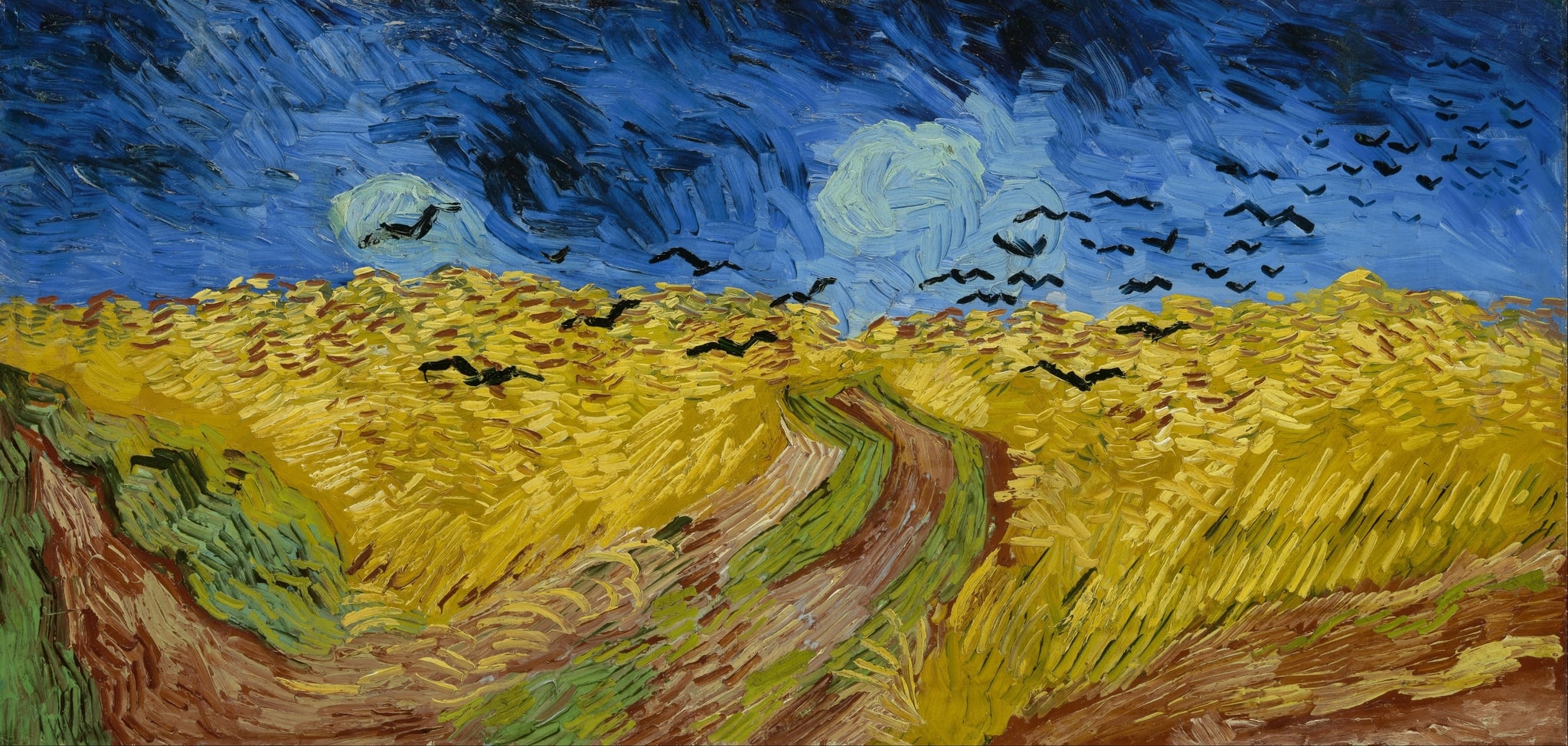
Van Gogh’s "three paths" split the foreground of Wheatfield with Crows into abrupt, diverging tracks that refuse to lead into the distance. Flaring red-brown ruts against green borders and gold grain, they pull the scene toward us and stage the painting’s charged tension between blockage and vitality.
Historical Context
Painted at Auvers-sur-Oise in July 1890, Wheatfield with Crows belongs to Van Gogh’s final, intensely productive weeks, when he adopted wide double-square canvases for panoramic field motifs. In a letter written around 10 July, he described working on “immense stretches of wheatfields under turbulent skies,” aiming to express “sadness, extreme loneliness,” while also conveying the countryside’s “healthy and fortifying” force 2. The diverging dirt tracks—our “three paths”—are part of this late sequence of experiments in which Van Gogh searched for new, monumental ways to stage landscape at eye level.
The Van Gogh Museum underscores that this canvas is frequently misidentified as his last work; research shows he painted other pictures afterward, a reminder that its mood should not be reduced to a biographical endpoint. The museum’s entry also remarks on the dead‑end quality of the central track and documents the canvas’s expansive format, which helps explain why the paths dominate the foreground as they splay across the wheat 1.
Symbolic Meaning
The three tracks have long been read as a motif of impasse and choice denied. Rather than converging toward a horizon, two paths veer off the edges and the central one stalls, leaving the viewer metaphorically “hemmed in” amid unstable weather—a reversal of the road-as-invitation common to 19th‑century landscape 3. Writers from Martin Bailey to museum texts stress their “going nowhere” character, a blunt emblem of blocked advance under a turbulent sky 41.
Meyer Schapiro offered a seminal close reading: the diverging roads mirror the zigzag swarm of crows, so that human passage and ominous flight form a single transverse movement aimed toward the viewer. Perspective collapses forward rather than receding, turning approach into confrontation 5. Yet Van Gogh’s own words temper a purely despairing gloss: he wanted the same fields to communicate what he found “healthy and fortifying” in nature 2. In this light, the no‑exit sensation of the paths coexists with the wheat’s radiant vigor—a deliberate tension between existential anxiety and the restorative reach of the open plain, consistent with Van Gogh’s broader dialogue with spiritual and journey metaphors in landscape 135.
Artistic Technique
Van Gogh renders the paths with hot, red‑brown ruts edged by green bands that splice through gold wheat under a saturated blue sky—complementary contrasts that make the tracks read as insistent cuts across the field 1. Thick, unblended impasto and short, directional strokes model the ruts and trampling along their edges, so paint ridges become physical equivalents of furrows and stalks 3. The panoramic double-square format widens the foreground stage, allowing the three routes to fan out dramatically before the eye and fracture normal perspective across the canvas’s breadth 6.
Connection to the Whole
The paths are the ground mechanism that powers the painting’s famous unease. As the roads split, stall, or slip away, the crows surge forward and the sky churns; together they invert depth and press the scene toward us. Schapiro argues that this binding of diverging ground-lines and advancing birds fuses wayfinding and threat into one frontal thrust 5. Britannica’s account of the paths’ pull toward the viewer reinforces how they short‑circuit entry into the landscape, leaving us confronted rather than consoled 3. Read with Van Gogh’s letter, this structural impasse is balanced by the wheat’s blazing vitality—an unresolved chord that keeps the entire composition poised between loneliness and the countryside’s fortifying strength 2.
Explore the Full Painting
This is just one fascinating element of Wheatfield with Crows. Discover the complete interpretation, symbolism, and hidden meanings throughout the entire work.
← View full analysis of Wheatfield with CrowsSources
- Van Gogh Museum, Wheatfield with Crows — collection entry
- Vincent van Gogh, Letter 898 to Theo and Jo (July 1890)
- Encyclopaedia Britannica, Wheatfield with Crows
- Martin Bailey, The Art Newspaper — analysis of the "three diverging paths"
- Meyer Schapiro, "Vincent Van Gogh" (essay) — diverging paths and crows
- Musée d’Orsay, Van Gogh in Auvers‑sur‑Oise — double‑square series
- Smithsonian Magazine — on the "last painting" myth and Tree Roots