The Turbulent Sky in Wheatfield with Crows
A closer look at this element in Vincent van Gogh's 1890 masterpiece
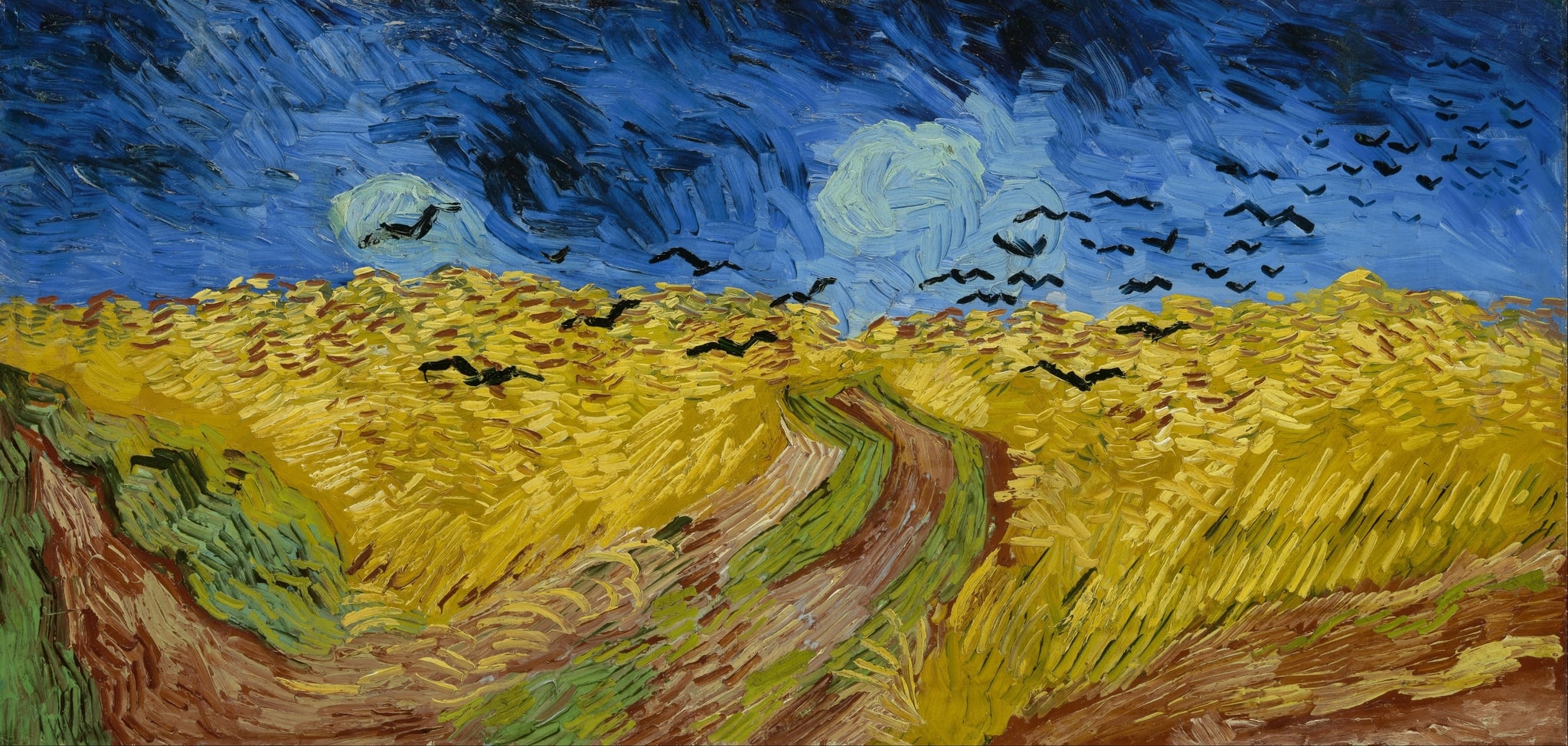
Van Gogh’s turbulent sky in Wheatfield with Crows is a storm-charged band of deep blue that bears down on the wheat with sweeping, agitated strokes. Compressed by the panoramic double‑square format, it becomes the painting’s engine of feeling—volatile, electric, and alive with crows that slice across the horizon.
Historical Context
In early July 1890, during his brief, feverish weeks in Auvers‑sur‑Oise, Van Gogh set out a concise series on elongated, double‑square canvases. He described these works in a letter as “vast fields of wheat under troubled [turbulent] skies,” made expressly to convey “sadness and extreme loneliness” rather than to record a specific view. This statement anchors the sky in Wheatfield with Crows as a deliberate expressive device, not mere backdrop 1.
The unusual 50 × 100 cm format let him stage wide, weather‑driven panoramas and register rapidly shifting conditions with speed and force. Exhibition reporting on the Auvers landscapes groups Wheatfield with Crows with companion double‑squares such as Wheatfield under Thunderclouds, underscoring the artist’s targeted interest in unsettled skies and their emotional charge in this final summer’s work 2.
Symbolic Meaning
The sky carries a double valence: it threatens and it renews. In one letter Van Gogh cast these fields under “troubled skies” to express loneliness, yet days later he wrote of an “immense plain” beneath delicate tones of blue, white, pink, and violet—language that folds restorative calm into the same motif 4. That tension tracks with Romantic notions of the sublime, where nature’s power provokes awe and dread in equal measure. Museum scholarship explicitly links the late wheatfields to this tragic‑sublime mood, quoting his “troubled skies” remark as programmatic 5.
Modern readings also reject a one‑note “suicide note” interpretation. Research led by the Van Gogh Museum shows Wheatfield with Crows was not his last painting—Tree Roots is the stronger candidate—so the sky’s import cannot be reduced to a premonition of death 7. Martin Bailey’s close reading stresses the coming thunderstorm and the scene’s simultaneous vitality: ripening wheat, kinetic brushwork, and birds in flight—all signs of volatile weather rather than terminal symbolism 3. Within the Auvers months, he repeatedly paired wheatfields with cloudy or storm‑laden heavens, making the sky a chosen vehicle for existential feeling and for the countryside’s “healthy and fortifying” force 64.
Artistic Technique
Van Gogh compresses the sky into a shallow upper band across the double‑square, intensifying its pressure over the field below 2. He lays it in with sweeping, curved strokes and emphatic impasto, producing a visibly “agitated” surface that reads as gusts and advancing fronts 3.
Color does the dramatic work: saturated, cool blues tipped toward near‑black create a high‑contrast complement with the yellow‑orange wheat, a chromatic clash that heightens the sense of impending storm 8. The approach aligns with the closely related Wheatfield under Thunderclouds, where a continuous dark blue vault states the same motif even more starkly, confirming the sky here as a repeated, intentional mood‑carrier in Auvers 9.
Connection to the Whole
The turbulent sky is the painting’s emotional motor. Its compressed, storm‑dark arc bears down on the luminous crop and the three diverging tracks, setting a charged counterpoint between ripening life and disruptive forces. The crows cut across this band like black accents, tying earth and air into a single surge of motion 3.
Because Van Gogh framed these canvases as “wheatfields under turbulent skies” made to voice strong feeling, the sky’s role is explicit and structural: it drives the picture’s mood while keeping meaning open to both sorrow and vitality 1. Freed from the outdated “last painting” myth, the sky reads not as a fixed death emblem but as weather—changeable, energetic, and inseparable from the living field it activates 7.
Explore the Full Painting
This is just one fascinating element of Wheatfield with Crows. Discover the complete interpretation, symbolism, and hidden meanings throughout the entire work.
← View full analysis of Wheatfield with CrowsSources
- Van Gogh, Letter 649 to Theo (July 1890): “vast fields of wheat under troubled skies”
- Associated Press reporting on the Auvers double‑square series and dating
- Martin Bailey, The Art Newspaper: analysis of the agitated sky and debunking the “last painting” myth
- JAMA: summary quoting Van Gogh’s paired July letters on “troubled skies” and “delicate tones”
- Thyssen‑Bornemisza Museum, Van Gogh: The Last Landscapes – discussion of the tragic‑sublime
- Kröller‑Müller Museum: note on Van Gogh painting many wheatfields under cloudy skies
- Smithsonian Magazine: research identifying Tree Roots as likely last painting
- Wiley Art History excerpt: on the sky shifting from blue toward black to create an ominous mood
- Wikipedia: Wheatfield under Thunderclouds (companion work for comparative evidence)